Shinar’s postwar peace
WatchmenShinar’s postwar peace is the precarious condition established after the Komani leave the planet. It ends the immediate bloodshed, but it is not presented as a simple imperial victory: its survival depends on military pressure, political calculation, local resistance, and the prospect that Shinar may move toward self-government. The peace therefore marks both the close of a campaign and the beginning of an unresolved political transition.
Conditions Behind the Peace
The settlement grows out of a conflict in which several authorities claim the right to determine Shinar’s future. Emil Vorgens arrives as an officer of the Star Watch with instructions to negotiate with the Komani raiders, offering them a peaceful return home if they stop raiding Imperial territory. He is also meant to remind them that Komani clan chieftains have pledged loyalty to the Terran Council and that the attack violates an older alliance between the Komani and the Terrans during the Galactic War. The proposed peace initially rests on imperial law, diplomacy, and the threat of force rather than on an agreement between Shinar’s own people and their rulers.
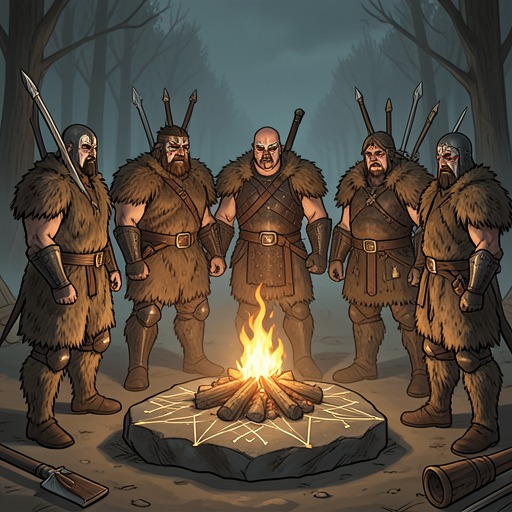
The Komani leadership rejects that framework. Okatar Kang treats the Empire as a power already in decline and argues that the people of Shinar and other worlds have learned to hate the Terrans. He hopes a Komani victory on Shinar will encourage other clans to unite against the Empire, transforming a planetary invasion into a wider galactic upheaval. Against this expansive vision of renewed conquest, Vorgens warns that Okatar is preparing another age of chaos. The peace that eventually follows is thus shaped by a contest between imperial order, Komani ambition, and Shinarian demands for political independence.
Humanitarian and Local Limits on War
Even before the fighting ends, the narrative establishes limits that the combatants repeatedly violate or dispute. When a Komani officer claims Terran prisoners in the name of Okatar Kang, Sittas refuses him entry to a place sheltering wounded men. Sittas declares the town a sanctuary, insisting that wounded soldiers are no longer warriors until they recover and that neither Okatar nor the Terran commander has the right to claim them there. His intervention temporarily places religious protection above military command and prevents the sanctuary from becoming another battlefield.
That episode gives the later peace a moral dimension. The end of fighting is not merely a matter of one army defeating another; it also depends on recognizing that wounded men, civilians, and local communities cannot be treated as limitless instruments of war. Sittas’s authority is imperfect and potentially subject to later legal judgment. He acknowledges that a Star Watch court may decide whether he had the right to assume such power. Yet his action saves Vorgens and the men of the Mobile Force, and the future peace begins from the same practical refusal to let military claims override every other form of protection.
The Withdrawal of the Komani
After Okatar’s death, the Komani lose much of their willingness to continue the campaign. Vorgens explains that Okatar’s death took most of the fight out of them, while Shinarian resistance helped the Komani realize that there was no glory to be gained on Shinar. A small group of reinforcements becomes the final pressure. The Komani nobles blame the disaster on Okatar and return home, allowing Vorgens to state plainly that the Komani have gone and that Shinar is at peace.
The withdrawal is therefore neither a clean military triumph nor a voluntary reconciliation. It is a face-saving retreat engineered through political psychology. Vorgens lets the Komani believe that additional Terran reinforcements may arrive at any moment, making continued resistance seem dangerous while giving the nobles a path away from the conflict that does not require them to admit complete defeat. He later concedes that this was more luck than skill: Okatar’s death, Shinarian resistance, and the reinforcement threat worked together to break the invasion’s momentum.
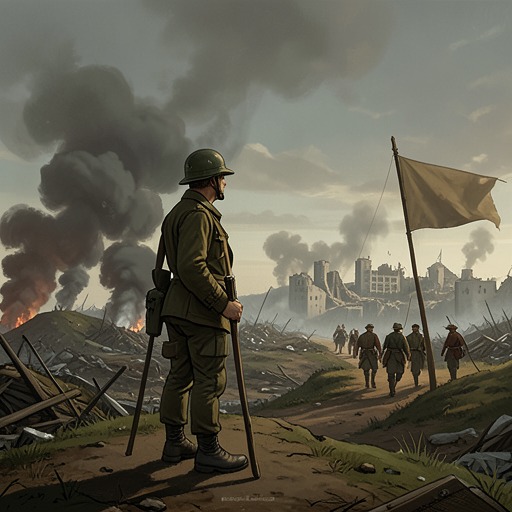
The cost remains visible in the peace’s immediate aftermath. When the troops report that Okatar has been killed, they also reveal that Sergeant McIntyre has died, alongside four other men, while another is wounded. The report calls Okatar’s death a great victory, but its tears and the question of whether McIntyre was killed prevent victory from becoming an uncomplicated celebration. Shinar is peaceful because the violence has exhausted and destroyed people, not because the violence was harmless.
Political Meaning and Fragility
The new peace does not settle the argument over imperial rule. Vorgens faces a court-martial for insubordination, armed mutiny, personal malice, and related charges, even though the fighting has stopped and the Komani have departed. At the same time, the Imperial Senate wants him to present the case for Shinar’s self-government. These opposing responses show that peace has opened a constitutional and political question that military command would prefer to close through discipline.
Sittas interprets the result as vindication of Vorgens’s judgment over Brigadier Aikens’s harder line. Vorgens rejects the language of personal triumph and describes himself as lucky, emphasizing how many contingencies made the settlement possible. Their exchange presents peace as a temporary achievement that depends on wisdom arriving before further sacrifice, not as proof that the underlying institutions have become just or stable.
The conflict also exposes competing historical memories. Vorgens defends the Terran Empire as more than an apparatus of conquest, describing the Star Watch as a carrier of law, stability, commerce, and order across much of the galaxy. His family history embodies that belief: his grandfather sent his oldest son into the Terran Star Watch in the hope of proving that life inside the Empire could be better than hopeless resistance, and Vorgens’s father remains in the Watch. Yet Shinarian resistance and Okatar’s anti-imperial rhetoric demonstrate that order imposed from outside cannot secure lasting consent merely by invoking its administrative benefits.
The Beginning of a New Shinar
Sittas declares that the violent men have had their day on Shinar and that it is now time for a wiser and better man to hold sway. The statement points beyond the cease-fire toward a change in political leadership and civic purpose. Peace is valuable precisely because it creates room for Shinar’s people to determine what should replace open rebellion, Komani intervention, and unchecked imperial command.
The departure scene reinforces that sense of transition. Vorgens leaves through the outer hatch toward a landing ship that will carry him to an orbiting starship and then back to Earth. Clanthas and others gather near the ship, while Sittas accompanies him down the ladder. Altai appears beside them wearing a simple dress, a striking change from the circumstances in which Vorgens first knew her. The scene places personal recognition and future possibility beside military departure: Vorgens is leaving the planet, but the question of what Shinar will become remains behind.
Shinar’s postwar peace is consequently a beginning as much as an ending. It stops the Komani campaign and gives the wounded and surviving communities relief, yet it also exposes the limits of force as a basis for rule. Its decisive achievement is that the immediate cycle of invasion, retaliation, and imperial suppression is broken. Its uncertainty is that the peace must still be converted into legitimate self-government before it can become more than an interval between wars.