Mobile Force encirclement at Carmeer
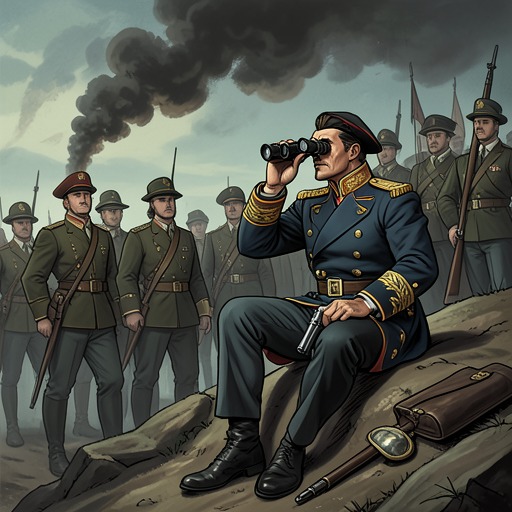
WatchmenMobile Force encirclement at Carmeer is the pivotal crisis that exposes the failure of the Terran Empire’s limited intervention on Oran VI. The Mobile Force of the 305th Imperial Marines, sent to reinforce the imperial garrison and impose order, is drawn into a valley, cut off, and threatened with annihilation by the Komani. Its predicament turns a supposedly controlled demonstration of force into a struggle for survival, while creating the conditions for Emil Vorgens to seek Shinarian cooperation against the invaders.
Formation of the Trap
The crisis becomes unmistakable after the day’s patrols return with mutually confirming reports. As evening falls, the valley lies in shadow while the surrounding hills, occupied by the enemy, remain in daylight. Sergeant McIntyre moves through a crowded concentration of land cruisers, dreadnaughts, troop carriers, supply vans, and scout cars, carrying an extra sidearm taken from a dying corporal and wearing a shirt marked with another man’s blood. The ordinary routines of military discipline have collapsed into self-preservation: guards and junior officers are too occupied with digging in to question his identity or criticize his non-regulation uniform.
The force is not merely under pressure; it is surrounded and totally cut off. Brigadier Aikens initially rejects the report as impossible, but his executive officer confirms that every patrol has made the same assessment. The stereomap on Aikens’s desk converts the scattered alarm into a single strategic fact: the Mobile Force is trapped in the valley, with only two patrols still outside and no reliable indication that they can return.
The assignment itself has helped produce the disaster. The Mobile Force was dispatched to Oran VI to bolster the imperial garrison and restore order among the native population. When Komani raiders landed, its orders were to induce them to return home through a demonstration of force rather than to fight a full-scale campaign. For nearly three weeks, however, the Komani avoided being pinned down while leading the Imperial Marines through a series of maneuvers. By the time the Terran command recognized the pattern, the enemy had selected the ground, severed communications, and prepared to fight on favorable terms.
Military Situation and Breakout Plan
The Komani possess modern weapons and have displayed masterful tactics, while Brigadier Aikens acknowledges that they have repeatedly outmaneuvered him. His first response is to send stronger patrols, supported by armor, to probe the Komani lines and keep them off balance. At the same time, he orders Vorgens to take an armored cruiser and a picked detachment through the encircling forces, outrun the Komani communications jammers, and summon reinforcements from the imperial garrisons in the cities still held by the Terrans.
Vorgens’s eventual breakout plan turns the valley’s geography into an operational sequence. Scout cars and troop carriers are to seize the slopes in Sectors W5 and W6, where the Komani presence has thinned. The scout cars will suppress isolated resistance, and light cruisers will follow with additional firepower. Engineers will then use force beams and explosives to grade a broad, unobstructed escape route. The plan responds to the earlier weakness of the existing trail: Vorgens’s battle cruiser had been forced to crawl along its twisting, narrow course, and a whole army attempting to escape in that fashion would be destroyed before reaching open ground.
While the assault troops hold the slopes and the engineers prepare the route, the rest of the Mobile Force is to withdraw gradually toward the escape sectors. Ten dreadnaughts, including Vorgens’s flagship, form a rear guard whose task is not simply to resist but to keep the Komani attack stalled and off balance until the main body can make its final dash. The encirclement therefore produces a battle plan based on timing, terrain, engineering, and controlled sacrifice rather than a direct attempt to defeat the Komani in the valley.
From Imperial Emergency to Political Crisis
The trap also exposes the political limits of imperial military power. On Shinar, Clanthas had organized farmers and demonstrations after imperial restrictions disrupted the nutrient processors on which his commercial and agricultural community depended. Protests in Katan and other cities grew into riots; troops fired on unarmed civilians, the Terran governor was murdered, and Komani warriors landed. Clanthas consequently became the acting leader of a people caught between Terran attempts to restore a docile colony and Komani plans of their own.
That background makes the encirclement more than a battlefield emergency. The Terrans need local assistance, but their earlier use of force has made cooperation morally and politically costly for the Shinarians. Merdon explains to Vorgens that some Shinarians first resisted through words, protests, and demonstrations, only to meet imperial force with force. The rebellion has become a war of attrition in which fighters intend to continue until the Terrans no longer consider Shinar worth the price.
Vorgens therefore presents the Shinarians with a stark strategic choice. The Mobile Force cannot defeat the Komani on Shinar by itself; it can defend itself, but Okatar Kang may ravage the planet before reinforcements arrive. Vorgens argues that Okatar must win quickly and decisively, and that delaying, frustrating, and keeping him off balance may prevent other Komani clans from joining him. He warns that Shinarian neutrality could hand the Komani the springboard for a wider galactic war, while cooperation with the Terrans might help the locals secure a future request for self-government. He offers no guarantee that the Empire will honor that request, only the possibility that it might.
Coalition and Aftermath
The political deadlock begins to break when Clanthas and the other Shinarian leaders decide to accept Vorgens’s word. Clanthas reports that they will help the Terrans and work against the Komani in whatever way possible. Their decision changes the meaning of the encirclement: the isolated imperial force is no longer relying solely on its own military resources, but is attempting to turn the population it had been sent to control into an ally.
Vorgens immediately treats the agreement as reciprocal. Because the Shinarians are trusting the Terrans, he tells Aikens that the Terrans must trust them in return. He orders the brigadier to contact the commanders of the four cities under imperial control and take stocks from their arsenals to equip the native forces. Aikens agrees only under protest, revealing the institutional resistance to sharing weapons with a population recently classified as rebellious. Vorgens nevertheless insists that the measure be implemented at once.
The alliance becomes personal as well as strategic during the crisis at Katan. When Merdon admits that he has been wrong about Vorgens and offers to fight beside him, Vorgens answers without a speech: he extends his hand. Merdon takes it in a firm grasp, and the two men go down side by side to the waiting people. The gesture marks a reversal in their relationship, from suspicion between an imperial officer and a rebel leader to cooperation against the Komani threat.
Narrative Significance
Mobile Force encirclement at Carmeer is the point at which imperial confidence gives way to contingency. The Terran command begins with a limited mission and a presumption that force can restore order, but the Komani convert that presumption into a trap. Military superiority proves insufficient without accurate intelligence, local legitimacy, secure communications, and a workable route through hostile terrain.
The encirclement also links the book’s military and political narratives. A tactical crisis compels Vorgens to negotiate with people whom the Empire has treated as subjects, while the Shinarians must calculate whether cooperation with their former oppressors is the lesser danger than Komani conquest. Their alliance is not presented as uncomplicated loyalty: it rests on shared necessity, conditional trust, arms, and the hope that resistance to the Komani may create leverage for self-government.
The episode’s decisive consequence is therefore not merely escape from a valley. It transforms the strategic balance on Shinar and reframes the conflict as a contest over who can mobilize the planet’s population, define its future, and prevent a local invasion from expanding into galactic war.