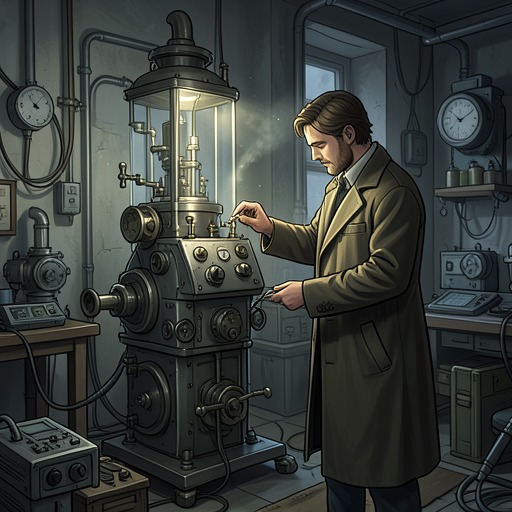
Odal’s amplified telepathy
WatchmenOdal’s amplified telepathy is the central hidden mechanism behind Major Par Odal’s extraordinary power in the dueling machine. It is not presented as ordinary fencing or superior marksmanship, but as a natural, unstable mental ability that the machine enlarges, stabilizes, and makes repeatable. Once amplified, the ability lets Odal transform a supposedly controlled contest into a collective attack, making the machine a conduit through which private aggression, diplomatic pressure, and institutional power can pass.
Discovery and Political Background
Odal’s unusual power first becomes legible against a pattern of political intimidation. More than a Terran year before the investigation, Chancellor Kanus had quarreled with the Safad Federation while seeking a particularly favorable trade agreement. A Kerak negotiator, Major Par Odal, argued with the federation’s minister of trade and challenged him to a duel. Odal won, after which the minister resigned, saying that he was psychologically incapable of opposing Odal and Kerak. Two weeks later, the former minister died, apparently by suicide, though Fernd Massan doubted that explanation.
The pattern repeated on Acquatainia. Three days before the discussion between Fernd Massan and Dr. Leoh, Odal had entered a bitter personal argument with Prime Minister Emile Dulaq at a Kerak embassy party. Because the argument became public and loud, Dulaq had no practical alternative but to challenge him. The earlier Safad episode therefore functions as more than background: it suggests that Odal’s victories can damage an opponent beyond the formal limits of the duel, leaving political resistance psychologically broken and perhaps contributing to death.
The Dueling Machine as Amplifier
The machine’s operation clarifies why Odal’s ability is so dangerous. Dr. Leoh and Hector H. Hector initially used it for comparatively harmless experiments, choosing environments and searching for one another while remaining inside the booths. They tested fencing with blunted foils, pistols, sonic beams, and grenades while imagining protective equipment. The machine did not give Leoh new knowledge or physical speed; it projected each participant’s existing abilities into a shared dream. Yet Leoh, although slower and untrained compared with Hector, won most of their direct contests.
That result led Leoh to recognize that the machine projected more than thoughts: it projected personality. The distinction is decisive for understanding Odal. The machine does not merely reproduce a weapon, a landscape, or a reflex. It carries the participant’s deeper mental structure into the encounter and magnifies the impulses that structure contains. In Odal’s case, the machine makes a talent that would otherwise remain vague and unreliable into an effective instrument of domination.
Telepathic Assistance and Collective Combat
Dr. Leoh eventually proposed that Odal was a telepath. The hypothesis reconciled two otherwise contradictory facts: Odal displayed his exceptional ability inside the dueling machine, yet there was no apparent mechanical way for him to connect five helpers to the contest. Leoh’s explanation was that Odal possessed a natural telepathic talent, comparable to documented cases among Terrans, but that the ability was erratic and difficult to control outside the machine. The machine supplied the missing amplification and reproducibility.
The proposed arrangement also changes the identity of the combatant. Odal would not need to fight alone. Five associates in the Kerak embassy could sit in on the duel and pool their minds with his. They might also be natural telepaths, though Leoh considered that unnecessary: the machine could use Odal’s talent as the active channel through which several minds became one coordinated force. Six men could therefore appear in the duel as a single exceptionally aggressive presence, while the formal rules continued to describe the encounter as a contest between two individuals.
The effect explains why an opponent expecting a polite, formal duel could be shattered by viciousness that seemed disproportionate to the visible circumstances. The machine amplified every impulse and sensation, so mental pressure became an experienced reality rather than a mere intention. Odal’s advantage was consequently both tactical and psychological. He could exploit the opponent’s expectations of fairness, then introduce an attack whose scale the opponent had no reason to anticipate.
Consequences for Safety and Governance
Odal’s amplified telepathy exposed the danger of treating the dueling machine as a neutral device. The machine had been valued because it allowed people to settle scores and work through aggressive feelings without mental or physical injury. Its apparent beauty lay in the separation between imagined violence and actual bodily harm. Odal’s use revealed the weakness in that assumption: if the machine amplified personality and telepathic coordination, then the boundaries protecting participants could be breached from within the system’s own mental space.
In response, Dr. Leoh added three circuits. The first psychonically isolated the duelists inside the machine, making it impossible for Odal or anyone else to contact the outside world while the machine operated. The second monitored the entire duel so that, if either side requested an investigation, the chief meditech could review the recording and determine whether rules had been broken. This measure did not erase the danger, but it created a means of detecting foul play after the fact. The evidence presents the technology as an institution as much as an invention: its safeguards had to be redesigned when human ingenuity found a way around its original assumptions.
The later development of the machine further demonstrates how mental power and machinery become inseparable. Dr. Leoh and Hector worked for twelve or more hours a day, testing how faithfully the device reproduced thought patterns and personality. Much later, Hector could teleport from one booth to another, making the jump in an average of four picoseconds while consuming power roughly equivalent to a starship’s drive engines pushing a mass equal to his own weight. That experiment is not identical to Odal’s telepathy, but it confirms the machine’s broader role: it converts psychonic capacities into measurable, reproducible operations with physical and political consequences.
Narrative Significance
Odal’s amplified telepathy shifts the story’s understanding of dueling from personal courage to systems of hidden participation. A duel appears to be an encounter between two wills, but Odal turns it into an arrangement involving an unseen group, a diplomatic institution, and a machine that magnifies what none of them could accomplish alone. The apparent individual is therefore also a network.
The state is significant because it joins personality to infrastructure. Odal’s natural talent by itself is described as limited; the dueling machine supplies scale, control, and repeatability, while the Kerak embassy supplies additional minds. Power emerges from the alliance among body, psyche, technology, and political organization. The resulting threat is not simply that one man possesses an unusual gift. It is that a supposedly protective machine can make that gift collective, efficient, and difficult to recognize until its victim has already been overwhelmed.