Shinar war of attrition
WatchmenShinar war of attrition is the prolonged military stalemate that follows the celebration at Katan and transforms the struggle for Shinar from a campaign of decisive battles into a contest of endurance. Okatar Kang seeks to strip the planet of its resources, while Emil Vorgens organizes a defensive system in which Shinarians assume much of the responsibility for protecting their own communities under Terran direction. The resulting war prevents an immediate Komani victory, but its very success exposes the limits of military containment: Shinar can resist without becoming peaceful.
Causes and Strategic Stakes
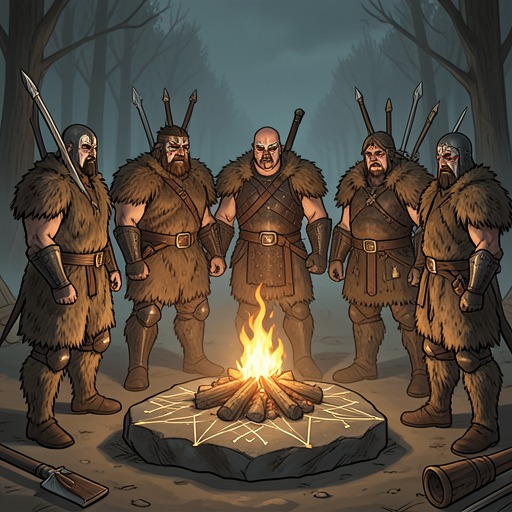
The conflict grows out of the wider crisis created by the Terran occupation, the Shinarian resistance, and the Komani intervention. Clanthas’s demonstrations, beginning with the farmers’ action in Katan and spreading to major cities, have escalated into riots, civilian deaths, the murder of the Terran governor, the arrival of the Imperial Marines, and the landing of Komani warriors. Merdon explains the Shinarian position as a response to force: protests and demonstrations have failed, so resistance now means fighting until the Terrans are no longer willing to pay the price of holding Shinar. The Komani are allies in that struggle, but they also pursue their own ambitions, making the planet a battlefield between competing forms of domination rather than a simple war of liberation.
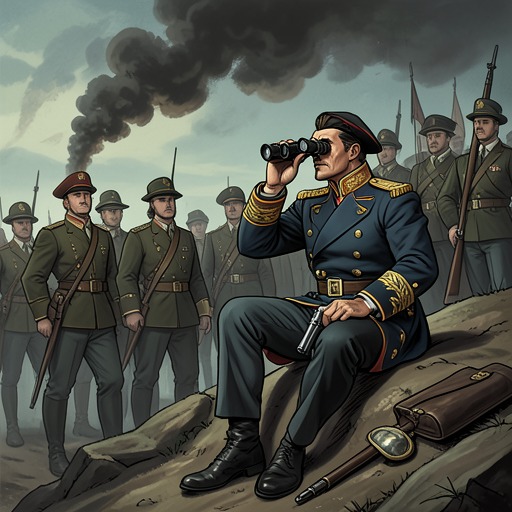
The military decision at the center of the stalemate is whether the Terrans will seek a conventional confrontation or preserve their force while helping Shinar defend itself. Vorgens warns Brigadier Aikens that the immediate tactical situation is subordinate to the strategic danger: if the defeat of the Mobile Force becomes the signal for a general uprising of the Komani clans, a battle fought at the wrong time and place could ignite a war of terrible proportions. He insists that the Komani are disciplined, well trained, and numerically superior, contradicting Aikens’s confidence that his troops can defeat any supposedly disorganized horde. Earlier, Aikens had argued for airpower and reinforcements from the city garrisons so that an external column and the Mobile Force could pin the Komani down and crush them; the attritional outcome shows why that expectation proves inadequate.
Vorgens later frames the strategic choice for Clanthas in even broader terms. The Mobile Force cannot defeat the Komani on Shinar by itself, and Okatar Kang could ravage the planet before reinforcements arrive. Okatar’s weakness is his need for a quick, decisive victory: if he is held at bay and kept off balance, the other Komani clans may refuse to join him, and even his own people may tire of a fruitless war. Shinarian cooperation with the Terrans therefore becomes a way to deny Okatar the victory that would give him a springboard for galactic war.
Course of the Fighting
The war begins its attritional phase after Katan, when six weeks of virtually uninterrupted battle spread across the breadth of Shinar. Okatar Kang does not attempt merely to hold territory. He decides to sack the planet, raiding every district and town and systematically taking whatever food, weapons, equipment, and ammunition he wants. His method makes the civilian landscape part of the military objective: resources are both supplies for the Komani and means of exhausting the society that resists them.
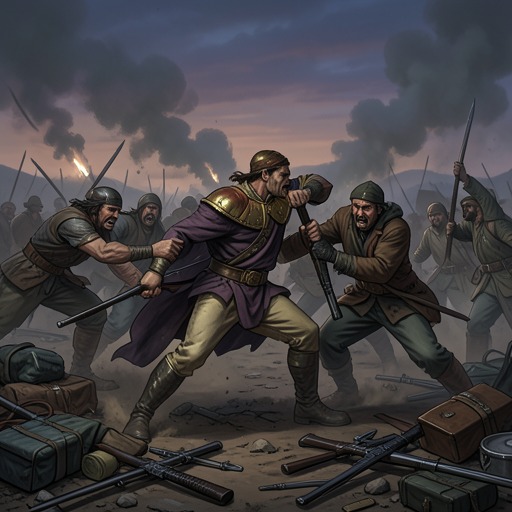
Against this stands Vorgens’s concept of Shinarian self-defense, directed and supported by the Terrans. The fighting is peculiar because it rarely consists of large masses of troops meeting head-on. Instead, the campaign proceeds through skirmishes, maneuvering, feints, sudden attacks, and ambushes; few individual actions involve more than a battalion. This dispersed form of battle denies Okatar the clean victory he needs and makes endurance, information, and mobility as important as massed firepower.
The defensive system depends on local participation and intelligence. Shinarians take over a substantial part of their own defense, while Merdon’s fighters provide reconnaissance and intelligence. When a Komani raiding party approaches a town, a fast and strong squadron of battle cruisers intercepts it. Farming villages become small fortresses scattered across the countryside, sometimes with a Terran dreadnaught stationed in the village square. Komani columns are ambushed, while Okatar’s attempts to mass his strength for a pitched battle fail because Terran forces can disperse and disappear into the countryside instead of accepting his terms.
The Terrans remain outnumbered overall, but the defensive method repeatedly creates temporary local superiority. Whenever they strike, they usually possess greater strength at the particular place and moment of contact. This is the operational logic of the stalemate: numerical inferiority across Shinar is offset by concentration at selected points, rapid movement, fortified villages, reconnaissance, and the ability to refuse battle when the Komani try to impose it.
Logistics, Trust, and Attrition
The campaign is sustained by a fragile political and logistical bargain. Vorgens argues that the Terrans must trust the Shinarians because the Shinarians are trusting them, and he orders Aikens to contact the garrison commanders in the four cities then held by the Terrans. Their arsenals are to be opened for supplies to the natives. Aikens agrees only under protest, revealing the institutional resistance within the occupying force: the defensive strategy requires the Empire to arm people it has treated as subjects, and its success depends on cooperation that ordinary colonial policy has made difficult.
The material costs of the war are not secondary details but its governing mechanism. Fatigue, hunger, and mechanical breakdown matter as much as weapons. The Komani can continue to outnumber the Imperial troops, yet every raid, interception, ambush, and failed concentration consumes strength. The Terrans and Shinarians, meanwhile, are also being worn down by continuous operations and by the effort of persuading a distrustful population to cooperate with its former rulers.
Vorgens himself becomes an embodiment of that pressure. He works almost without rest, living on stimulants, cajoling Aikens, and persuading the Shinarians to trust the Terrans. His exhaustion is not presented as evidence of victory but as part of the price of preventing defeat. The command’s ability to keep fighting therefore conceals a deeper deterioration: the system functions, but it does not produce the political result for which it was designed.
Meaning of the Stalemate
At the officers’ wardroom table, Vorgens gives the attritional situation its decisive judgment. He says that the best the alliance can claim is a stalemate: the Terrans have beaten off most attacks and the people are learning to defend themselves, but the objective is peace, not perpetual fighting. In that formulation, military success and strategic failure coexist. The defensive network protects towns, frustrates Okatar, and keeps the Komani from turning Shinar into a secure base, yet it cannot convert battlefield survival into a settlement.
The war therefore dramatizes the difference between tactical adaptation and political resolution. Aikens’s original vision of reinforcements, air cover, and a crushing encirclement imagines the conflict as a problem solvable by superior force. Vorgens’s later system is more flexible and more attentive to local conditions, but it still remains a military answer to a political crisis. The Terrans can help Shinarians defend themselves, distribute weapons, and exploit temporary concentrations of strength; they cannot, through those measures alone, remove the resentment produced by imperial rule or guarantee that Komani intervention will end.
The attritional state also enlarges the scale of consequence. Vorgens has already explained that the Terrans are building their Empire because they fear the distant Others and want the capacity to exterminate them if they return. Against that imperial horizon, Shinar is treated as a component in a larger machine. Yet the local war repeatedly resists such abstraction. A town’s food, a village’s defenses, a raiding column, and a single battalion determine what the grand strategy can actually accomplish. The planet is simultaneously a strategic foothold and a collection of communities being exhausted by the struggle.
Recurrence and Narrative Significance
The pattern of Shinar war of attrition is defined by repeated reversals of scale. A large imperial project is reduced to local ambushes; a numerically superior Komani force is checked by brief concentrations of Terran power; a campaign intended to produce conquest instead produces exhaustion; and an alliance formed to secure peace sustains ongoing war. The repeated refusal of decisive battle is thus not an absence of action but the central action of the campaign.
Its significance extends beyond the immediate military episode. The conflict tests whether self-defense can become a bridge from imperial rule toward Shinarian autonomy, or whether arming and organizing the population merely creates a more efficient way to prolong violence. Vorgens understands that the Komani must be denied a decisive triumph, but he also recognizes that indefinite stalemate is failure. The war’s unresolved condition leaves Shinar defended, wounded, and politically unsettled, while preserving the danger that a local struggle may still expand into a galactic war.