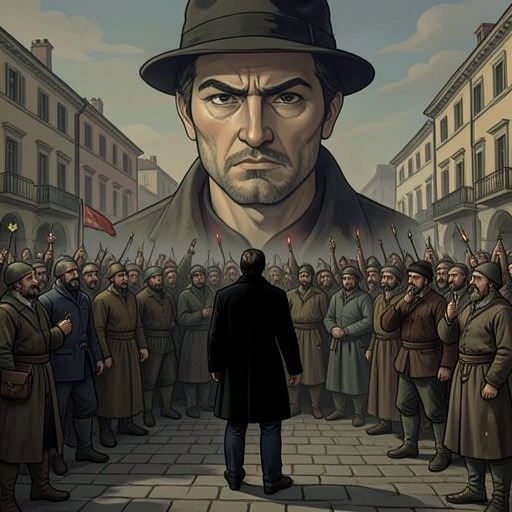
“Don’t mourn for me—organize”
1919“Don’t mourn for me—organize” is Joe Hill’s last message to working people: a refusal to let his death end in private sorrow, and a call to continue the labor organizing for which he had been condemned. The book gives the expression its weight through the concrete record of his organizing, imprisonment, and execution, then places that insistence on collective action beside the state’s elaborate commemoration of an unidentified soldier.
Origin in Joe Hill’s organizing
At Bingham, Utah, Joe Hill organized Utah Construction Company workers into the One Big Union. Their organizing won a new wage scale, shorter hours, and better food. The gains make the expression more than a general appeal to solidarity: it follows a story in which organization had already produced material changes in workers’ lives.
The book links the hostility he faced to that work. The angel Moroni is presented as moving Mormon opinion toward the belief that Joe Hill had shot a grocer named Morrison; the Swedish consul and Woodrow Wilson tried to secure a new trial, but the Utah Supreme Court upheld the guilty verdict. Joe Hill spent a year in jail and continued making up songs. In November 1915, he was stood against a wall in the Salt Lake City jail yard.
A final message, not a eulogy
The line appears as the last word Joe Hill sent to the working people of the Industrial Workers of the World. The narrative gives it a physical setting: he stood before the guns, looked into their muzzles, and gave the word to fire. In that sequence, the appeal to organize is not a denial of death or a request that his followers forget him. It redirects attention from mourning him as an individual to carrying forward the work that brought him to the firing squad.
The expression’s compact structure makes the redirection unmistakable: mourning is displaced by an imperative. The book reinforces that meaning with the aftermath of his execution. Joe Hill was dressed in a black suit, stiff collar, and bow tie, shipped to Chicago for a funeral, and photographed in a still, forward-looking pose. The following May Day, his ashes were scattered to the wind. The formal funeral and the dispersal of his remains mark different forms of remembrance; the final message supplies the action that remembrance should take.
Collective action and public remembrance
The book later recounts the lynching of Wesley Everest, a discharged soldier and logger who returned to his old work in the Pacific Northwest. Arrested during the violence surrounding the loggers, he was taken from jail by a mob and hanged from the Chehalis River bridge. Before the mob came, he whispered to the men in the other cells that he had done his best and asked them to tell the boys. That scene echoes the pattern of a condemned labor activist addressing comrades at the edge of death, though it is a separate episode and not another instance of Joe Hill’s message.
The book also sets the language of worker remembrance against the official burial of an unidentified American soldier. The government arranged for a body whose identity had not been established to be brought from Châlons-sur-Marne for burial at Arlington. At the ceremony, silence, tears, songs, prayer, muffled drums, and soft music expressed national approval; President Harding offered an impersonal tribute, and honors from several nations were pinned where the dead soldier’s chest would have been. The contrast is not simply between one funeral and another. Joe Hill’s last message names an audience and gives it a task, while the national ceremony honors a body whose name and personal history remain unknown. In that juxtaposition, the expression stands for remembrance measured not by ceremony but by what the living organize after the dead are gone.