L’Union des travailleurs fera la paix du monde
1919L’Union des travailleurs fera la paix du monde is a French slogan declaring that workers’ union will bring world peace. Across its appearances in Paris, it moves from a banner carried in a street demonstration to a repeated urban refrain and finally to a torn handbill left after unrest. The changing settings place its confident promise beside the force used against workers and the fragility of their printed words.
The slogan in the street
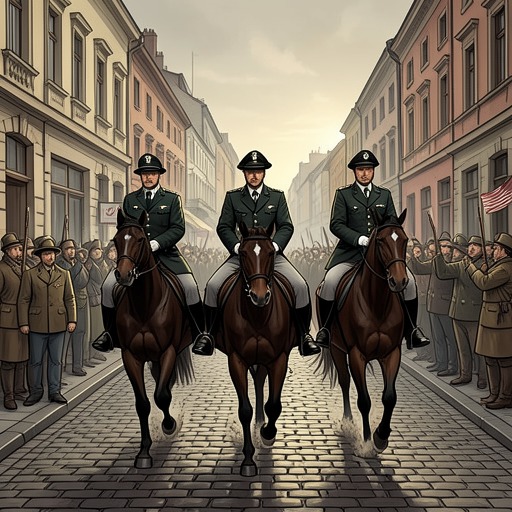
At a crossing in Paris, a group of old men in work clothes carries a red flag and a sign bearing the slogan. Republican Guards ride toward them with drawn sabres flashing in the sun; the men run or flatten themselves into doorways. The sentence’s international promise is thus introduced not as an abstract political proposition but as a public act of collective speech, exposed to immediate physical repression.
A refrain in the city
In a later, compressed urban passage, the slogan appears among manifestos fresh on kiosks and other slogans scrawled in chalk on urinals. It joins images of revolution around the spinning Eiffel Tower and the burning away of the previous year’s diagrams. The surrounding language imagines a break with inherited time: dates fly off the calendar, and the present is named as a new first year and a first day of spring. Here the slogan is no longer attached to one identified group of demonstrators; it has become part of the city’s circulating political vocabulary, mingling with the signs and fragments of a hoped-for beginning.
The damaged handbill
After street fighting, a later glimpse beneath a café shutter finds the rain falling on an empty street. A smashed umbrella and an old checked cap lie in the gutter beside a torn handbill bearing only the beginning of the slogan, ending at FERA. The incomplete printing sharply changes the force of the earlier declaration: the words that once promised peace through workers’ union survive as a damaged trace amid the aftermath of confrontation. The recurrence links a carried sign, the city’s proliferating slogans, and a scrap left behind, preserving the promise while showing how readily its public expression can be interrupted.