The White Man’s Burden
1919The White Man’s Burden names an imperial ideal that the narrative repeatedly puts under pressure: the powerful claim a duty to uplift others, while the scenes surrounding that claim expose racial hierarchy, commercial extraction, and struggles over territory and resources. The phrase connects Theodore Roosevelt’s self-image as a public servant to the larger networks of trade, diplomacy, and finance that turn paternal language into political authority.
Rooseveltian Duty and Racial Rule
The phrase’s clearest political foundation is Theodore Roosevelt’s belief that his family had a special obligation to the nation and to people who had arrived more recently on its shores. The narrative ties that sense of duty to a career built on a frontier persona: after marrying young and traveling to Switzerland to climb the Matterhorn, Roosevelt went to the badlands of western Dakota to ranch on the Little Missouri River. On returning to Manhattan, he was celebrated as a straight-shooting Westerner who had roped cattle, fought a grizzly, and served as a deputy sheriff. In the West, that deputy felt the white man’s burden while arresting wrongdoers; service, the account observes, was “bully.”
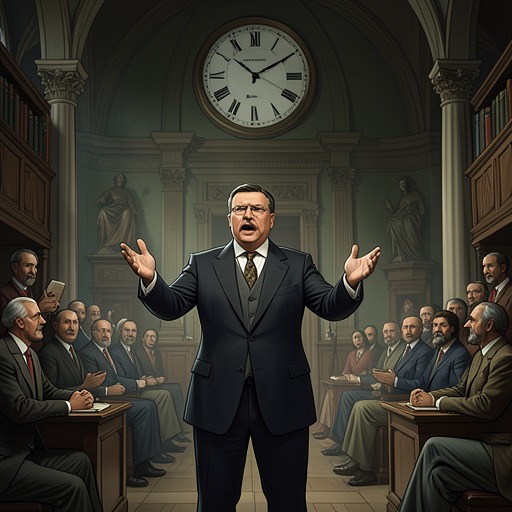
Roosevelt’s public language made the ideal more explicit. He filled magazines with hunting and adventure stories and political meetings with slogans about strenuous life, just government, and righteous war. His exhortations joined national service to racialized standards of strength: those who feared work or war, or women who feared motherhood, were presented as unfit. The narrative places this rhetoric beside his lecture to Nationalists in Cairo, where he declared that this was a white man’s world. The supposed duty to uplift therefore appears not as a neutral ethic but as a claim to define who rules and who is ruled.
From Paternalism to Policy
The narrative follows the same outlook from personal creed into diplomacy. A Roosevelt-supporting diplomat, who believed his career owed much to Beveridge and put faith in reform, antitrust laws, and the Big Stick, helped engineer the revolution that took the Canal Zone from Colombia. He later defended Roosevelt in the Pulitzer libel suit, was sent to The Hague, and resigned from the diplomatic service in 1912 to campaign for Roosevelt. The sequence places reformist language alongside interventions that altered control of territory: the promise to secure the common person’s due coexists with an exercise of power over another country’s political future.
Roosevelt’s own travels extend the pattern beyond the American West. The narrative recalls him addressing Nationalists in Cairo and then traveling through Mato Grosso in Brazil by dugout across waters infested with piranhas. These episodes build the image of a tireless, adventurous public figure, but the juxtaposition also reveals how a personal story of courage and service can lend glamour to a wider language of white authority.
Trade, Labor, and the Colonial Encounter
A seafaring episode gives the phrase a material counterpoint. While Joe Williams is working aboard the Callao, the ship waits outside Roseau, Dominica, for limes to be crated. The crew complains about quarantine and delays, and Joe and Larry go ashore with local boatmen. The narration presents the sailors’ talk and conduct through openly racist assumptions, making the hierarchy of the encounter visible rather than abstract. Their casual expectation that the island and its inhabitants exist for their amusement is the everyday underside of a world divided between those who command and those who serve.
An older island resident redirects the sailors’ attention from racial contempt to the company controlling their cargo. Over drinks on his terrace, with the Callao lit among the lighters below, he calls United Fruit Company a monopoly and says that if growers refuse its prices, their limes are left to rot on the wharf. His rebuke recasts the voyage: the ship carries a commodity through a commercial system in which local producers bear the risk and a powerful company sets the terms. The scene sharply contrasts the sailors’ treatment of island people with the old man’s account of the economic power behind their own employment.
The wider maritime narrative reinforces that contrast. Joe’s passage along the French coast takes place among camouflaged freighters, returning transports, hospital ships, and naval patrols checking papers. The ships move in organized streams through waters made dangerous by war, linking distant ports and workers to military and commercial systems. The imperial burden is thus more than a speech or a heroic pose: it is carried through routes, cargoes, and labor, while those who control the system remain far from much of its immediate risk.
Oil, War Finance, and the Burden’s Inheritors
In Paris, talk of Baku makes the conflict between public principles and material interests explicit. At the Café de la Paix, Standard Oil engineer Rasmussen argues that the United States risks losing its primacy in world oil production to British interests in the Near East. He discusses mandates for territories including Armenia and Baku, while invoking national self-determination to argue over who should control the region. His conversation with J. W. Moorehouse and Eveline Hutchins turns the language of principle into a contest over oil, strategic influence, and the outcomes of a peace settlement. The burden of managing distant peoples is inseparable from the question of who will command their resources.
The narrative’s financial montage widens the same critique. By 1917, the Allies had borrowed $1.9 billion through the House of Morgan; by the end of the Peace Conference, the phrase “J. P. Morgan suggests” carried the weight of $74 billion. The contrast between going overseas for democracy and the reach of private financial power makes the moral language of intervention difficult to separate from the institutions financing it. What appears as a national duty is also embedded in the power of banks, corporations, and international credit.
The motif finally turns toward inheritance. In a passage dated January 6, 1919, Roosevelt’s death leaves the white man’s burden on the shoulders of his sons. The image transfers the obligation from an individual hero to a family and a succeeding generation, preserving the language of service even as the narrative has shown its entanglement with racial dominance and economic control. Across its returns—from Roosevelt’s speeches to colonial shipping, oil diplomacy, and war finance—the phrase becomes an ironic measure of the distance between a claimed duty to others and the power exercised in their name.