Keep the Home Fires Burning
1919Keep the Home Fires Burning, also known as Till the Boys Come Home, is a song of separation and anticipated return. Its refrain gives the domestic image of a burning hearth a public wartime meaning: the home is kept ready while soldiers remain far away. When a military band plays it on Lower Broadway, that promise of reunion sounds against Ben Compton’s sharply different account of the people celebrating around him. The song’s significance lies in this double register: it offers comfort through longing, yet its place in the street procession also makes it part of a patriotic scene that Ben cannot accept as innocent.
The Refrain and Its Promise
The surviving lyric fragments build their meaning through repetition and a simple movement between those at home and those away. The appeal to keep the home fires burning lasts until the boys return; the following lines name yearning, distance, and the absent men’s longing for home. Domestic warmth is therefore not presented as a completed comfort. It is maintained through an interval of separation, as a sign that return remains expected.
The refrain’s emotional structure depends on two perspectives held together. Those at home wait and yearn, while those far away are also said to long for home. The song makes separation reciprocal rather than depicting only one side’s distress: distance divides the household, but longing connects it. Its language turns the home fire into a compact image of continuity, a light kept for people whose absence is understood as temporary. That assurance is central to the song’s appeal, but the evidence does not show whether the promised return is realized for any particular soldier.
A Song in the Street
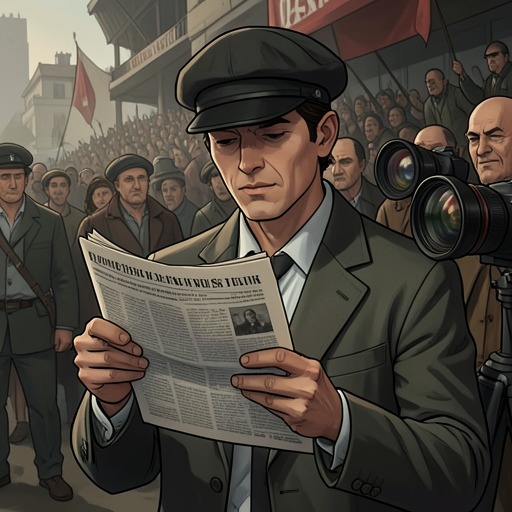
On a fresh summer morning, Ben comes up from the subway onto Lower Broadway, where flags cover the street in red, white, and blue and clerks, stenographers, and officeboys line the pavements. Motorcycle police keep the street clear. From the direction of the Battery, a military band plays Keep the Home Fires Burning, and the crowd appears flushed and happy. The scene gives the song a public setting: its language of waiting for absent men travels with a band through a street arranged for a national celebration.
The music exerts a physical pull on the scene. Ben finds it hard not to walk in step, even as he keeps reminding himself of the crowd’s political associations. That detail makes the song more than background accompaniment. Its rhythm can draw the body into the procession before Ben’s judgment draws him back from it. The passage does not say that he joins the march or changes his convictions; instead, it holds the pull of the music beside his deliberate resistance to its surrounding celebration.
Ben Compton’s Counter-Memory
The contrast becomes sharper because Ben’s thoughts recall recent and continuing repression. The preceding account describes deputies beating wobblies after making two lines toward the railroad track; Ben, who identifies himself as a wobbly, is among those seized. On Lower Broadway, he associates the celebrants with the imprisonment of a socialist, the killing of labor organizers, the violence in Everett, and the prospect that he himself will be jailed for years. These memories make the cheerful public scene inseparable from coercion in his mind.
The song’s homecoming promise thus meets a question the refrain does not address: whose safety and belonging does the national celebration include? Its words imagine absent soldiers and waiting homes, whereas Ben’s attention is fixed on workers punished at home. The difference is not that the music ceases to signify longing; rather, its tenderness sounds amid a civic ritual that, for him, conceals or accepts political violence. The passage lets the song’s familiar emotional appeal remain audible while denying the crowd’s happiness the status of a universal feeling.
Narrative Function
The song links private attachment to collective display. Its refrain gives the parade a language of separation and hoped-for reunion, while the flags, police, crowd, and military band establish the public force of the occasion. Ben’s inward counter-memory interrupts that apparent unity without interrupting the music itself. The result is an unresolved juxtaposition: the tune can make marching feel natural, but it cannot reconcile the promise of home with the exclusion and punishment Ben remembers.
The title’s image consequently carries both consolation and tension. Keeping the fire burning affirms fidelity across distance; in Ben’s scene, the public performance also exposes the gap between a nation’s reassuring language and the experience of those it treats as enemies. The song does not resolve that gap or answer whether the boys come home. Its role is to make the promise audible at the very moment the narrative places that promise beside a dissenting account of who is allowed to feel at home.