Keep the Boys Fit to Go Home
1919“Keep the Boys Fit to Go Home” is a YMCA slogan set against the work of men left among the material wreckage of war. In the “Camera Eye” sequence, they spend their days moving scrap while their service records and identification plates are lost; the promise of a journey home becomes an official refrain with no clear way to fulfill it.
The slogan and its setting
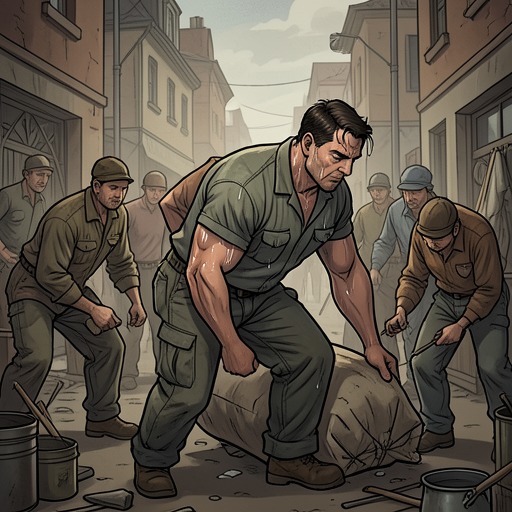
The phrase first appears amid an exhausting routine: for four hours the men pile scrap iron into flatcars, and for four more they drag it back off and stack it beside the track. The YMCA’s all-capital slogan, “KEEP THE BOYS FIT TO GO HOME,” sounds like a benevolent instruction, but the scene gives it a harsher setting. Canvas gloves do not stop jagged metal from cutting hands; grey slag dust fills noses and ears and stings eyes. The men are not being shown in a triumphant homecoming but at repetitive labor among the remnants of military equipment.
Men reduced to scrap and paperwork
The inventory surrounding the slogan turns the war’s leftovers into a landscape: mashed mudguards, broken springs, shovels and entrenching tools, twisted hospital cots, mountains of bolts, miles of wire, acres of tin roofing, parked trucks, and locomotives along the sidings. The scale of the scrap contrasts with the men’s precarious status. They are described through an unceremonious catalogue of national and ethnic labels, while the office sergeants handle paperwork and cannot determine where some of them belong. Their service records, outfits, and aluminum identification plates have been lost; language barriers make the search harder, as the passage strings together their attempts to say that they cannot speak or understand English and other languages.
The promise breaks down
The slogan returns in a changed form: “KEEP THE BOYS FIT TO GO” is followed by the office’s lost records and the men’s inability to make themselves understood. Later, the repeated phrase becomes “KEEP OUR BOYS FIT,” but the question that follows exposes the gap between the official assurance and the men’s actual circumstances: “for whatthehell the war’s over”. A corporal explains that without a service record, the office cannot work out a discharge. The war has ended, but its administrative machinery still determines whether these men can leave.
Refrain and irony
The changing refrain is the passage’s central irony. “The Boys” begins as a phrase of collective care, but the men are treated as unidentifiable bodies among broken equipment: their hands are cut, their faces are obscured by dust, and their records have disappeared. The final word, “scrap,” compresses the sequence’s material and human registers without equating them: the scrap is sorted and counted, while the men remain difficult for the system to place. The slogan’s homeward promise thus exposes the distance between patriotic language and the unresolved work of returning soldiers to civilian life.