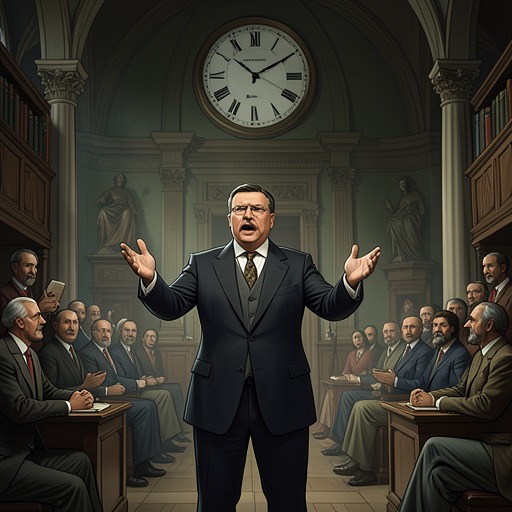
The Happy Warrior
1919The Happy Warrior is the book’s name for Theodore Roosevelt as a figure of exuberant force and moral certainty. The epithet gathers together his many public identities, but its meaning darkens when war drowns out his voice, Woodrow Wilson bars him from military command, his son Quentin is killed, and Roosevelt himself falls gravely ill on Armistice Day.
An Inherited Confidence
The passage introduces the Roosevelts as a family rooted in Manhattan for seven generations. Their property and standing—a large brick house on 20th Street, an estate at Dobbs Ferry, city lots, a pew in the Dutch Reformed Church, and investments—underwrite a sense that Manhattan and America belong to them. Theodore Roosevelt emerges from this setting with an expansive confidence that is at once personal and political.
The epithet belongs to a portrait deliberately crowded with roles: naturalist, explorer, magazine writer, Sunday-school teacher, cowhand, moralist, politician, and righteous orator. Its energy comes from the combination of public authority and domestic playfulness. The same figure who denounces liars through his Ananias Club also enjoys pillow fights with his children; the grinning teeth and wagging forefinger make his righteousness vivid, but also leave room for the narrative’s irony about his certainty and short memory.
The Warrior Denied a War
The arrival of world war breaks the confidence associated with the title. The Democrats return to power, while the roar of exploding lyddite overwhelms what the narrative calls the Happy Warrior’s righteous voice. Roosevelt wants to lead a division, but Wilson refuses to let him do so, insisting that this is not an amateur’s war. The passage suggests that regular officers may also remember the round robin at Santiago, adding an older military grievance to the immediate rejection.
Unable to take command, Roosevelt writes magazine articles against the Germans and sends his sons to war. The distinction between the public warrior and the man denied a place in the fighting becomes sharply personal when Quentin is killed. The epithet’s buoyant promise no longer matches the wartime course: Roosevelt remains active as a writer and father, but neither his convictions nor his family’s sacrifice can restore the role he sought.
Armistice and Reversal
On Armistice Day, when the fighting’s end might seem to complete the warrior’s story, Roosevelt is taken to Roosevelt Hospital gravely ill with inflammatory rheumatism. The scene turns the title inward: the public figure known for physical vigor and forceful action is now described through illness and confinement. The narrative’s judgment, “Things weren’t bully any more,” makes the reversal plain without declaring that his spirit has disappeared; it immediately adds that Roosevelt had grit.
The epithet thus holds both admiration and contradiction. It recalls a man whose confidence, varied pursuits, and moral rhetoric filled public life, while its placement beside political defeat, Quentin’s death, and Roosevelt’s illness exposes the limits of that force. The warrior remains recognizable, but the world in which his characteristic kind of action could flourish has changed.