Ichikawa City
1Q84Ichikawa is the suburban home of Tengo’s childhood and the point of contrast between his family life and his classmates’ more conventional routines. Although the city belongs to Chiba Prefecture, Tengo’s father works in central Tokyo, where he takes his son along on Sunday rounds collecting NHK fees. Those rounds turn an ordinary urban landscape of homes and streets into the setting of Tengo’s imposed labor, public embarrassment, and growing isolation.
Setting and family routine
Tengo lives in a residential area of Ichikawa, while his father’s collection territory lies downtown and Tengo attends school in another neighborhood. The distance means that the pair do not usually knock on the homes of his kindergarten or elementary-school classmates. It does not, however, keep the work entirely hidden: on crowded downtown streets, Tengo sometimes encounters a schoolmate and slips behind his father so as not to be recognized.
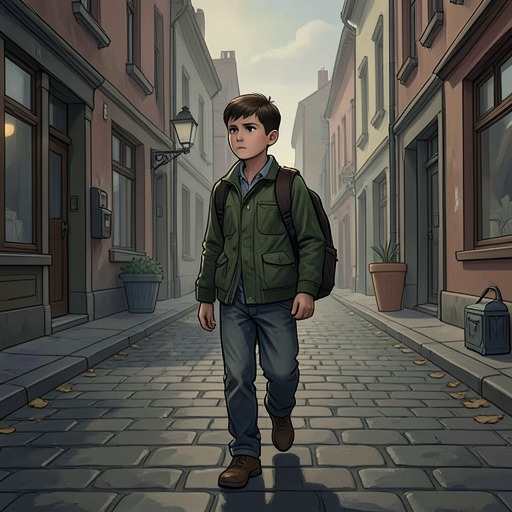
The Sunday route reaches through the city from morning until evening. At houses whose occupants resist paying, the father uses Tengo’s presence as leverage: most people find it harder to refuse a collector holding a young boy by the hand and meeting their gaze. Tengo understands the part he is expected to play and despises it, even as he tries to perform it well enough to keep his father pleased and be treated kindly that day. The collection route is therefore not simply a workplace; it is a family routine in which the child’s presence is deliberately made useful.
The city and the schoolyard
The difference between Tengo’s Sundays and his classmates’ weekends becomes especially sharp on Mondays. His classmates talk excitedly about amusement parks, the zoo, baseball, summer swimming in Minami Bōsō, winter skiing, car trips, and mountain hikes. Tengo has no comparable outing to describe. He has spent the day ringing strangers’ doorbells, head lowered, and taking in money; when people refuse, the pair may have to threaten, cajole, or argue, and sometimes they are insulted and driven away like stray dogs.
By the third year of elementary school, the class learns what Tengo’s father does, perhaps because someone has seen them on the route. Tengo is then nicknamed NHK. In a school attended by children of white-collar families, he is marked as different: the ordinary experiences his peers take for granted are unavailable to him, and their lives seem to belong to another world. His strong academic results, excellence in gymnastics, and muscular strength earn his teachers’ regard, so he is not simply excluded or dismissed. Yet recognition of his ability does not remove the social distinction the nickname makes visible.
A route with no exception
The collection schedule governs Tengo’s social life as firmly as his Sundays. When friends invite him to an outing or gathering, he cannot accept; even when he tells his father that friends have invited him, he already knows that the request will not be entertained. He repeatedly has to decline, until invitations stop coming. In Ichikawa’s streets and at school, the same routine thus produces opposite forms of exposure: he hides behind his father when classmates might see him downtown, but at school the secret becomes a label everyone knows.
His father’s rule admits no exception or alteration. Tengo must go whether he has a cold, a persistent cough, a fever, or stomach pain. He sometimes follows with unsteady legs and imagines that collapsing and dying might finally make his father understand how harsh he has been. But Tengo’s sturdy constitution keeps him from falling or losing consciousness on the long rounds, even when feverish or nauseated; he does not even cry. The city’s long Sunday walks give concrete form to a childhood discipline that leaves him physically enduring yet socially alone.
Narrative significance
Ichikawa is presented less as a scenic backdrop than as the geography of a divided childhood. Its residential neighborhood, distant school, and busy center determine where Tengo can hide, where he can be seen, and how far his father’s work separates him from the shared experiences of his peers. The repeated journey from door to door also explains why Tengo’s isolation is not a single rejection: it accumulates through a rule that repeatedly takes his Sundays and, eventually, the invitations that might have connected him to a group.