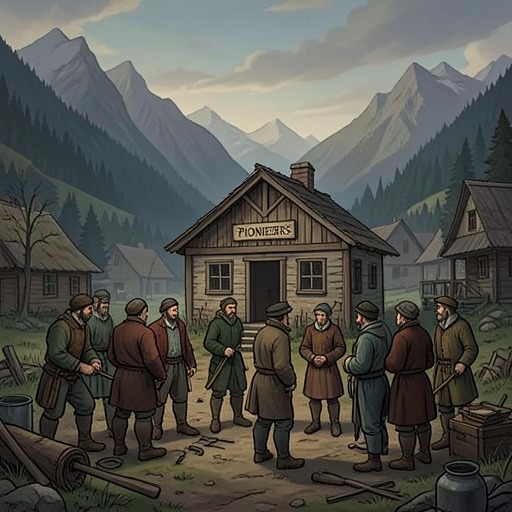
Yamagata Prefecture mountainous area
1Q84The Yamanashi mountains serve as both the secluded center of the Pioneers and a landscape associated with political violence and institutional opacity. The community’s remote location helps keep its activities out of view, while the mountains also anchor the investigation into the group and its hidden leadership.
A Remote Community and Its History
The Pioneers began as a revolutionary agricultural community before separating from L’Aube, an extremist group. After the split, the Pioneers changed their direction and developed into a sect. Police investigated whether the community was connected to L’Aube’s gun battle, but concluded that it was not. The group then consolidated rapidly, though its actual activities remained unknown even to people investigating it.
The mountains of Yamanashi contain the Pioneers’ principal section. Its leader stays there, usually in a secluded place occupied with meditation, and seldom appears in public. Even within the community, few people have met him. His identity, past, and appearance remain uncertain to those trying to learn about him, making the remote headquarters a source of both authority and unanswered questions.
Violence and Investigation
The mountains are also the site of violent exchanges of gunfire between police and a radical group. In Aomamé’s recollection, this was among the changes she had not known about: she notices that police uniforms and weapons have been renewed and recalls news of the Yamanashi clashes. The incident places the region within the wider political upheaval surrounding the groups, even as the Pioneers were officially found unrelated to the earlier gun battle involving L’Aube.
The distance between what can be publicly established and what remains hidden shapes the investigation. The Pioneers’ rapid consolidation followed the police inquiry, but neither that inquiry nor the group’s outward presence disclosed its real activities. The secluded leader’s near-invisibility intensifies the problem: the people seeking information cannot readily approach the center of the organization.
Restricted Access and Children
The mountains’ isolation has consequences for children in the community. Some children of Pioneers members initially attend the local primary school, but many stop going after a time. The sect responds to school inquiries by saying that certain children find attendance difficult and that the community provides their education itself. Teachers, however, report a repeated pattern: children who seem cheerful when young become less talkative and increasingly withdrawn as they grow older, then stop attending school.
Because nonmembers are refused entry to the Pioneers’ grounds, teachers cannot find out what happens to children after they leave school. The landscape therefore functions as more than a backdrop: the boundary around the community blocks outside observation precisely where concern about the children becomes most acute. The evidence establishes the reports and the barrier to access, while leaving the children’s later circumstances unknown.
Narrative Significance
The Yamanashi mountains connect the novel’s accounts of armed conflict, secretive religious organization, and limited public oversight. Their remoteness shelters a group whose leadership and activities are difficult to verify; the same restricted access makes independent understanding of its residents’ lives difficult. The location’s significance lies in this tension between what is reported from outside and what remains beyond the community’s perimeter.