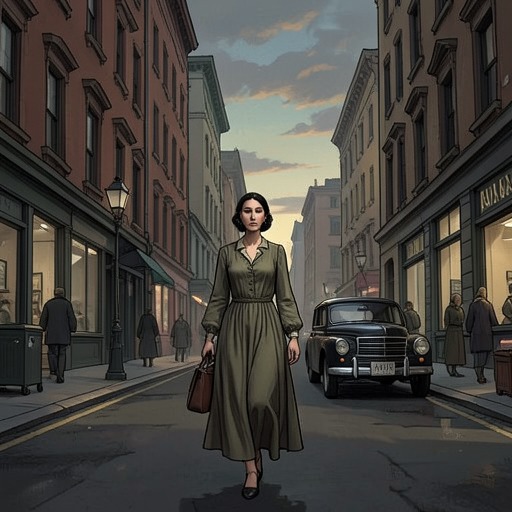
Sanzan Chayachō
1Q84Sangenjaya is the urban threshold at which Aomamé’s journey off the Metropolitan Expressway becomes a test of whether the world around her is still the one she knows. First a traffic landmark, it becomes the setting for her descent from the expressway and, moments later, for a small but unmistakable discrepancy in the ordinary order of things.
Setting and Traffic
On a trip from Kinuta toward Ikejiri, Aomamé takes the Metropolitan Expressway Route 3 from Yoga. Traffic flows freely at first, then backs up shortly before Sangenjaya until the road is nearly blocked. The congestion is strikingly uneven: traffic toward the Tokyo suburbs moves normally, while the opposite direction is jammed. Because mid-afternoon traffic on that stretch would not ordinarily be so heavy, the obstruction frustrates the route she had chosen as the quicker way to travel.
The stalled taxi also makes the delay personal. Aomamé imagines being confined in it until sunset, while Janáček’s music continues and the distortion she had felt begins to recede. The traffic supplies a mundane explanation for why the journey has slowed, but it does not explain the disorientation accompanying it.
The Expressway Stairway
Aomamé eventually leaves the expressway by an extraordinary emergency stairway somewhere near Sangenjaya. The neglected stairs are webbed with cobwebs; after descending, she notices that her tights have torn. The route is not a comfortable or ordinary way off the road, but it carries her out of the traffic and toward the city below.
The stairway’s details become part of Aomamé’s private reckoning. She compares the spiders’ fixed existence—web-spinning and waiting, with no room for hesitation or regret—with her own need to act. Her thought, “I move. Therefore I am,” makes the descent an assertion of agency rather than mere escape. The image of a dusty rubber tree on a balcony and the torn tights keep the passage grounded in an unglamorous, physical cityscape.
Street-Level Encounter and Significance
After crossing National Route 246, Aomamé enters a drugstore, buys replacement tights, and changes into them in a corner of the shop. The queasy sensation she had carried with her disappears. Rather than hail another taxi into the reported traffic, she decides to walk to the nearest station and take the Tokyu Shin-Tamagawa Line.
At Sangenjaya station she passes a young, tall police officer. He does not look at her, but his uniform catches her attention: its cut is looser, its fabric softer, and its collar shorter than the familiar version. More disturbing, he carries a large-caliber semiautomatic pistol rather than the revolvers Japanese police usually carry. Aomamé remembers that officers had still been wearing the old uniforms and carrying the old weapons only hours earlier; she reads the newspapers closely and believes such a change would have been widely reported. Sangenjaya thus marks more than a route change. The traffic, stairway, station, and altered police equipment turn a recognizable Tokyo neighborhood into the first concrete setting in which Aomamé registers that the world itself may have changed.