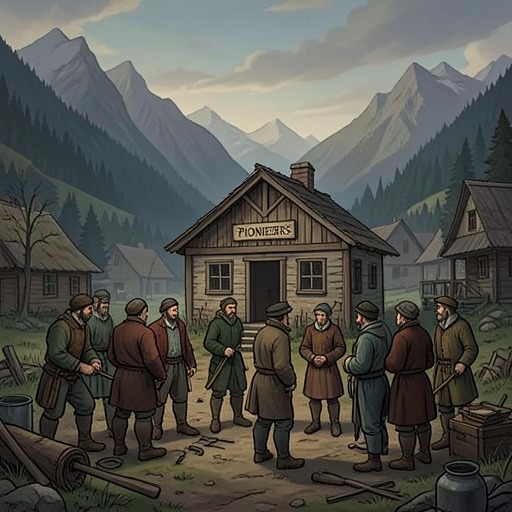
Takashima Juku
1Q84Takashima is a communal agricultural settlement where property and work are organized collectively, and where dairy products find a market across Japan. It first provides Tamotsu Fukada, his wife, their young daughter Eri, and a remnant of his expelled students with somewhere to go after his university career collapses. But the refuge is also a system that, in the Master’s judgment, trains people out of independent thought: what can shelter a small child can become a kind of hell once the self begins to develop.
Formation and communal life
After Fukada was removed from the university, about ten students from the remaining core of his “Red Guards” followed him into Takashima; most had been expelled as well. His wife and Eri joined them. The group needed a place to go, and the course offered a practical refuge, one that had even attracted notice in the media at the time.
The course’s defining principle is collective ownership and collective living. Its members make their living through agriculture, with particular emphasis on dairy products that begin selling nationwide. Tengo recognizes the arrangement as a communal system in which nothing belongs to an individual and everything belongs to the collective. That structure provides both the material basis for the settlement and its claim to offer an alternative way of life.
Refuge and experiment
The Master describes Takashima as the kind of earthly utopia Fukada sought after being driven out of the university. Yet he insists that no such perfect society exists, any more than alchemy or perpetual motion does. His account distinguishes Fukada from people who might welcome Takashima’s strict order: Fukada, he says, is a man who wants to think with his own intelligence and lives for science. He could not be satisfied there, even though circumstances left him little choice.
For Fukada, Takashima was therefore more than a place of shelter. The Master suggests that he also wanted to understand how the system worked. Fukada and his students arrived as city people with virtually no agricultural knowledge, so they had to learn the work from its rudiments and by practice. The account presents their entry into communal life as an imposed necessity and an inquiry into the institution at once: they depended on Takashima while trying to grasp its mechanisms.
Discipline and the cost of belonging
The Master’s criticism is not simply that Takashima requires people to live together. He condemns it for producing, in his view, people unable to think for themselves, as though the mechanisms of independent thought had been removed from their minds. He compares its world to the one George Orwell described in his novel and observes that some people choose such a condition because it is more comfortable: they can follow orders from above without having to think through difficult questions. In this account, obedience is sustained not only by the rules of the community but by the relief of surrendering judgment.
That order has different consequences at different ages. For small children, the Master allows, Takashima may be a happy place. As they grow up and their true selves develop, however, many find their spontaneous desire to think independently ruthlessly stifled. He likens the process to foot-binding: just as girls’ feet were once forced into tiny shoes to keep them from growing, the community’s discipline constrains the growth of the mind. The comparison makes the settlement’s apparent shelter inseparable from the harm its conformity can inflict.
Eri’s remembered home
When the Master recalls Fukada’s arrival, he supposes that Eri was so young that she remembers none of it. Fukaeri breaks her silence only to identify the place as Takashima. Her brief recognition anchors the discussion in her own childhood without supplying a fuller account of what she remembers or experienced there.
The location thus carries two meanings that the conversation does not reconcile. Takashima gave Fukada’s displaced group, including his family, a place to live and work; at the same time, the Master describes its communal ideal as a system that can extinguish the very independence Fukada valued. Eri’s terse identification leaves the settlement present as a remembered home, while the discussion exposes the tension between the security of belonging and the cost of growing into oneself.