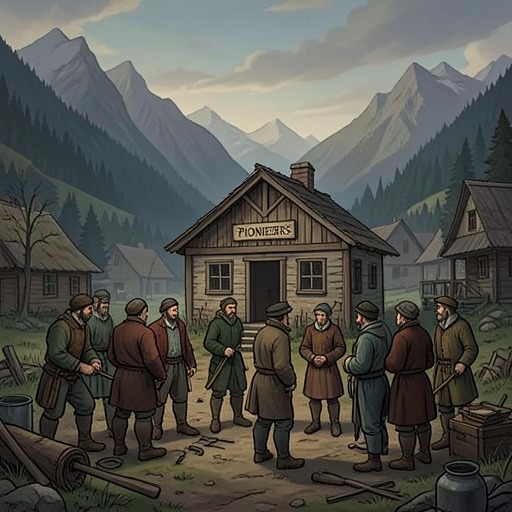
Pioneer Community
1Q84The Pioneers are a farming community established in 1974 in a sparsely populated mountain village in Yamanashi Prefecture. Founded by Fukada and roughly thirty members, they turned abandoned farms and inexpensive houses into a working settlement, developing an organic food business and a flexible model of communal life. That model made room for both a moderate community and a revolutionary faction, but the differences between them ultimately led to a split.
Founding and Material Basis
Fukada’s group sought a village where farms had no successors and the remaining elderly residents could no longer work the fields. In the mountains of Yamanashi Prefecture, they acquired land and houses cheaply, along with plastic greenhouses. The local government offered a subsidy on the condition that they continue cultivating the land already in use; during the first years, they also received favorable tax treatment. These practical advantages helped make settlement possible, but the project depended on a further and less transparent resource: Fukada’s private source of funding.
Fukada never disclosed where that money came from or what its nature was. The capital was substantial enough to finance farm equipment, construction materials, and reserve funds. The members repaired existing houses and built the facilities needed by a community of about thirty people. The Pioneers were therefore founded on a combination of local assistance, agricultural assets, and a source of private wealth that even Fukada’s close friend, Professor Ebisuno, could not explain.
Learning to Live and Work Together
The community took several years to adjust to its new surroundings. Fukada wanted strict management, but the transition went better than he expected: the climate was favorable, nearby residents sometimes helped, and neighbors respected Fukada’s honesty and admired the younger members’ hard work. Regular contact with local people gave the settlers practical advice, helping them learn both farming and communal life in the area.
The Pioneers retained practices they had learned at Takashima while adapting them to their new circumstances. They adopted wholly organic cultivation, abandoning chemical insecticides and growing vegetables with organic fertilizers. Because many members had grown up in cities, they understood urban consumers’ willingness to pay more for fresh, attractive, uncontaminated produce. They sold food to affluent city customers, arranged delivery through a company, streamlined distribution, and sent the produce quickly to the city. They also took the unconventional step of selling vegetables that were irregularly shaped and still covered in soil. The enterprise combined the community’s self-sufficient agricultural work with a deliberate commercial strategy, and anticipated the later popularity of ecological farming.
Communal Organization
Unlike the collectivist system of Takashima, the Pioneers did not abolish personal ownership. Fukada, though politically radical, was also a practical realist who favored moderate communalism over a society organized like an anthill. The community was divided into units in which members lived cooperatively but retained personal property; remuneration was shared to a limited degree. A member dissatisfied with one unit could join another, and leaving the Pioneers was possible. Members could also maintain free contact with the outside world.
This arrangement imposed little ideological re-education and nothing resembling brainwashing. Fukada had learned at Takashima that a more open, natural system could produce better working results. The organization’s flexibility was thus a considered principle, not simply an absence of rules: it allowed members to negotiate how they lived and worked together. At the same time, the structure would provide room for markedly different understandings of what the settlement was for.
The Split and Its Political Stakes
Under Fukada’s initial leadership, the farms became established, but the community divided into two factions. The militant faction, centered on former Red Guards trained by Fukada, treated agricultural life as preparation for revolution. Its members concealed their purpose behind farming and maintained that they would take up arms when the time came. The larger, moderate faction also opposed capitalism but kept its distance from politics, seeking instead an autonomous communal life in nature.
The two groups could carry out ordinary agricultural work together, but disputed the community’s broader direction. Their differences repeatedly produced fierce arguments, and compromise became harder over time. The flexible unit system had allowed divergent commitments to coexist, yet it could not reconcile the factions’ incompatible goals. Fukada was eventually forced to choose. By then he understood that revolutionary change was not imminent in 1970s Japan. He had regarded revolution chiefly as a possibility or metaphor, and as a necessary, healthy form of anti-system thought; the former students he had led wanted an actual revolution in which blood would be shed.
Fukada bore responsibility for the gulf between those positions. Under pressure from events, he had told his students stirring stories about revolution without making clear that he meant it as a concept rather than a literal program. His eloquence helped create a dangerous myth, while his pride made it difficult to admit publicly that his former students had taken his rhetoric further than he intended. He no longer believed in revolutionary romanticism, but repudiating revolution outright would also mean confronting his own part in the movement’s history.
Two Settlements and an Unresolved Bond
The moderate faction remained in the original village, while the militant faction moved about five kilometers away to establish a base for its revolutionary movement. Fukada’s family and the other families stayed with the Pioneers. The separation was initially fairly amicable, and Fukada apparently helped the dissidents obtain the money needed to establish themselves. For a time, the two agricultural settlements continued a limited practical cooperation: they exchanged necessary provisions and used the same distribution networks, since mutual assistance supported both communities’ survival.
That traffic soon stopped as their aims diverged. Fukada nevertheless continued to communicate with the former students he had organized and led into the Yamanashi mountains. He felt responsible for them and could not simply abandon them for convenience; moreover, his secret source of funds remained indispensable to the dissident community. The Pioneers’ history consequently did not end at the point of formal separation. Their founding leader remained caught between the moderate settlement he had chosen and the revolutionary project he had helped make possible, a tension that exposed the limits of both communal flexibility and personal political responsibility.