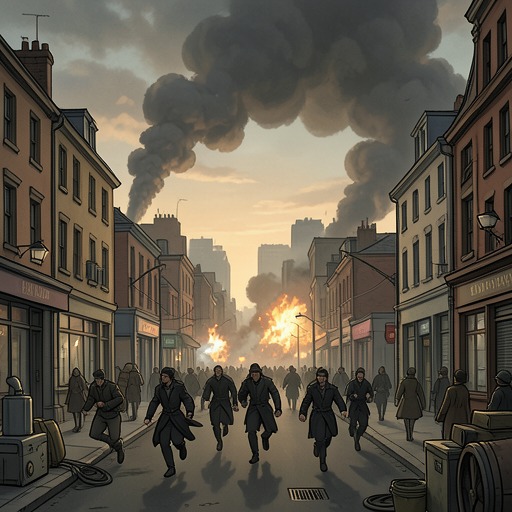
There is no protection from mankind
AniaraThere is no protection from mankind is the governing assertion of a passage in Aniara that turns a catalogue of familiar dangers into a judgment on human self-destruction. As the speaker grieves for Doris’s death, the line distinguishes the hazards people may guard against from the destruction they bring upon one another and their world.
Meaning and Form
The passage begins by naming protections against nearly everything, then gives examples: fire, damage from storm and frost, and whatever other blows might come to mind. The list evokes dangers that can be anticipated and met with practical precautions. Its calm accumulation makes the reversal sharper: against mankind, the speaker declares, there is no protection.
That contrast gives the expression its weight. The threat is not an unfamiliar force arriving from beyond human life, but harm arising from humanity itself. The next lines sharpen the accusation: in a moment of need, no one sees clearly; clarity appears instead when people set about beating down and desolating the heart’s treasury of dreams. The passage thus links physical catastrophe to the destruction of the hopes that might have sustained people through cold and evil years.
The Passage in Aniara
The line is spoken in the first person as the speaker turns to others and cries out in pain at Doris’s death. In the wider poem, the name Doris belongs to the personification of Earth, while the section called The Song of Doris and Mima culminates in the nuclear destruction of Dorisburg. That destruction is recounted by the Detonee, the last voice from Earth to reach the Aniara. The expression therefore stands within a narrative of planetary loss, not as a detached maxim but as an anguished response to a world made vulnerable by human action.
The catastrophe also reaches the poem’s instruments of perception. Soon after the cry over Doris’s death, Mima is blinded by a bluish bolt, and the speaker is left dumbstruck by the events pouring upon Earth. Elsewhere, a stone-deaf man begins to describe the worst sound he has heard, only for the poem to say that it lies beyond hearing. These images make catastrophe difficult to see, speak, or even register: the warning is voiced, but witnessing itself is failing.
Historical Context
The poem’s early appearance coincided with intensifying public fears about nuclear weapons. In August 1953, the Soviet Union announced that it possessed a hydrogen bomb described in the Swedish press as a hundred times worse than an ordinary atomic bomb; four days later, it detonated one. The account of Aniara’s emergence identifies this news as part of the atmosphere fostering somber contemplation of catastrophe. This context makes the line’s human-centered warning especially pointed, without reducing its meaning to a reference to any single weapon or announcement.
Recurrence and Significance
The accusation resonates beyond the destruction of Earth. In another episode, Gond is caught in flame from a phototurb and twisted into a spiral of torrid gases. The weapon’s violence turns a place and its fate into an image of devastation, echoing the poem’s larger concern with the destructive capacities people have made and cannot reliably control.
The expression’s force lies in the mismatch between the ordinary list of safeguards and the scale of the danger that follows it. Storm and frost belong to a world where precautions still seem imaginable; mankind names a threat that defeats that confidence from within. By joining a stark, almost proverbial statement to grief, failed perception, and nuclear ruin, Aniara makes the line both a lament for a lost world and a warning about the source of its undoing.