A little bubble in the glass of Godhead
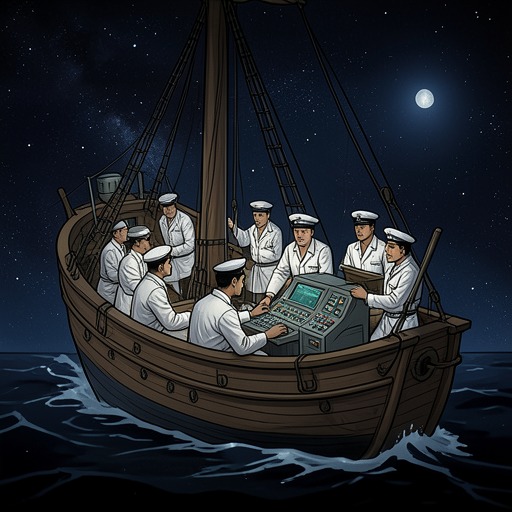
Aniara“A little bubble in the glass of Godhead” is the passage’s governing image for Aniara: a small, vulnerable vessel moving within a reality so vast that its journey cannot be understood as a purposeful route through ordinary space. The metaphor follows a stark recognition. The travelers race “Through God and Death and Mystery” aboard a ship “without goal or trace”; they wish they could return to their base, but now understand what their ship is: “a little bubble in the glass of Godhead.” The image makes their predicament cosmic without making it grandly heroic. Aniara is in motion, yet that motion offers neither destination nor assurance of control.
The Image and Its Context
The expression arrives as the answer to a change in understanding. The speaker first names the travelers’ movement through “God and Death and Mystery,” then describes their ship as racing without a goal or trace. The wish to turn back follows that description, but it does not restore a route home. Instead, the speakers’ realization changes the scale at which the ship must be imagined: Aniara is no longer simply a vehicle traveling through space, but a bubble contained within a greater medium.
The phrase’s grammar reinforces that reversal. Aniara is not presented as the glass or as the whole field of existence; it is the “little bubble” inside the glass. “Little” establishes disproportion, while “in” makes containment central to the image. The ship’s occupants may experience themselves as voyagers across immense distances, but from the metaphor’s wider perspective their vessel is only a minute feature of a larger whole. The grandeur belongs to the surrounding reality, not to the travelers’ command of it.
The phrase “Godhead” gives that enclosing whole a theological register. Yet the passage does not explain the Godhead as a person, a doctrine, or an agent directing the ship. Instead, the word names an encompassing order whose scale exceeds the travelers’ grasp. The metaphor therefore holds spiritual and physical language together without resolving one into the other: a glass can be pictured as an actual container, while “Godhead” makes the container a figure for ultimate reality.
The Glass Analogy
After introducing the image, the speaker promises to explain glass so that the listeners will understand. The account depends on a patient, ordinary analogy: a bubble in glass, left untouched long enough, can make a voyage within it. The text specifies the startling duration as a thousand years. This miniature movement supplies a model for thinking about Aniara’s much larger journey, but it does not make the ship’s course purposeful or manageable. Rather, it makes motion itself difficult to interpret from within the moving bubble.
The analogy pivots from the bounded glass to “a boundless space.” A gulf measured in light-years throws its arch around Aniara as the bubble continues on its march. The change in scale is the passage’s central imaginative operation: the bubble inside a glass becomes a ship inside an immense spatial gulf. The image invites comparison between the tiny motion visible within a container and the vessel’s movement across a reality beyond ordinary measure, while stopping short of claiming that space is literally glass or that Aniara is physically a bubble.
The ship’s speed sharpens this contrast. The passage acknowledges that Aniara travels rapidly, faster than the swiftest planet, but speed does not amount to freedom. The bubble’s voyage persists within its glass; similarly, the ship’s great velocity does not supply a goal, a traceable route, or a means of returning to its base. The image separates how fast the vessel moves from whether its movement can be directed toward a desired end.
Scale, Motion, and Confinement
The metaphor’s force comes from holding two apparently opposed conditions together. Aniara travels, and the surrounding space is boundless; at the same time, the ship is figured as something enclosed within a larger whole. Its motion is real, but its scale makes it seem almost negligible against what surrounds it. The bubble is not still, yet movement alone cannot prove that it is making progress toward anywhere the travelers can choose.
This contrast gives the wish to turn back its particular poignancy. The travelers recognize that their ship is not an independent center of action in the universe but a small thing within an order larger than itself. Their longing for a return to their base remains present in the passage, but the bubble image offers no route back and no promise that wishing can alter the ship’s course. It recasts the desire as a human response to confinement, not as evidence that escape is available.
The scale-shift also links the passage’s concrete and abstract registers without erasing their difference. A bubble in glass makes a vast, hard-to-grasp journey momentarily imaginable; Godhead and the light-year-deep gulf restore the scale that the domestic analogy can only approximate. The result is not a scientific account of the ship’s motion, but a way of apprehending its disproportionate place within an incomprehensible expanse.
Significance
As an expression, “a little bubble in the glass of Godhead” condenses the passage’s movement from bewilderment to recognition. The ship’s travelers first name the forces through which they race, then confront the smallness of their vessel within a larger reality. The glass analogy gives that realization a memorable form: the journey can continue for a long time, and at great speed, without becoming a chosen journey with a knowable destination.
The image is therefore both expansive and confining. “Boundless space” opens the scale of the scene almost beyond conception, while the bubble remains an enclosed, minute object within it. That tension is what makes the expression more than a decorative description of Aniara. It gives the ship’s ungoverned motion a shape, and makes the travelers’ wish to return legible against the immense order surrounding them—without claiming that the order will answer their wish.