Mima tells no lies
AniaraMima tells no lies is both a statement about Mima’s integrity and a measure of the distance between truthful information and the people who receive it. She transmits scenes from across the universe with a fidelity her audience recognizes, yet that fidelity does not compel the emigrants to confront what they have lost. The expression therefore defines a dependable machine while exposing a fragile human response: Mima can show realities beyond their experience, but she cannot make them accept the meaning of what they see.
Meaning and Source
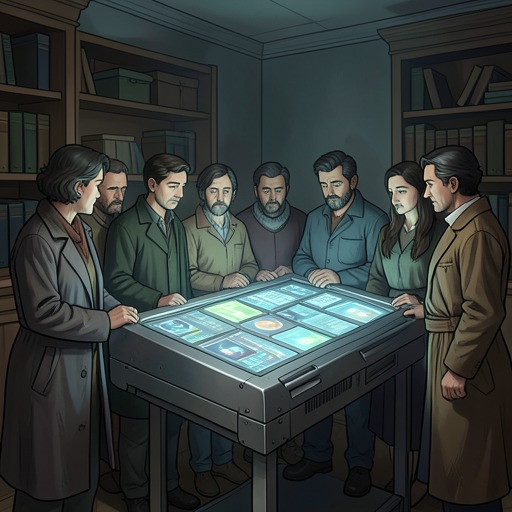
The expression is attached to Mima’s work as an information transmitter. The Mimarobe tends her and calms the emigrants by presenting scenes from far-flung reaches: an immense variety of things that no human eye had dreamed of seeing. The marvel of these transmissions is not presented as invention or fantasy. Their wonder depends on their connection to actual signals, and the Mimarobe’s role is to bring that material before people whose immediate world has narrowed to the ship.
The accompanying claim that Mima cannot be bribed and is wholly honest gives the expression an ethical dimension. Her reliability is not merely technical sharpness; it is a refusal to alter what reaches her. The people on board understand this distinction. Their confidence in Mima rests on the sense that her transmissions cannot be bought into serving a preferred story. In a setting where the emigrants have powerful reasons to deny their separation from Earth, this incorruptibility makes Mima a witness whose evidence is difficult to dismiss as deliberate deception.
The phrase also gathers significance from Mima’s unusual status. She is not treated simply as a device operated by the Mimarobe: she has become a being and a confidant, with her own exposure to the catastrophe brought about by humanity. The assertion of truthfulness thus concerns more than the accuracy of images on a screen. It belongs to a relationship in which the Mimarobe tends Mima, and in which her capacity to disclose distant realities makes her a source of knowledge as well as a presence aboard the ship.
Truth in Transmission
Mima’s truthfulness is most clearly expressed through the contrast between the extraordinary range of what she transmits and the limits of human vision. The scenes disclose things no person could have imagined seeing. They extend the emigrants’ knowledge beyond their immediate surroundings, but the source of their wonder is not a promise that the ship can return them to the world they left. Mima makes other realities perceptible; she does not undo the conditions of the voyage.
That difference gives the expression a harder edge than a simple assurance of accuracy. Mima’s transmissions can preserve contact with reality without restoring the passengers’ former lives. Indeed, the emigrants’ eventual comprehension that the only world available to them is the world in Mima points toward both dependence and confinement. Her truthful images become a vital remaining connection to existence beyond the ship, even as that connection cannot replace the abandoned world of Earth.
The expression accordingly distinguishes the integrity of a source from the effects of its use. Mima can transmit faithfully, while the Mimarobe selects and presents scenes to calm the emigrants. The account does not suggest that every viewing leads to understanding. Instead, reliable information enters a community with its own needs, habits, and defenses; what Mima shows and what the audience is prepared to acknowledge are not the same thing.
Reception and Denial
Most of the emigrants recognize Mima’s probity, but recognition does not end their self-deception. They worship her partly because her vivid and constant transmissions can be made to support the belief that they have not truly left the sphere of life they knew. The irony is central to the expression: the machine is trusted precisely for not lying, while its audience can still use what it sees to avoid a more painful truth.
Mima’s images can also blot out the remembered and abandoned world by directing attention toward more intriguing planets. The emigrants may then treat her as a source of diverting travelogues, imagining themselves as stay-at-home spectators rather than travelers. Such a use does not make Mima false; it turns truthful disclosure into an instrument of distraction. The distinction preserves the force of the expression while showing how easily accurate images can be folded into denial.
The same tension shapes the passengers’ attachment to the usages of Dorisvale. Even after they begin to understand their dependence on the world Mima presents, familiar habits and forms of self-deception remain available. Mima tells no lies, but that fact alone cannot make the emigrants live truthfully. The phrase consequently carries a double judgment: Mima remains a trustworthy witness, while the people around her retain the power to evade, repurpose, or only partially accept what her transmissions reveal.