Blue Eyes Empty to All, in the Twilight of Yomi
AnotherBlue Eyes Empty to All, in the Twilight of Yomi is a doll gallery in the town of Misaki and one of the most important private spaces in Koichi Sakakibara’s developing relationship with Mei Misaki. More than a shop or exhibition venue, it is a threshold between ordinary town life and the enclosed world surrounding Mei: visitors enter through a public gallery, descend into a crypt-like basement, and confront dolls whose likenesses and fragmented bodies make questions of identity tangible.
Setting and Physical Arrangement
Blue Eyes Empty to All, in the Twilight of Yomi occupies a building in Misaki with a public gallery on the first floor and a basement display room reached by descending from it. Koichi Sakakibara pays an entrance fee on one visit, while the old woman Amane later waives it when he arrives after telephoning Mei Misaki. The arrangement gives the location a controlled quality: access is possible, but it is mediated by payment, by the household’s permission, and by the separation between the visible gallery and the concealed lower room.
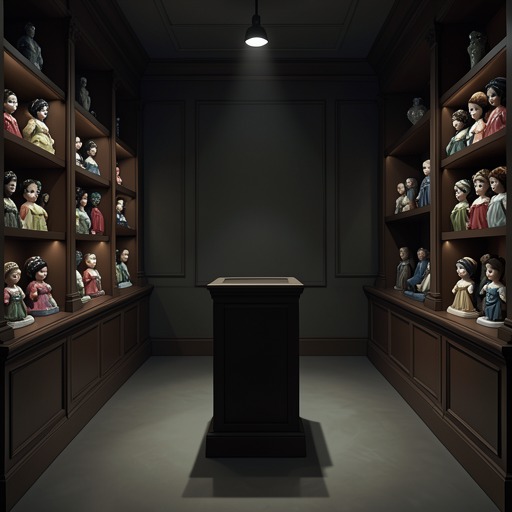
The basement is repeatedly described as crypt-like, sunken, and chill. Dolls are arranged throughout the room with their various parts exposed, creating an environment in which crafted bodies are not presented as ordinary household objects but as assembled presences. A gloomy string melody plays there, perhaps the same music Koichi heard during his first visit in May. The repeated music and the recurring descent make the basement feel less like a changing exhibition than a chamber preserved outside ordinary time.
At the back of the room stands a black hexagonal coffin set before a deep red curtain. Inside it is a doll that looks exactly like Mei. The coffin and the doll provide the gallery’s most concentrated image: the living Mei can stand beside an artificial duplicate, while the display simultaneously invites recognition and denies certainty. On one June visit, Mei positions herself so that her body hides the doll from Koichi’s view. On another, she is already standing beside it when he arrives, wearing skinny jeans and a plain T-shirt whose ashen color appears coordinated with the dress worn by the doll.
Koichi and Mei’s Encounters
During the remaining days of June, Koichi visits Misaki twice. On one occasion he goes immediately after visiting the municipal hospital for a prognosis on his collapsed lung. He pays the fee, examines several new creations by Kirika, and descends alone into the basement display room, but he does not encounter Mei and does not ask Amane to summon her. The absence unsettles him because he has begun to associate the gallery with meeting Mei; leaving without seeing her makes the familiar place feel strangely incomplete.
The second June visit occurs on Tuesday, June 30, after Mei invites Koichi over on their way home from school. He does not go to the home on the third floor and does not see Kirika. Instead, he and Mei sit on sofas in the empty first-floor gallery while Amane makes tea. This ordinary hospitality briefly softens the gallery’s isolation: the space becomes a place for companionship rather than only investigation. It is also the first time Koichi accepts Amane’s tea, which he finds far better than canned iced tea.
Afterward, Mei leads Koichi into the basement. The familiar music, cold atmosphere, scattered dolls, and black coffin remain in place, but Koichi notices a change in his own response. He no longer feels quite as strongly that he must breathe for all the dolls. His growing familiarity does not make the room ordinary; instead, it marks his gradual accommodation to a world that initially seemed unbearable and unreal.
Later Return and the Coffin Display
More than a month after Koichi’s first telephone call to the gallery, he returns after leaving Inoya and parting from Naoya Teshigawara and Yuya Mochizuki. The decision is compelled by his state of mind, suggesting that the gallery has become a destination he seeks when ordinary routes and explanations fail. Kirika answers the telephone, recognizes Koichi as Sakakibara, and passes the call to Mei without asking why he wants to visit.
Mei agrees to meet him in the basement because there probably will not be any customers. When Koichi arrives, Amane waives the entrance fee and he goes directly to the display room. Mei is standing beside the black coffin and beside the doll inside it that exactly resembles her. The scene makes the gallery’s central tension explicit: Mei is not merely associated with the doll through appearance, but is repeatedly staged in relation to it, as though the room demands that Koichi compare the living girl with her manufactured double.
The gallery therefore operates through juxtaposition rather than explanation. It offers no simple separation between person and representation. Its dolls are handmade creations associated with Kirika, its basement is arranged like a burial chamber, and its most striking exhibit repeats Mei’s image. The result is a physical setting in which the novel’s questions about resemblance, hidden identity, and the boundaries between the living and the dead are encountered as spatial facts before they are resolved as information.
Relations to Other Spaces
The gallery belongs to a wider network of restricted or unsettling places. At school, the art club room occupies a former classroom on the first floor of Building Zero, divided in half and located at the building’s western end; the secondary library is another secluded refuge, empty when Koichi and Mei arrive. The abandoned former classroom of third-year Class 3 lies on the second floor of an unused building, marked by grime, damage, dust, and a stagnant smell. At the Sakitani Memorial Hall, a Western-style building in a forest at the foot of Yomiyama, the class’s effort to escape the curse also turns a supposedly functional institution into a dangerous threshold.
Against those spaces, Blue Eyes Empty to All, in the Twilight of Yomi is distinctive because its danger is intimate and curated. The school spaces are governed by class arrangements, tactical plans, or prohibitions; the Sakitani Memorial Hall is a donated building whose purpose the school does not know how to manage. The gallery, by contrast, is a private domestic-commercial space organized around the deliberate presentation of dolls. Yet the same pattern recurs: movement into a supposedly separate room produces contact with what the characters have tried to isolate.
Narrative Significance
Blue Eyes Empty to All, in the Twilight of Yomi is significant because it converts secrecy into architecture. The public gallery, the sofas, the tea, and the possibility of paying an entrance fee make the place seem accessible, while the basement, the cold, the music, and the coffin preserve an atmosphere of concealment. Koichi’s repeated returns show that the location is both refuge and source of pressure: he goes there to be near Mei, but each visit also brings him closer to the unsettling image that surrounds her.
Its objects function as more than decoration. The coffin gives the display the form of a death scene; the doll’s exact likeness to Mei introduces the problem of duplication; and the scattered doll parts expose construction where a finished body would normally appear natural. The gallery’s aura depends on the tension between handmade uniqueness and mechanical resemblance: every doll is a crafted object, yet one of them reproduces a living person so precisely that the distinction between original and copy becomes unstable.
The location’s importance finally lies in its unresolved openness. Koichi repeatedly encounters concrete arrangements—the basement, the black coffin, the red curtain, the duplicate of Mei—but the gallery does not immediately explain what those arrangements mean. It instead makes the reader assemble significance from recurrence, absence, likeness, and descent. In that sense, the gallery is not merely where Koichi meets Mei; it is the novel’s material laboratory for testing whether a person can be known through images, and whether a familiar place can remain familiar after it has revealed what it was built to conceal.