Secondary Library
AnotherThe Secondary Library is one of the most important investigative and transitional spaces in Yomiyama North Middle School. Although it initially appears to be an empty school library, it becomes a protected meeting place where Koichi Sakakibara and Mei Misaki can occupy their “not there” status together, consult records, and hear Tatsuji Chibiki’s testimony about the Yomiyama phenomenon. The room’s quiet order contrasts with the phenomenon’s corruption of documents, memories, and images, making the library a place where suppressed history can briefly become legible.
Setting and Physical Situation
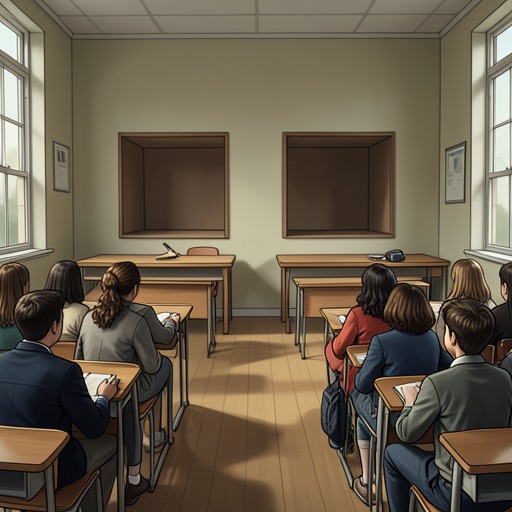
The Secondary Library belongs to the old part of the school complex and is associated with Building Zero. On the rainy day when Koichi Sakakibara and Mei Misaki avoided eating with the rest of their classmates, they left the classroom together rather than remain among students who treated them as absent. Mei proposed the library as their destination, and they went there for lunch before the beginning of fifth period.
The room was empty when they arrived, and there was no sign of its librarian, Tatsuji Chibiki. Its emptiness gives the library an unusual double character: it is a functioning school space, yet it feels detached from ordinary school life. The building’s institutional purpose remains visible, but the absence of students and staff allows the room to operate as a private zone within the school’s public structure.
The Secondary Library is also linked spatially to the art club room. The art club room occupies half of a former classroom on the first floor of Building Zero, at the building’s western end; the adjacent room is the culture club room, marked by a placard reading “Local Historical Society.” This arrangement places the library within a larger network of repurposed and semi-specialized rooms rather than in the center of the school’s everyday circulation.
Refuge for the “Not There”
The library becomes especially significant because Tatsuji Chibiki is not directly connected to Yomiyama North Middle School Third-Year Class 3. He explains that people without a direct link to the class are effectively safe, so his ordinary interaction with Koichi Sakakibara and Mei Misaki should not produce consequences. This status explains why Mei had been able to visit him repeatedly and obtain information about the class and its history.
When Koichi Sakakibara and Mei Misaki return to the library after a period of disasters, Tatsuji Chibiki greets them with an artificial tone and smile. Mei answers with controlled politeness, describing their condition indirectly as the effort to avoid bizarre accidents and sudden illnesses. The exchange shows how the library permits conversation about the curse while preserving a thin surface of normal school etiquette.
The room therefore functions as a refuge, but not as a place free from danger or knowledge of danger. Its safety depends on social and supernatural boundaries: Tatsuji Chibiki stands outside the class’s direct range, while Koichi Sakakibara and Mei Misaki are temporarily treated as absent from it. The library’s protected quality is consequently conditional, produced by the rules of the phenomenon rather than by ordinary security.
Chibiki’s Archive and Testimony
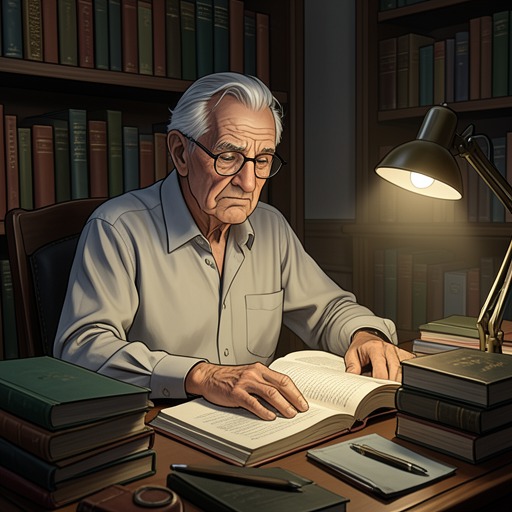
Tatsuji Chibiki is the “master” of the Secondary Library and presents himself as an observer of the disasters. He appears shortly after Koichi Sakakibara returns the 1972 yearbook to its shelf, dressed in black with black-rimmed glasses and salt-and-pepper hair. His physical appearance and reserved manner emphasize his distance from the image of the energetic educator remembered by Koichi’s grandmother.
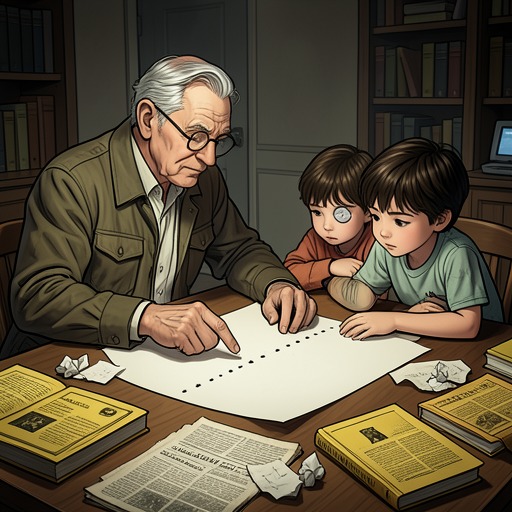
The library is where Tatsuji Chibiki offers to tell the story of the event twenty-six years earlier, admitting that he dislikes speaking about it but may be the last person at the school who experienced it directly. His account turns the room from a place of study into an oral archive. Mei Misaki has heard only fragments, while Koichi Sakakibara receives much of the explanation for the first time, so the conversation also establishes the library as a site where partial knowledge is assembled into a historical record.
To make the explanation concrete, Tatsuji Chibiki removes his glasses, searches through a desk drawer, and produces a binder with a dark black cover. The object’s material presence matters: the phenomenon may alter records, but the investigation still proceeds through shelves, yearbooks, binders, and other physical media. The library is consequently both a repository and a laboratory for testing what documents can and cannot reveal.
Tatsuji Chibiki explains that while the phenomenon is active, searching alone accomplishes nothing. The corruption reaches class lists, school records, official documents, diaries, notes, photographs, videotapes, and computer data. It conceals contradictions that should appear when the casualty joins the living, making details that ought not to match appear consistent. The library thus houses evidence of a system designed to defeat archival verification.
His explanation also establishes the phenomenon’s geographic and familial range. The disasters extend to members of the class and blood relatives within two degrees: parents, grandparents, and siblings. Relatives without blood ties, such as stepparents and stepsiblings, have not been affected in the same way. The library’s records therefore support not merely a story of haunting but an attempt to identify rules through accumulated observation.
Books, Records, and Hidden Contradictions
Koichi Sakakibara uses the library independently as well as in conversation with Tatsuji Chibiki. He returns to the same bookshelf the librarian had previously indicated and retrieves the yearbook for 1972. He is not looking simply to revisit the appearance of his mother, Ritsuko Sakakibara, as a middle-school student; he has remembered a detail that he wants to check. He then examines the group photograph of Third-Year Class 3, treating the image as a possible test of the past.
Mei Misaki, meanwhile, reads The Lonely Crowd, a book borrowed from the main library. The title seems to speak to her, and her solitary reading at the large table makes the room’s social function visible: the library accommodates isolation while also enabling a carefully chosen companionship. Koichi Sakakibara sits two seats away rather than directly beside her, preserving the quiet separation characteristic of their status while remaining within the same investigative space.
The library’s materials repeatedly promise certainty and then expose its limits. A yearbook can be consulted, a binder can be opened, and a photograph can be inspected, yet the Yomiyama phenomenon can corrupt every one of these forms. The room’s apparent stability therefore becomes dramatically ironic. It is the school’s place for preserving knowledge, but the very history sought there has been altered across records and memories.
Rumor, Return, and Narrative Significance
The Secondary Library is also the setting of one of Building Zero’s best-known Seven Mysteries. According to the story, a person can sometimes be heard moaning quietly inside it. The rumor adds a spectral layer to a room already associated with hidden deaths, missing information, and the return of the casualty. It transforms the library from a neutral archive into a place where suppressed voices seem capable of resurfacing.
That reputation is reinforced by the library’s connection to abandoned and restricted spaces. The former classroom of Third-Year Class 3 lies on the second floor of Building Zero, the third room from the western end, and has been unused for years. The old classroom yields the cassette tape later identified as Katsumi Matsunaga's cassette tape, whose recording begins a confession that ends abruptly before the speaker continues on the B side. Although the tape is found elsewhere in the building, the library’s investigative role prepares the reader to understand such objects as fragments of a damaged archive.
The library’s atmosphere also contrasts with the Sakitani Memorial Hall, a Western-style building standing in a forest at the foot of the mountain and donated to the school by a local alumnus and celebrity. The memorial hall becomes a setting of threatened communal activity, whereas the Secondary Library is marked by concentration, silence, and controlled inquiry. Both spaces preserve the past, but the library preserves it through questioning while the hall embodies the danger that emerges when the past breaks into the present.
Late at night, a hallway stretches from the dark foyer toward an only slightly open door, producing an unsettling echo and an impression of abandonment. The image recalls the Secondary Library’s broader function: doors, shelves, and records do not simply contain information; they mark thresholds through which hidden history may enter. Even the library’s silence becomes narratively active, because the room is repeatedly associated with what has been excluded, erased, or returned.
In the aftermath, photographs examined by the group show five people in both images, despite the effort to identify the extra person. Such visual evidence belongs to the same unstable field that the library helps the characters investigate. The Secondary Library’s decisive significance lies in this tension. It is a place where the characters seek reliable knowledge, yet it teaches them that the phenomenon can make false continuity look natural. Its shelves and testimony do not defeat the supernatural concealment outright; they provide the disciplined setting in which its contradictions can finally be recognized.