Yomiyama Mountain
AnotherYomiyama Mountain is the mountain north of Yomiyama and the landscape from which the town takes its name. More than a geographical landmark, it is bound to the town’s oldest stories about death and to the school’s efforts to contain the Yomiyama phenomenon: its foothills hold the Sakitani Memorial Hall, its slope holds Yomiyama Shrine, and its summit offers a view over the entire town. In 1998, the mountain becomes the destination of a class camping trip and a desperate ritual intended to stop the disasters afflicting Third-Year Class 3.
Name, Landscape, and Local Memory
Yomiyama was originally the name of the mountain; the town was named after it. Older residents, including Koichi Sakakibara’s grandmother, call the mountain Mount Yomi. She recalls hiking it with her husband when they were young and describes the view from its summit as encompassing the entire town. That elevated perspective gives the mountain a physical relationship to the community below: it stands outside ordinary town life while overlooking it in its entirety.
The name also carries a darker association. Tatsuji Chibiki explains that Yomiyama was the surname of the boy Misaki who died twenty-six years earlier, linking the mountain’s name to the death that remains central to the class’s history. People have additionally suggested that the name derives from Yomi, the land of the dead. These associations turn the mountain from a neutral place-name into a site where local geography, remembered death, and supernatural interpretation converge.
The Mountain’s Associated Sites
At the foot of Yomiyama stands the school-owned Sakitani Memorial Hall, a Western-style building in a forest. The facility was originally built by Sakitani, a North Yomi alumnus and local celebrity, for his company and donated to the school several decades later. By 1998 it is still maintained and occasionally used for club camping trips, although its uncertain future and likely dilapidation give it an abandoned, residual quality.
Partway up the slope stands Yomiyama Shrine, named after the mountain. Tatsuji Chibiki describes it as an old shrine and reports that oral traditions regard it as a linchpin separating this world from the next. The shrine therefore occupies a literal middle position between the town and the mountain’s higher reaches, but it also functions in the story as a threshold between ordinary life and the realm associated with the dead. Its alleged power is not presented as settled fact; it belongs to the rumors and conjectures surrounding the disaster.
The mountain is also connected to the school through remembered and concealed spaces. The 1998 students’ investigation reaches the abandoned former Third-Year Class 3 classroom in the old building, while the school’s present-day movements repeatedly connect classrooms, the Secondary Library, Building Zero, and the mountain facilities. This network makes Yomiyama Mountain part of a larger geography of restricted rooms, institutional memory, and dangerous returns rather than an isolated scenic setting.
The 1983 Camping Trip and Shrine Visit
The mountain’s decisive narrative history comes from a previous Third-Year Class 3 camping trip. The class stayed for two nights and three days at Sakitani Memorial Hall beginning on August 8, and twenty students participated. The head teacher, Mr. Koga, proposed the trip and the visit to Yomiyama Shrine after thinking deeply about the problem and reportedly consulting a medium, although the exact circumstances of that consultation remain uncertain.
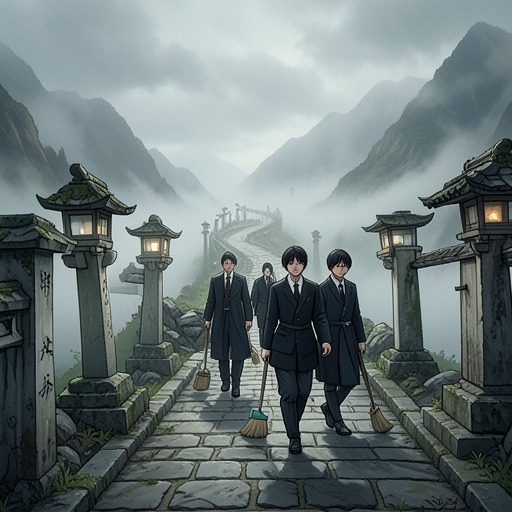
On the second day, August 9, Mr. Koga led the students up the mountain to the shrine. They found it unbelievably run-down, apparently neglected despite sharing its name with the town. The students cleaned it together and gradually became convinced that their labor might break the curse. Mr. Koga reinforced that belief by assuring them, “Everything is going to be all right now.” The collective cleaning creates a temporary sense of unity and control: the class treats physical restoration as a ritual response to a supernatural contamination.
The ritual fails. The students’ confidence collapses when the disasters continue, revealing that the mountain and shrine cannot be mastered through a simple communal act. The failed visit becomes part of the class’s suppressed history and helps explain why later characters approach Yomiyama Mountain with a mixture of hope, fear, rumor, and fatalism.
The 1998 Return and Narrative Significance
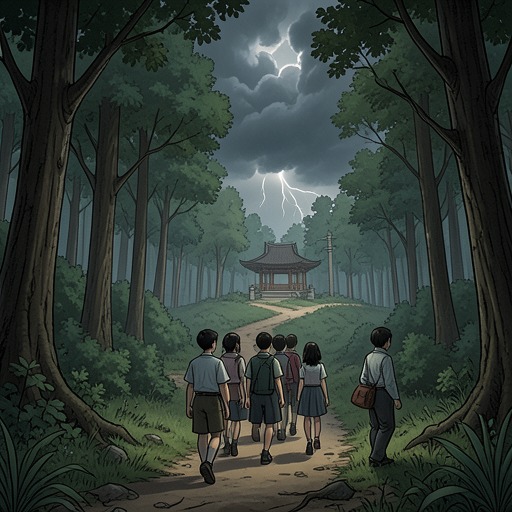
In 1998, the plan is for the entire class to ascend Yomiyama again, accompanied by Tatsuji Chibiki, who intends to help ensure that everything goes well. The proposed outing repeats the earlier movement from the school and Sakitani Memorial Hall toward the shrine. Its purpose is likewise defensive: the students and adults seek a way to interrupt the cycle of deaths, even though the earlier attempt has already demonstrated the limits of ritual confidence.
The threat of rain becomes significant because bad weather may cancel the ascent. Tatsuji Chibiki explicitly warns the group to be careful about accidents on the return and discusses the possibility that the outing will be called off if the weather deteriorates. His practical language places ordinary safety measures beside the supernatural crisis, showing how the mountain’s danger is understood simultaneously as a physical hazard and as the terrain of the Yomiyama phenomenon.
Yomiyama Mountain thus organizes the novel’s movement between memory and present action. It is the source of the town’s name, the setting of a shrine imagined as a boundary between worlds, the destination of a failed attempt to cleanse the curse, and the point toward which the 1998 class again turns when institutional strategies prove inadequate. The mountain does not simply contain the story’s supernatural explanations; it gives those explanations a shared physical location, allowing historical rumor, collective ritual, and present fear to gather around the same slope.