Yomiyama North Middle School
AnotherYomiyama North Middle School is not merely the backdrop for the 1998 third-year Class 3 crisis. It is the institution in which the Yomiyama phenomenon is repeated, concealed, studied, and temporarily managed. Ordinary school spaces become instruments of exclusion and surveillance: classrooms can deny a person’s existence, the Secondary Library preserves decades of records, and abandoned rooms preserve the physical traces of earlier classes. The school’s authority therefore appears in two forms at once—public normality and a private system of emergency measures built around death.
Institutional Setting
Yomiyama North Middle School stands at the center of the town’s recurring history of third-year Class 3 disasters. Detective Oba hears the phenomenon described as the “curse of third-year Class 3,” with irregular “cursed years” in which someone connected to the class dies every month. The rumor is not supported merely by superstition: investigation reveals earlier years in which many students and people connected with the school actually died. The school is consequently both the location where the phenomenon is experienced and the institution most invested in keeping its existence from becoming public knowledge.
The school’s response is shaped by concealment rather than open acknowledgment. The principal in the late 1970s insisted that talk of a curse not become public, while allowing Tatsuji Chibiki to remain at the school as librarian after he stopped teaching. This arrangement gave the school a quiet observer who could monitor each year’s phenomenon from outside the affected class. The school thus preserves an appearance of ordinary education while permitting a parallel, unofficial history to survive in records and private testimony.
Spaces of Exclusion and Refuge
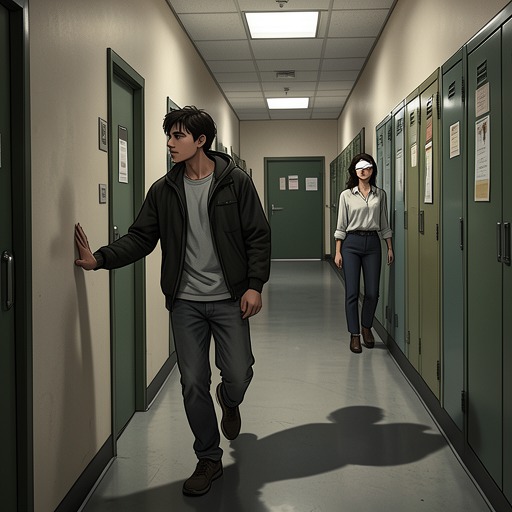
The school’s physical layout produces distinct zones of belonging and exclusion. During June, every student and teacher treats Koichi Sakakibara and Mei Misaki as if they do not exist, while the two of them respond by treating everyone else the same way. The classroom becomes an artificially divided social space in which recognition itself is suspended. This “not there” tactic is not simply a private insult; it is a schoolwide emergency practice intended to compensate for the extra person hidden within the class.
The Secondary Library offers a contrasting space. It is removed from the immediate classroom hierarchy, and no one else is present when Koichi Sakakibara and Mei Misaki arrive there for lunch. Tatsuji Chibiki can interact with them normally because he has no direct link to third-year Class 3 and is therefore considered safe. His position outside the class allows the library to function as a zone where suppressed information can be spoken, even though the institution itself has kept that information unofficial. Mei Misaki’s reading of The Lonely Crowd in the empty library reinforces the room’s association with isolation, observation, and life apart from the group.
The art club room provides another temporary refuge. Located at the western end of the first floor of Building Zero, it occupies half of what was once a regular classroom; the adjacent room bears a placard identifying it as the Local Historical Society. Because Yuya Mochizuki belongs to the art club, the room can be opened for private meetings without immediately attracting suspicion. It becomes the starting point for the students’ secret investigation, showing how an ordinary institutional room can be repurposed as a clandestine headquarters.
Records, Memory, and the Old Classroom
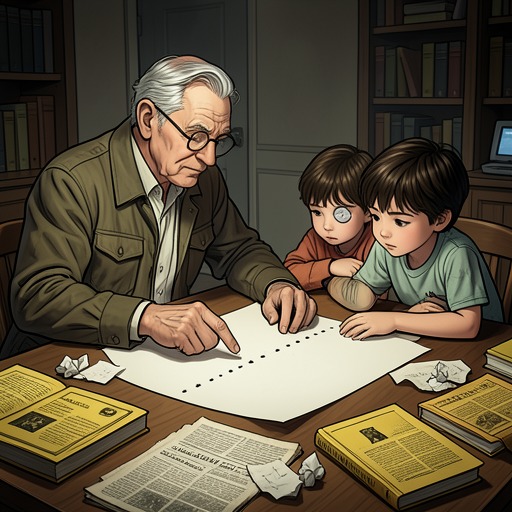
The Secondary Library also contains the school’s most important documentary counterweight to supernatural confusion. Tatsuji Chibiki keeps copies of the third-year Class 3 class lists for twenty-seven years, from 1972 through 1998, arranged with the newest lists on top. The binder records the names of teachers and students, but its apparent stability is threatened by the phenomenon’s alteration of memories and records. When the extra person, or casualty, is present, details that should be impossible are made to seem ordinary, and no one recognizes the casualty’s true identity. Tatsuji Chibiki confirms that this tampering genuinely occurs.
The school’s attempts to control the phenomenon repeatedly demonstrate the limits of institutional language. One earlier countermeasure changed class designations from numerical labels to letters, turning third-year Class 3 into third-year Class C in the hope that changing the name of the “site” would break the curse. It failed. The eventual tactic was instead social: designate someone as “not there” in place of the extra person. In 1998, increasing the number of ignored students to two proves ineffective, and after Mr. Kubodera’s death the class gradually stops ignoring Mei Misaki and Koichi Sakakibara. The school’s policy is therefore shown to be both rigid and improvised, dependent on collective behavior that can change without any explicit decision.
The former third-year Class 3 classroom is another material record of this history. It lies on the second floor of an unused part of Building Zero, the third room from the western end. The corridor is bright with daylight but marked by years of grime, damage, dust, and stagnant odor. The room’s abandonment makes the school’s past physically palpable, while its location matters because students previously retrieved a desk and chair from it for the person designated as “not there.” The old classroom is consequently both a forgotten institutional space and a source of objects used to reproduce the current class’s emergency arrangement.
Disasters Within the School’s History
The school’s history is defined by attempts to distinguish ordinary years from years affected by the phenomenon. Off-campus trips had once been considered safe because leaving Yomiyama placed the students outside the phenomenon’s geographic range. That assumption failed in 1987, when third-year Class 3 students were being taken by bus to the airport for a class trip. On the highway at the edge of town, a truck whose driver had fallen asleep at the wheel struck their bus. The accident extended the school’s disaster history beyond its grounds and exposed the instability of the supposed geographic protection.
The school also contains scenes in which institutional routine collapses into sudden violence. During Mr. Kubodera’s classroom suicide, the teacher’s speech disintegrates into unintelligible sounds before he withdraws a sharp-bladed object from a bag on his desk. The classroom, normally governed by lessons and supervision, becomes the site of an irreversible breach in adult authority. After his death, the previous attempt to treat both Mei Misaki and Koichi Sakakibara as nonexistent loses its purpose, and the class’s behavior begins to change.
The Sakitani Memorial Hall, a Western-style building in a forest at the foot of the mountain, is also tied to the school’s institutional network. It was built by an alumnus and local celebrity for his company and donated to the school decades later. Although the school has no clear use for it, its ownership places the neglected building within the school’s wider geography. Its uncertain status—school property without a settled function—helps make it another peripheral space where ordinary supervision is weak and the veneer of peace can fail.
Administrative Knowledge and Narrative Significance
Yomiyama North Middle School repeatedly converts people and places into administrative categories: safe outsiders, students who are “not there,” an extra person, a casualty, an on year, or an off year. These classifications are meant to make an incomprehensible phenomenon manageable, but they also suspend normal recognition and responsibility. Even Reiko Mikami, who is Koichi Sakakibara’s aunt and lives with him, must be treated at school as a separate person from the relative known at home. The school’s rules therefore reach beyond its buildings into family relationships and everyday speech.
The institution’s power depends on collective participation. Teachers and students enforce the June strategy, class members retrieve furniture from an old classroom, and Tatsuji Chibiki preserves records while remaining formally outside the class’s danger. Yet the school never achieves full control. A renamed class does not stop the phenomenon, memory and documentation can be altered, and deaths expose the inadequacy of each new countermeasure. The school is therefore significant as a machine for producing normality under impossible conditions: its bells, classrooms, lists, clubs, libraries, and official roles continue to operate, but each ordinary structure is repeatedly bent toward the management of death.