Yumigaoka Municipal Hospital
AnotherYumigaoka Municipal Hospital is the principal medical space linking the novel’s ordinary emergencies to its deeper pattern of death and remembrance. It is where Misaki Fujioka dies, where Koichi Sakakibara first encounters Mei Misaki, where Detective Oba begins to connect recent fatalities, and where Koichi returns after another collapse of his lung. The hospital therefore functions not merely as a place of treatment, but as a threshold at which illness becomes family history, memory becomes evidence, and apparently separate deaths begin to acquire a common significance.
Medical Setting and Narrative Geography
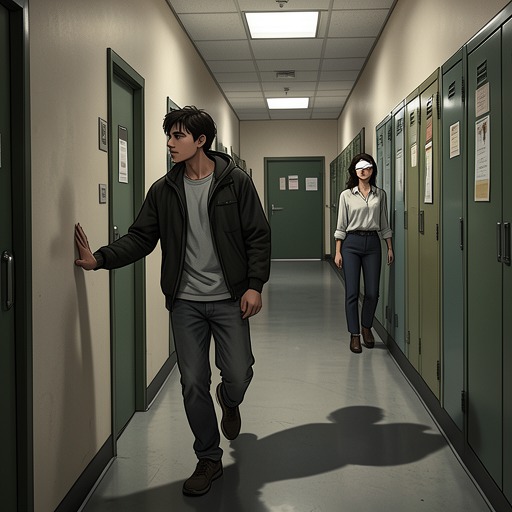
Yumigaoka Municipal Hospital is located in Yumigaoka and includes the inpatient ward where Koichi Sakakibara receives treatment. Its physical presence is established through repeated movement: Koichi remembers getting off the elevator at the second basement level, while later recollections place his first meeting with Mei Misaki in the elevator of that same ward. The hospital is consequently both a concrete institution and a point of orientation in the story’s geography, tying Koichi’s personal illness to Mei’s family history and to the wider investigation into the Class 3 deaths.
The hospital also stands in contrast to the other dangerous or secret spaces around Yomiyama. School rooms, abandoned classrooms, the basement display room at Blue Eyes Empty to All, in the Twilight of Yomi, and the Sakitani Memorial Hall are marked by concealment, ritual, or menace. The hospital appears to promise diagnosis and orderly care, yet its corridors preserve unanswered questions. What should be a place where causes are clarified instead becomes the setting in which the central mystery first takes visible form.
Misaki Fujioka and Mei Misaki
Misaki Fujioka’s death at Yumigaoka Municipal Hospital is the hospital’s decisive event in the plot. Misaki had suffered a serious kidney illness and faced lifelong dialysis unless she received a transplant. Her mother, Mitsuyo Fujioka, donated one kidney and Misaki was admitted to a large hospital in Tokyo for the operation; Mei Misaki had wanted to donate her own kidney, since the two were fraternal twins and were physically similar in size, but doctors considered transplanting an adult kidney into a child especially difficult because of the difference in size. Misaki’s condition then suddenly worsened, and she died before anything could be done. The date of death was April 27, a Monday.
That death explains why the hospital matters so intensely to Mei. Koichi first sees her there, and the image of her stepping from the elevator returns to him with unusual immediacy. Mei later explains that she had been thinking about Koichi ever since she first saw him get off the elevator at the second basement level. The hospital thus contains the beginning of their relationship as well as the absence that defines it: Koichi meets Mei at the site where her cousin’s life has ended, before he understands either the relationship or the grief surrounding it.
Koichi Sakakibara’s Treatment
The hospital is also the place to which Koichi returns after his own body fails. During June, he visits the municipal hospital to obtain a prognosis for his collapsed lung, and afterward goes to Blue Eyes Empty to All, in the Twilight of Yomi. On a later occasion, after suffering another spontaneous pneumothorax and a collapse more severe than his previous two experiences, he is taken back to the familiar ward at Yumigaoka Municipal Hospital. He has little memory of what happened immediately after the collapse or how he was rescued, emphasizing the gap between bodily crisis and conscious recollection.
Koichi’s grandmother comes to his bedside. After discussions with the head physician, surgery is recommended to prevent further recurrences, and Koichi’s father in India is contacted for permission. Two days later Koichi undergoes thoracoscopic surgery, in which approximately one-centimeter incisions allow an endoscope and other instruments to be inserted without the burden of open-chest surgery. The hospital therefore provides a genuine counterpoint to the supernatural deaths elsewhere in the narrative: medical knowledge can treat Koichi’s recurring physical danger, even though it cannot explain the larger pattern that surrounds the patients, relatives, and deaths connected to the institution.
Illness, Death, and Investigation
The hospital’s significance expands beyond the Misaki family and Koichi’s treatment. Detective Oba names the accidental death of Sanae Mizuno and the accidental death of Yukari Sakuragi, together with Yukari’s mother’s death in a car accident on the same day, while speaking with Koichi. These references place the municipal hospital within the chain of recent deaths that troubles the detective, even when the deaths themselves do not all occur there. Oba’s concern is personal as well as professional: his daughter might eventually attend North Yomi and could one day enter Third-Year Class 3. The hospital is thus part of the institutional network through which the community encounters, records, and tries to interpret the deaths.
Medical language repeatedly offers a partial vocabulary for the novel’s terror. Doctors examine Mei and find nothing abnormal when she reports sensing a strange color, and she gradually learns to interpret that color as a sign that death is present. Her account joins clinical examination to an experience medicine cannot validate. Likewise, Kazami identifies Wakui’s asthma during an emergency, pointing out the portable inhaler in Wakui’s hand while Mr. Chibiki tries to help him breathe. These episodes distinguish treatable bodily crises from the symbolic or supernatural meaning attached to death. The hospital can diagnose a collapsed lung, manage a transplant-related illness, or recognize asthma; it cannot settle what death means when the same color, memory, and pattern recur across apparently unrelated cases.
Narrative Significance
Yumigaoka Municipal Hospital is a threshold between separate systems of explanation. It is a place of surgeons, physicians, diagnoses, inhalers, and family consent, but it is also where the novel’s concealed relationships become legible. Misaki Fujioka’s death gives Mei’s presence its emotional origin. Koichi’s first sight of Mei there initiates a connection he does not yet understand. His later return after surgery shows the persistence of ordinary bodily vulnerability, while the hospital’s association with the deaths of classmates and relatives allows personal grief to widen into the mystery of the Yomiyama phenomenon.
The hospital’s recurring role is therefore one of convergence. Its patients arrive with individual conditions, yet their stories do not remain medically isolated: kidney disease leads to Misaki’s death, that death shapes Mei’s identity and perception, Koichi’s lung disorder brings him back into the same ward, and the investigation gathers separate fatalities into a disturbing sequence. The building’s apparent promise of rational order makes the unresolved elements more powerful. At Yumigaoka Municipal Hospital, the body can be examined and operated on, but the story’s most important question remains beyond diagnosis: how should the living respond when death continues to return through memory, resemblance, and place?