Sakitani Memorial Hall
AnotherSakitani Memorial Hall is the school-owned overnight facility at the foot of Yomiyama, a place where the 1998 Third-Year Class 3 camping trip transforms a supposedly protective school activity into a concentrated ordeal of fear, violence, and death. The building gathers together the class’s hopes of breaking the curse, its improvised rituals, its attempts to maintain ordinary social order, and the final revelation that six people died there before dawn on August 9, 1998.
History and Physical Setting
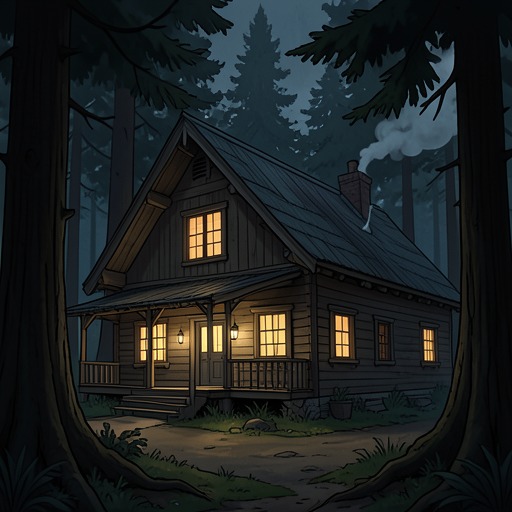
Sakitani Memorial Hall stood in a forest at the foot of Yomiyama. Rather than resembling a rustic mountain hut, it was a Western-style building with a slightly classical air. The school had received it decades earlier from Sakitani, a North Yomi alumnus and local celebrity who had originally built it as a facility for his company. Although the school had continued to maintain and occasionally use the property, it no longer knew what to do with it, and the building had acquired an uncertain status between institutional property and neglected remnant.
The facility was associated with the mountain and with the shrine above it. The school’s camping trips used the lodge as an overnight base, while Yomiyama Shrine stood partway up the slope. According to Tatsuji Chibiki, the 1983 class had also stayed at the facility and visited the shrine. The connection acquired a darker resonance because the surname of the boy Misaki who died twenty-six years earlier was Yomiyama, while local traditions linked the mountain’s name to Yomi, the land of the dead. Some oral accounts even described the shrine as a linchpin separating the living world from the next.
The 1998 Camping Trip
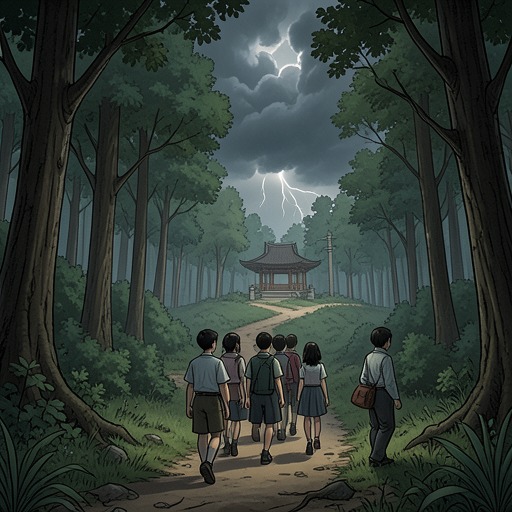
The 1998 Third-Year Class 3 camping trip lasted two nights and three days, beginning on August 8, 1998. The head teacher, Mr. Koga, proposed both the trip and the visit to Yomiyama Shrine. The plan was presented as a possible means of securing the class’s safety, and after Atsushi Ogura died despite shutting himself away at home, students who had previously refused to participate changed their minds. A rumor promised that those who went on the camping trip would be saved, causing the final number of participants to rise sharply after the deadline.
Fourteen students ultimately went: nine boys and five girls. With Reiko Mikami as chaperone, fifteen people were to spend the two nights and three days at Sakitani Memorial Hall. On arrival, the group was told that it would climb Yomiyama the next day to visit the shrine and pray for the class. The reaction was mixed, however, and even before the disaster unfolded, the proposed ritual seemed to lack firm conviction among several participants, including Naoya Teshigawara and Yuya Mochizuki.
The shrine visit was treated as an act of collective repair. The shrine was so run-down that the students helped clean it, persuading themselves that this labor might break the curse. Mr. Koga expressed confidence that everything would now be all right. The confidence proved false: the curse did not yield to the cleaning, and the ritual’s failure exposed how little control the participants actually possessed over the danger surrounding them.
A Temporary Social Space
At Sakitani Memorial Hall, the students attempted to create a temporary community through ordinary routines and planned activities. The lodge’s entrance became the setting for a group photograph. Everyone lined up before the gate, centered on a bronze plaque mounted on a blackened stone gatepost bearing the name “Sakitani Memorial Hall.” Yuya Mochizuki directed the arrangement, asking Koichi Sakakibara and Mei Misaki to move closer and telling Reiko Mikami to join the shot. The shutter click preserved an image of togetherness just as the group’s confidence was beginning to fracture.
The lodge’s communal structure also made the students vulnerable. When Tatsuji Chibiki announced that everyone would ascend Yomiyama the next day, he said he would accompany them and help ensure that the plan went well. He also warned them to be careful of accidents on the return journey. Yet deteriorating weather threatened to cancel the outing, and Reiko Mikami could offer only an uneasy assurance that the decision would depend on conditions the next day. The promised ritual therefore remained suspended between institutional planning and forces beyond anyone’s command.
The building’s rooms became charged with the class’s attempts to preserve or evade normality. In the rain, Koichi Sakakibara and Mei Misaki, both treated as “not there,” avoided eating in the classroom with everyone else and went elsewhere after fourth period. The art club room in Building Zero and the empty Secondary Library offered alternative spaces, but Sakitani Memorial Hall ultimately became the place where separation from ordinary school life was no longer protective. Its isolation made it possible for fear, secrecy, and violence to develop away from the school’s normal supervision.
Violence and Destruction
The disaster at the lodge was not a single accidental catastrophe. In the days afterward, firefighters found that Sakitani Memorial Hall had been almost entirely destroyed before dawn on August 9, 1998, and that six bodies lay at the scene. The autopsies established that none of the victims had died because of the fire itself. The caretaker Kensaku Numata had been stabbed in the neck with numerous metal cooking skewers and was burned afterward. Four students—Manabu Maejima, Yonemura, Sugiura, and Nakao—died from blood loss after being stabbed and cut repeatedly with a sharp blade. Izumi Akazawa died from the spinal fracture caused by her fall from the second-floor balcony.
The fire was therefore an act of concealment and destruction following the killings. Evidence and witness testimony established that Mieko Numata, Kensaku Numata’s wife and co-manager of the hall, had caused the deaths. She was believed to have scattered kerosene through the kitchen and started the fire after killing Kensaku. Tatsuji Chibiki restrained her, but before she could be handed over to the police, she died by biting through her own tongue in an apparent suicide. The motive for her string of crimes remained unclear, leaving the lodge with an unanswered human mystery alongside the larger supernatural one.
The violence was foreshadowed by the atmosphere inside the building. After Naoya Teshigawara reported that Tomohiko Kazami had been acting strangely and might have murdered Kazami, Koichi Sakakibara entered the dark dining hall after noticing a door standing open by only a few centimeters. He encountered blood and then a hand gripping his ankle. When he opened another door, he discovered that the strange sound and smell came from a fire: flames filled the room, while intense heat and smoke forced him to retreat. Elsewhere, before the lodge’s final destruction, Mr. Kubodera’s classroom suicide had already shown how quickly an apparently controlled school setting could become a site of inexplicable violence; at Sakitani Memorial Hall, that instability became organized murder.
Narrative Significance
Sakitani Memorial Hall functions as both threshold and trap. Its position at the foot of Yomiyama places it between the ordinary school world and the shrine associated with the dead, while its use as an overnight facility physically separates the students from everyday safeguards. The planned movement from school to lodge to mountain shrine resembles a protective communal ritual: departure, seclusion, ascent, purification, and hoped-for return. Yet the ritual never produces security. Cleaning the shrine fails, the weather threatens the ascent, the group photograph becomes a fragile record rather than a guarantee, and the lodge’s temporary community collapses into suspicion and bloodshed.
The building also embodies the instability of preserved history. It was donated as a useful institutional facility, retained without a clear purpose, and gradually became dilapidated. Its name, attached to a bronze plaque at the entrance, gives the place an official identity, but the massacre reveals how little an institution’s name can contain. Sakitani Memorial Hall is at once a school property, a site of inherited rumor, a ritual destination, a communal refuge, and a crime scene. Its destruction turns that layered history into a ruin, making the lodge the clearest physical expression of the 1998 Third-Year Class 3 disaster: an attempt to construct safety in a haunted social space that instead concentrates the forces of memory, exclusion, and violence.