Yomiyama Shrine
AnotherYomiyama Shrine is an old shrine on the slope of Yomiyama, above the Sakitani Memorial Hall at the mountain’s foot. Within the story, it is more than a neglected religious site: its name and legends make it a suspected “linchpin” between the living world and the land of the dead, so the school turns it into the destination of a desperate attempt to break the Yomiyama phenomenon. The shrine’s physical abandonment and its imagined sacred function stand in stark tension, making it the setting where collective belief is briefly organized against an apparently repeating disaster.
Location and Physical Setting
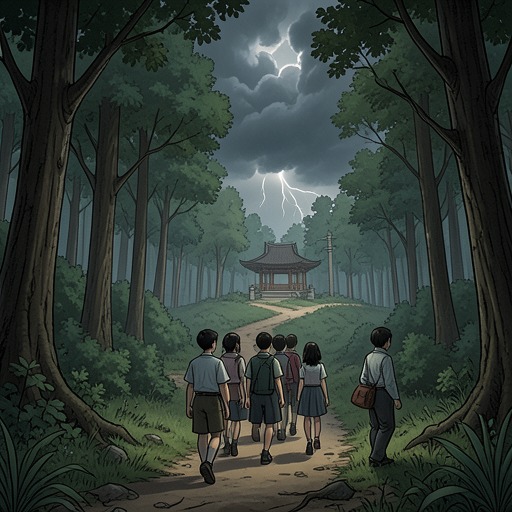
Yomiyama Shrine stands partway up Yomiyama, while the Sakitani Memorial Hall lies below it at the mountain’s foot. The hall is the school’s former overnight facility, still maintained for occasional club camping trips, and it serves as the base for the later third-year Class 3 excursion. The route from the lodge to the shrine therefore creates a literal ascent from an institutional building into an older, more isolated space associated with the mountain’s history.
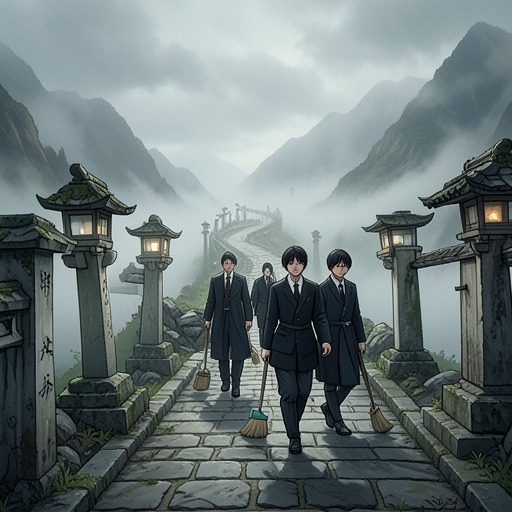
The shrine itself is described as unbelievably run-down. Although it shares its name with the town, it appears scarcely maintained, as if it had been forsaken by the rest of the world. The students do not encounter a visibly powerful or carefully protected sacred monument. Instead, they find a neglected place whose decay seems to intensify the legends attached to it. Its condition also makes the later cleaning effort concrete: the students do not merely pray at the shrine, but physically work to restore some order to it.
Legends and Sacred Boundary
The shrine’s significance is tied first to the name Yomiyama. Mr. Chibiki explains that the mountain has long been associated with “Yomi,” the land of the dead, while Yomiyama was also the family name of the boy Misaki who died twenty-six years earlier. These overlapping associations allow the shrine to be read as a threshold between ordinary life and death rather than simply as a local place of worship.
Oral traditions describe the shrine as a “linchpin” separating this world from the next. The claim is not presented as established fact; it is one of several explanations people have offered for the disasters. Nevertheless, it gives the site an unusually precise role in the community’s imagination. If the disasters arise from a breach between the dead and the living, then the shrine appears to offer a place where that breach might be closed. Its supposed power comes from its position between worlds, while its neglected state mirrors the instability that the characters are trying to contain.
The 1983 Camping Ritual
The shrine becomes central to the account of the earlier third-year Class 3 camping trip. The class stayed for two nights and three days beginning on August 8 at the Sakitani Memorial Hall, with twenty students participating. The head teacher, Mr. Koga, proposed the trip and urged the class to visit Yomiyama Shrine because he believed that going there would break the curse. He had reportedly thought deeply about the problem and consulted a medium, although the exact source of his advice remains uncertain.
On the second day, August 9, Mr. Koga led the students up the mountain. The group did not initially possess complete faith that the visit would accomplish anything, but the shrine’s condition changed the character of the gathering. While there, all of the students helped clean the neglected grounds. The shared labor transformed skepticism into temporary conviction: the students became persuaded that their action might genuinely break the curse, and Mr. Koga assured them that everything would now be all right.
That confidence proved false. The cleaning did not stop the disasters, and the account insists that the curse was not weak enough to be broken by such a simple act. The shrine thus becomes the site of a failed rite. It can gather the class into a temporary community, give fear a visible object, and produce a momentary veneer of peace, but it cannot guarantee reintegration into ordinary life. The failure is especially important because the ritual is not wholly empty: it creates real solidarity and hope, yet those human effects cannot overcome the phenomenon the characters fear.
Return to the Shrine and Narrative Significance
In the 1998 crisis, the plan is again for everyone to ascend Yomiyama, with Mr. Chibiki accompanying the group and helping to ensure that the outing proceeds safely. The proposed ascent repeats the earlier pattern of collective movement toward the shrine, but the adults now emphasize caution and the possibility of accidents on the return. Rain threatens to cancel the outing, showing that the ritual depends not only on belief but also on weather, institutional decisions, and the physical hazards of the mountain.
Yomiyama Shrine therefore links repeated attempts to manage the same disaster across different years. The school’s response converts an inexplicable pattern into a scheduled communal activity: travel to the mountain, visit the shrine, and perform an act intended to restore balance. Yet the shrine’s neglected appearance and the earlier failure of the cleaning ritual undermine the promise of control. It remains a powerful narrative threshold precisely because it cannot settle whether the danger is supernatural, historical, or produced by the community’s interpretation of death.
As a setting, the shrine condenses the story’s central opposition between the living and the dead, the maintained and the abandoned, and rational administration and ritual hope. Its climb, its isolation, and its connection with Yomi make it a symbolic border, while the students’ practical labor prevents that symbolism from becoming purely abstract. The shrine is both a real place that requires cleaning and an imagined mechanism for closing the boundary between worlds. That double status explains why characters return to it even after the first ritual has failed: it offers the form of an answer when no reliable answer is available.