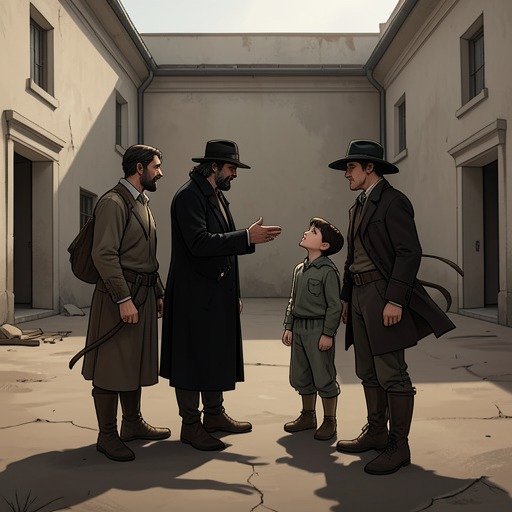
Battle of Thebes between Eteocles and Polynices
AntigoneThe Battle of Thebes between Eteocles and Polynices is the brothers’ fatal conflict over the rule of Thebes: after Eteocles refuses to yield the throne at the end of his year, the brothers fight outside the city and kill each other. Their deaths save neither the family nor the city from conflict; instead, they leave Creon in power and set the play’s central struggle over political authority and the duty to bury the dead in motion.
Causes and Background
Eteocles and Polynices are the sons of Oedipus, and their agreement is that they will rule Thebes in turn, one year at a time. At the end of the first year, Eteocles refuses to hand over the throne to his brother. The battle follows from that broken arrangement: what was meant to divide rule between them becomes a contest that ends with both brothers dead.
Polynices has won seven foreign princes to his cause. They are defeated before the seven gates of Thebes, so the attack fails to take the city even as the brothers’ own fight destroys both claimants. The account presents the outcome in two linked terms: the city has been saved, but its ruling family has lost both sons of Oedipus.
The Battle and Its Outcome
The brothers fight outside the walls of Thebes and kill one another. The text gives no extended account of the combat itself; its emphasis is on the decisive result. Eteocles’s refusal to yield has turned a succession agreement into fratricidal conflict, and neither brother survives to rule.
The Chorus’s opening account places the battle at the beginning of the story being told. It is the event from which the play’s present crisis proceeds: the brothers are dead, the city has survived the assault, and Creon must establish authority in their wake.
Political Aftermath
Creon, now king, assigns opposite public meanings to the dead brothers. He orders a grand funeral for Eteocles, presented as the good brother, while Polynices is designated a villain and traitor and denied mourning and burial. The burial prohibition makes the aftermath of the battle more than a question of succession: it turns the treatment of a dead family member into a test of obedience to the new ruler.
Creon later explains that Polynices joined the Argive army after Oedipus refused to punish him for an earlier fight. He says that attacks and attempts against Oedipus followed, and that captured assassins admitted they had been paid by Polynices and others. Creon also describes Eteocles’s funeral as a public performance of civic unity: the city attends, schoolchildren contribute money for wreaths, and priests, music, military honors, and a royal speech make the dead brother a hero and saint of Thebes. Creon says that he could not afford to leave a villain in both camps. His account complicates the simple contrast between good brother and traitor while showing how the battle’s legacy is shaped by political necessity and public ceremony.
Significance in the Play
The battle creates the conditions for the conflict between Creon’s political order and Antigone’s obligation to her brother. Antigone treats the roles as already set: Creon must put her to death, and she must bury their brother. She also says that, whatever she cannot change, she can at least do what she can. The battle’s consequence is therefore not only the brothers’ deaths but the choice it leaves to the living.
Creon’s image of the state as a ship taking on water explains why he insists that someone must say yes, take the wheel, and issue orders in a crisis. Antigone rejects the premise that political necessity can settle what she owes her brother; she insists on her freedom to say no, even when Creon’s crown and guards give him the power to put her to death. The brothers’ contest over who will rule thus reverberates through a second conflict: one asks who can command the city, while the other asks whether that command can override the duty to bury the dead.