Antigone’s second burial attempt and arrest
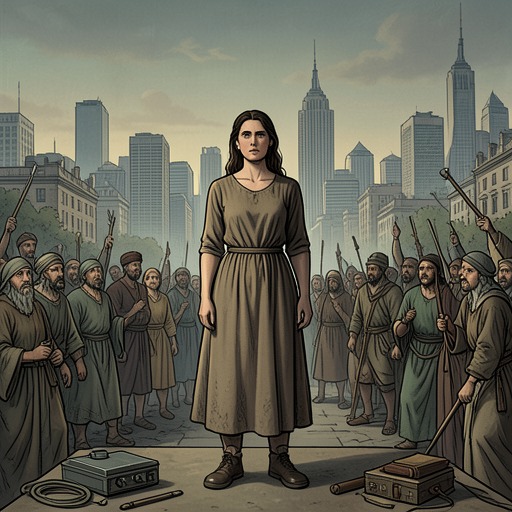
AntigoneAntigone’s second burial attempt and arrest is the moment when her defiance of Creon’s prohibition becomes impossible to dismiss as intention alone: she is caught digging earth over Polynices’ exposed body with her hands, in broad daylight, and is brought before the king. The arrest turns a private act of kinship into a direct political confrontation, while the circumstances of her capture show that she does not stop even when the guards see her and run toward her.
Causes and Stakes
Creon confronts Antigone with the rule she has violated: he had forbidden anyone to approach Polynices’ body, and he asks what she was doing near it. The Guard answers for her, reporting that she was trying to cover the corpse again. The word “again” places the arrest in a sequence of continued resistance: the effort to enforce the prohibition has not ended Antigone’s effort to bury her brother.
The stakes are not simply a dispute over whether the body should be covered. Antigone describes the opposing actions as roles already assigned: Creon has to put them to death, and they have to bury their brother. She does not present the conflict as one that can be settled by a practical adjustment. Her own account makes burial a duty she must fulfill, while Creon’s order makes her action punishable.
The Capture
The Guard’s account gives the capture a precise, physical setting. After uncovering the body, the guards pass the watch to the relief and keep watch nearby. As the sun grows hotter, the corpse begins to smell; the men retreat to a little hill for a breeze, telling themselves that daylight makes it safe. They nevertheless decide that one of them must always watch the body.
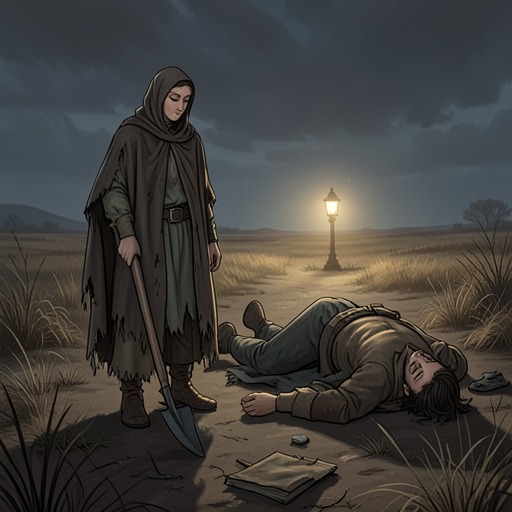
By noon, the wind has died, the smell has worsened, and the heat overwhelms the Guard. He describes his vision wavering and his eyes straining to stay open. He turns briefly to a fellow guard for a chew to clear his head. When he looks back, Antigone is digging with her hands. The lapse is momentary, but it is enough: she has returned to the body and begun covering it again.
The Guard emphasizes that Antigone makes no attempt to flee or stop when he runs at her. She continues digging as fast as she can, as though she does not see him. When he seizes her, she fights and tries to keep digging, shouting that the body is not yet completely covered. Her arrest thus happens in the middle of the task, before she has finished it; her attention remains fixed on completing the burial even as the guards take hold of her.
Aftermath and Meaning
The guards uncover the body once more, hand over the watch to the relief without saying anything, and bring Antigone to Creon. The sequence leaves the burial incomplete again, and replaces Antigone’s solitary action at the corpse with an official confrontation before the ruler whose ban she has defied.
Antigone’s account of what she can do makes the limits of her action explicit: she knows it may amount to nothing beyond this, but insists that she must do what she can. Later, she rejects Creon’s political obligations and claims the choice to say no as her own; he, by contrast, can have her put to death because he has said yes. Their disagreement is therefore about more than the immediate fate of Polynices’ body: they assign different meanings to action, responsibility, and the price of refusing.
Creon answers with the image of a storm-struck ship that must be steered. He argues that someone has to say yes and take the wheel as crime, poverty, and misery threaten everyone aboard; in such a crisis, the ruler cannot pause to make fine distinctions before giving orders. Antigone’s arrest puts that defense into practice. The same act that she understands as the duty still available to her becomes, for Creon, a challenge to the authority needed to keep the ship from sinking.
The burial attempt also anticipates the later argument over happiness and compromise. Antigone refuses a modest share of life in exchange for accepting terms she rejects, insisting that she wants everything whole or nothing. Her capture does not resolve the conflict; it carries it from the guarded body into a face-to-face struggle between her refusal and Creon’s claim that political survival requires someone to say yes.