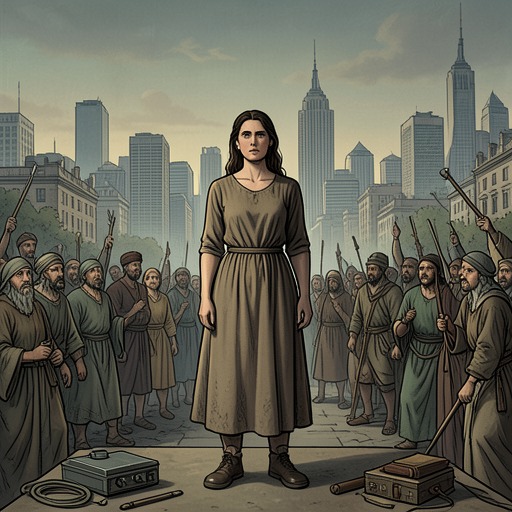
Creon’s efforts to save Antigone
AntigoneCreon’s efforts to save Antigone are a desperate attempt to keep her alive by hiding her attempted burial of Polynices and securing her silence. The plan offers a narrow reprieve, not a reconciliation: Antigone will not accept safety on terms that require her to abandon her brother, and Creon cannot make his political case meet the moral standard she has chosen. The rescue fails because each treats the other’s proposed way out as an intolerable surrender.
A reprieve built on concealment
Creon gives Antigone specific instructions for escaping immediate discovery: she is to go to her room, go to bed, claim that she is sick, and say she has not been out since the previous day. Her Nurse is to repeat the same account. Creon adds that he will make the three men who know about the incident disappear. His offer rests on controlling who knows what happened and giving Antigone a plausible absence, not on withdrawing the decree or publicly defending her act.
Antigone immediately identifies the weakness in the plan. She asks why she should follow it when Creon knows perfectly well that she will simply go out again. The pause after her answer leaves the conflict in view: Creon’s arrangements may conceal the attempt once, but they cannot change her intention. His rescue can work only if she cooperates in pretending that the matter is over.
The approaching deadline
Creon explains that the chance to save her is exceptionally fragile. If anyone beyond the three men discovers what she tried to do, he will be forced to have her put to death; if she gives up what he calls her madness and stops speaking about it, he still has time to intervene, but that opportunity will disappear within five minutes. His warning frames silence as the condition of survival and makes the rescue a decision with an immediate deadline.
Antigone answers with the fact that defeats the offer: she has to go bury her brother because the guards have uncovered him. Creon points out that guards remain around Polynices’ body. Even if she manages to cover it again, they will uncover it, and the effort will only leave her fingernails bleeding and lead to her being dragged back. He describes the act as pointless because it cannot secure the body or prevent her arrest; she acknowledges that it may accomplish nothing beyond the gesture, but insists that it is at least something she can do. The rescue fails at the level of purpose: Creon measures the act by its likely result, while Antigone measures it by the obligation to act at all.
Refusal and political argument
The exchange belongs to the larger confrontation in which Antigone defines her resistance as a refusal to say yes. She dismisses Creon’s politics, obligations, and personal explanations as things she does not have to accept, and insists that the choice remains hers. In her account, Creon can have her put to death because he has said yes to the political order he serves; his power does not make her assent his to command. His practical offer of concealment therefore cannot resolve the deeper disagreement: remaining alive by silence would mean yielding the choice she claims as her own.
Creon answers not only as a ruler but as a man who believes that someone must take responsibility for keeping the state functioning. Shaking Antigone in desperation, he casts political duty as steering a ship taking on water from every side. Crime, poverty, and misery fill it; the wheel spins in the wind; the crew pillages the hold while officers build a raft with fresh water reserved for themselves. The mast cracks, the wind howls, and the sails tear. In such a crisis, he argues, a leader cannot pause over fine distinctions about saying yes or no: someone must seize the wheel, issue orders, and stop the first person who advances. The image explains why Creon sees compromise as necessary, but also shows its cost: in the storm, individuals lose their names, and only the ship and the storm remain.
The terms of the failed rescue
The contrast between them is not simply that one wants Antigone to live and the other accepts death. Creon tries to preserve her by making her action disappear; Antigone refuses because concealment would leave her brother uncovered and her purpose abandoned. Earlier, she had described the parts assigned to them in bluntly reciprocal terms: Creon has to put them to death, and they have to bury their brother. That fatal division of roles makes his offer intelligible as an attempt to interrupt the expected outcome, but it also reveals why she treats it as inadequate: it asks her to stop performing the duty she believes belongs to her.
As the confrontation continues, Antigone rejects the contented compromise represented by the life Creon would preserve. She compares people who seek small chances at happiness to dogs licking whatever they find, and declares that she wants everything, whole and complete, here and now—or nothing. Her change from formal address to familiar address marks her contempt in the exchange. The rescue consequently reaches beyond a hidden room and a temporary lie: Creon offers continued life within limits, while Antigone refuses a life purchased by accepting those limits. His attempt to save her makes their incompatible standards of an acceptable outcome unmistakable.