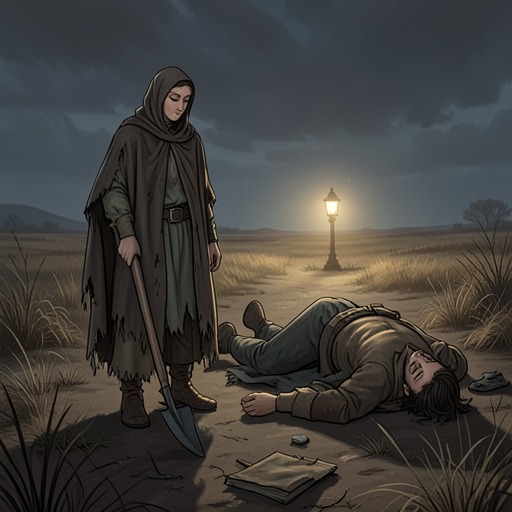
Antigone’s first burial of Polynices
AntigoneAntigone’s first burial of Polynices is the initial act of defiance that turns her obligation to her brother into an open conflict with Creon. She covers Polynices with a small iron shovel marked with his name, returns from the burial before Ismene sees her, and later admits to Creon that she was responsible. For Antigone, the burial is a limited but necessary thing she can do; for Creon, her refusal intensifies a conflict between private conscience and public order.
Background and First Return
Antigone tells Ismene that when Ismene saw her that morning, she had just come back. The exchange places the first burial before their conversation and establishes that Antigone has already acted before her sister can join or dissuade her. Antigone then leaves, with Ismene following, while the act itself remains something Antigone has completed and must later explain.
The burial is not only a declaration of principle but an intimate act of care for her brother. When Creon asks whether she was also responsible the previous night, Antigone confirms that she was. She describes carrying a little iron shovel the family used on vacation to make sandcastles at the beach. It belonged to Polynices, who had carved his name into its handle with a knife; Antigone says this is why she left it near him. The familiar tool brings a trace of their shared life into the burial, and its marked handle identifies the dead not as an enemy of the state but as her brother.
Confession and Stakes
Antigone does not deny what she did when Creon questions her. Her answer is direct: she buried Polynices the first time, using the shovel. The shovel was taken away, and when she attempted the burial again she had to use her hands. The first burial therefore precedes both the confiscation of the tool and the later, more physically exposed attempt; the two actions are linked, but Antigone distinguishes their circumstances.
Her explanation does not claim that the burial can undo the political conflict or secure a larger victory. She tells Creon that she knows it is no more than what she can do, but that at least she can do this, and must do what she can. The smallness of the act is central to its force: she accepts the limits of her power without treating those limits as a reason to abandon her brother.
Defiance and Competing Duties
Antigone frames the confrontation as a clash of assigned roles. Creon, she says, has to put them to death, while she and Ismene have to bury their brother; that is how the roles were cast. Her formulation makes the burial part of a larger, already unfolding tragedy, but it does not make her action passive. She has chosen to carry out the familial duty even while speaking as though the opposing roles have already set the outcome in motion.
When Creon invokes politics and obligation, Antigone rejects his assumption that she will care about them or accept his terms. She insists that she did not say yes, that she can still say no to what she dislikes, and that the choice is hers alone. She contrasts her refusal with Creon’s authority: his crown and guards allow him to have her put to death, but, in her account, that power follows from his own decision to say yes. The burial is thus not merely a concealed act of mourning; once acknowledged, it becomes the ground on which Antigone asserts her independence from the political order that condemns it.
Creon’s Counterargument and Significance
Creon answers with an image of a ship in crisis. Someone, he argues, has to say yes and steer: the vessel is taking on water, the crew is refusing to work and pillaging the hold, the officers are making a raft for themselves, and the mast and sails are failing. In this account, political rule requires action amid disorder, even when distinctions and individual names are lost in the emergency. His image gives the confrontation a scale beyond the burial itself, setting Antigone’s absolute refusal against his claim that governing demands compromised, collective choices.
Antigone’s later insistence that she wants everything, whole and complete, or nothing clarifies why compromise cannot resolve the conflict for her. The first burial is the action from which that refusal grows visible: a small tool, bearing Polynices’ carved name, becomes evidence of her decision to honor him despite the state’s opposing command. The act binds family memory, bodily effort, and political defiance together, while the questioning that follows turns a private burial into an irreversible public confrontation.