Eteocles’ state funeral
AntigoneEteocles’ state funeral is the public ceremony through which Creon makes one of the dead brothers a hero and leaves the other unburied. Its pageantry gives Thebes a usable story of loyalty and treason, but Creon’s private account to Antigone reveals that the distinction between the brothers was politically imposed, not morally secure.
Background and Political Purpose
After Eteocles and Polynices kill one another, Creon orders a grand funeral for Eteocles. The ceremony follows a period of attacks and attempted assassinations, which Creon says were financed by Polynices and others. He presents the funeral as a necessity of rule: he could not afford to leave Thebes with a villain on both sides. The burial therefore does more than honor a dead prince; it assigns public virtue to one brother and disgrace to the other.
Creon describes the funeral as taking place the day before his conversation with Antigone. He insists that the ceremony had to be done, even though what he knows about the brothers contradicts its official moral division. His choice converts the uncertain and violent history of the royal family into a civic judgment that the city can repeat.
The Ceremony and Its Public Audience
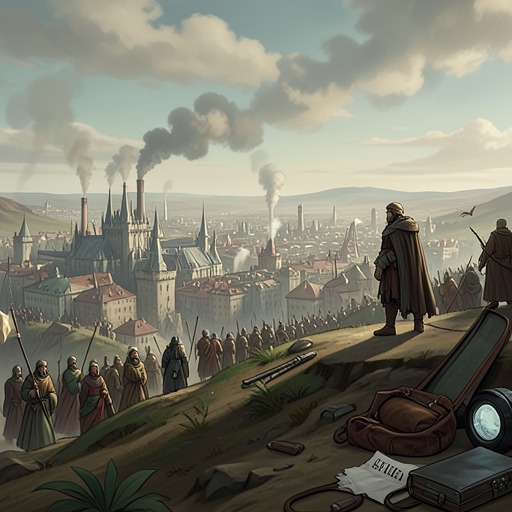
The entire city attends. Schoolchildren empty their piggy banks to buy wreaths, while old men, whom Creon says pretend to be moved, praise Eteocles as the good brother, Oedipus’s faithful son, and the loyal prince. Priests appear in their finest clothing, stirring music accompanies the rites, and military honors complete the spectacle. Creon gives a speech as part of the ceremony.
These details make the funeral a collective performance, not merely a private rite of mourning. Children’s savings, the priests’ finery, the music, and the soldiers’ honors all help establish Eteocles’s public identity as a hero and saint of Thebes. The ceremony’s unanimity depends on suppressing the darker account Creon later shares with Antigone.
The Hidden History of the Brothers
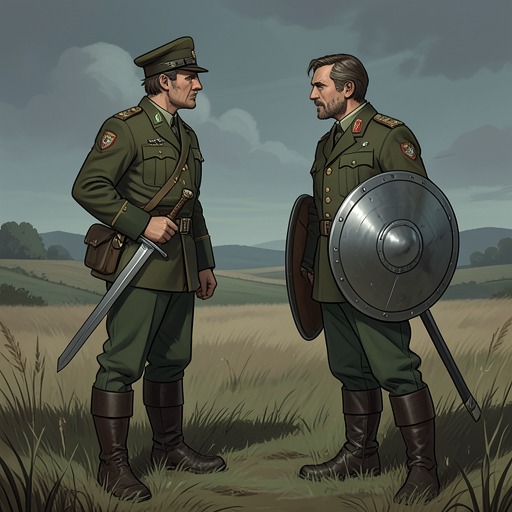
In confidence, Creon tells Antigone that Eteocles was no better than Polynices. He says Eteocles had also tried to arrange their father’s assassination and had decided to sell Thebes to the highest bidder. Creon claims to have proof that Eteocles was preparing the same treason for which Polynices’s body is left to rot in the sun; Polynices’s plan merely succeeded first.
Creon describes the brothers as petty thieves who lied to one another and to the city, then killed each other over the division of spoils. Their deaths do not provide a clean moral distinction between loyal defender and traitor. The funeral’s public praise thus sits beside Creon’s admission that the honored brother shared the condemned brother’s treachery.
Bodies, Burial, and the Official Story
Creon says the brothers were found in each other’s arms, impaled on one another’s swords and trampled by Argive cavalry until they were unrecognizable. He had both bodies located on the battlefield among the other dead, then ordered the less mangled body brought in for the national funeral. He did not know which brother it was, and says he did not care.
That uncertainty sharpens the ceremony’s political meaning: the public honors are attached to a body Creon cannot identify, while the other is left exposed. In his account, the funeral does not reliably honor Eteocles’s remains so much as furnish Thebes with a hero. Its solemn pageantry and its arbitrary treatment of the dead are two sides of the same decision.
Dramatic Significance
The funeral’s contradiction feeds the conflict between Creon and Antigone. Antigone says that each has a part to play: Creon must have them put to death, and she must bury her brother. She also insists that the choice to refuse remains hers, even as Creon claims that someone must say yes and steer the ship of the state through crime, poverty, and misery. Their exchange places political order and personal refusal in direct opposition.
Antigone’s insistence that she must do what she can gives burial the force of an action still available to her, while the funeral demonstrates how power can decide which dead person receives public rites. Creon’s revelation does not undo the ceremony; it exposes the gap between its polished story and the compromised choices that produced it. The state funeral consequently stands as both a civic ritual and evidence of the political construction of honor.