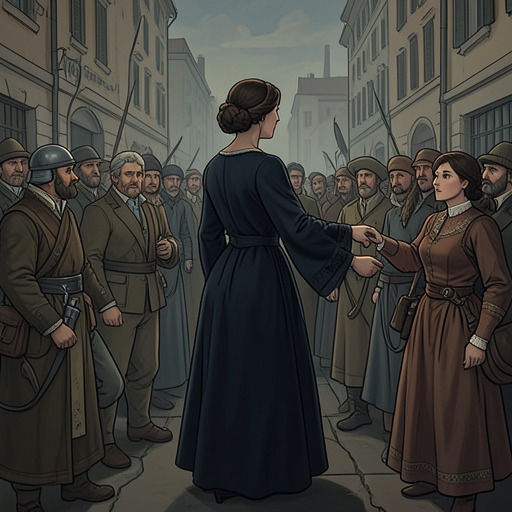
Ismene
AntigoneIsmene is Antigone’s sister, a radiant and sociable young woman whose ease with dancing, laughter, and the prospect of happiness contrasts with Antigone’s solitude and uncompromising defiance. She is also the woman Haemon dances with at a party before he unexpectedly asks Antigone to marry him, making her an early point of comparison in the sisters’ different relations to love, risk, and the life Antigone is about to leave behind.
Identity and Introduction
At the opening, Ismene is talking and laughing with Haemon, while Antigone sits apart, silent and absorbed in thought. The Chorus identifies the young man beside her as Haemon, Creon’s son and Antigone’s fiancé. To an onlooker, Ismene would seem the more obvious match for him: she is described as beautiful, blonde, and happy, and her taste for dancing and pleasure appears to align with his. Their easy companionship makes Antigone’s engagement seem unexpected.
The account of the engagement sharpens that contrast. At a party, Haemon dances only with Ismene, who shines in a new dress; afterward he finds Antigone daydreaming alone in a corner, her arms around her knees, and asks her to be his wife. Antigone accepts with a serious look and a small, sad smile. The narrator says that no one knew why Haemon chose her, and foreshadows that the marriage could never take place and that the honor of being her husband would bring him an early death.
Conflict with Antigone
When Antigone insists that they must bury their brother, Ismene’s response is grounded in the immediate threat: Creon will have them put to death. Her question, “Why not?”, challenges Antigone’s apparent acceptance of that consequence, but Antigone answers that the parts have already been assigned: Creon must sentence them, and they must bury their brother. The exchange establishes a fundamental difference in emphasis. Ismene sees the danger as a reason to hesitate; Antigone treats the act and its cost as inseparable.
Ismene enters again during the confrontation between Antigone and Creon, but the available evidence does not describe what she says or does at that point. Her return nonetheless places her once more beside the dispute at a moment when Antigone’s refusal has become explicit. Antigone declares that she has not said yes to Creon’s terms and that, even with his crown and guards, he can kill her only because she has refused consent. Ismene’s presence marks the continuing contrast between the sister who is drawn into danger and Antigone, who claims the choice to refuse as her own.
Love, Happiness, and Refusal
Ismene’s early scene with Haemon gives her a particular place in the play’s treatment of love and happiness. She is the attractive, laughing figure with whom Haemon appears naturally at ease, yet he chooses Antigone instead. That reversal does not make Ismene a rival in the evidence; rather, it shows how little the expected signs of a suitable match—beauty, sociability, shared pleasure—can explain Haemon’s decision or avert the tragedy already foreshadowed for him.
Antigone later rejects the accommodating pursuit of happiness with language that divides her sharply from the life Ismene initially embodies. She condemns those who seek a small chance at happiness by asking for little and insists on wanting everything, complete and immediate, or nothing. In that confrontation she shifts from formal address to the familiar form, a gesture of disrespect that intensifies her break with the world of compromise. Ismene’s opening laughter and Antigone’s later rejection of modest contentment therefore bracket the play’s central opposition: a life oriented toward ordinary pleasures, and a refusal to accept them on diminished terms.
Narrative Role
Ismene is defined chiefly through contrast and placement rather than through an independently developed plot in the supplied scenes. She appears at the outset in conversation with Haemon, is named as the sister Antigone is leaving behind, and later stands within the orbit of the argument over burial and obedience. The play uses her visible proximity to love, beauty, and happiness to make Antigone’s isolation concrete without suggesting that the sisters share the same choices.
Her limited but recurrent presence also helps frame the tragedy’s cost. Antigone’s decision to bury their brother leads toward the death she foresees, while the engagement that once seemed to bind her to Haemon is foreshadowed as a union that cannot be fulfilled. Ismene remains on the side of the living relationships and pleasures from which Antigone is moving away, making her a quiet measure of what Antigone’s refusal places beyond reach.