Jonas
AntigoneJonas is the First Guard, identified as a member of the Second Company, and one of the men assigned to watch Polynices’ body under Creon’s burial decree. Coarse and simple in the stage description, he appears green with fear when brought before Creon; his lengthy explanations turn that fear into a wary, concrete account of guard duty. He is neither the author of the decree nor its principal interpreter. His role is to report what the guards saw, explain what they did, and deliver Antigone into the machinery of the palace’s law.
Identity and Introduction
The stage direction introduces Jonas as the Guard: a coarse, simple man, visibly frightened when he is brought in. He stands at attention and identifies himself as a member of the Second Company. The formal posture contrasts with the fear that colors his entrance, establishing a character who is subject to authority even as he tries to manage the account he gives to it.
Jonas’s defining dramatic feature is his voice. He speaks in a rush of circumstantial detail, repeatedly insisting on the guards’ vigilance and explaining the bodily conditions of their watch. Rather than presenting himself as a heroic sentinel, he describes the work through tired eyelids, stiffness, cold, fog, heat, and the need for a chew. The concrete texture of his testimony makes the guard post feel less like an abstract arm of government than a place where ordinary physical limits affect the enforcement of law.
The Night Watch and the First Discovery
Reporting to Creon, Jonas describes the first discovery of the body during the two-o’clock watch, which he calls their hardest shift. Night was nearly over: their eyelids felt heavy, their necks stiff, shadows moved, and morning fog was coming in. He insists that the guards were talking and stamping their feet, and emphatically denies that any of them had been asleep. His insistence both supplies the conditions of the watch and reveals his concern to defend himself and his companions against blame.
Jonas says he had glanced at the body from time to time, although the guards were only two steps away. He presents this repeated checking as proof of his vigilance, describing himself as a stickler and beginning to invoke his commander’s praise. Creon cuts him off before he can finish. The interruption sharply limits the space Jonas has to justify himself: he may give evidence, but Creon controls the exchange and decides which parts of the guard’s story matter.
Antigone’s Arrest
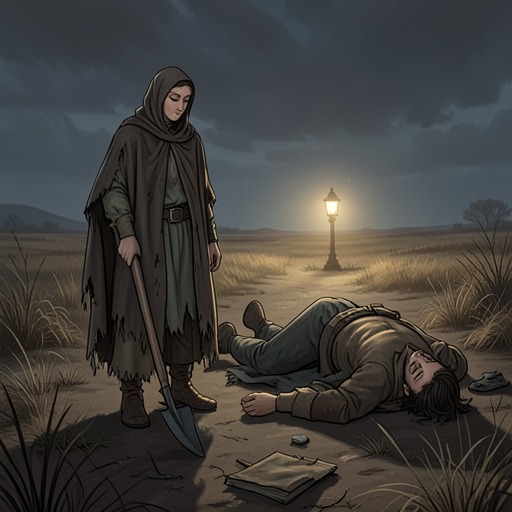
Jonas’s most consequential report concerns Antigone’s second attempt to cover Polynices’ body. After the guards returned and uncovered it, the rising heat made the corpse smell. They moved to a nearby little hill to catch a breeze, telling themselves that the broad daylight meant they were not risking anything. They nevertheless agreed that one guard would keep watch at all times.
By noon the wind had died, the smell had worsened, and the heat felt overwhelming. Jonas says that everything wobbled before his eyes and he could see nothing. He went to a companion to ask for a chew to clear his head; in the short time it took to put it in his cheek and thank the man, he turned back and saw Antigone digging at the body with her hands. The lapse is brief, but its consequence is decisive: the guards’ watch fails at the very moment she resumes the burial.
Jonas emphasizes that Antigone worked in broad daylight, not attempting to hide from the watchers. When he ran toward her, she did not stop or try to escape. She kept digging as fast as she could, apparently not attending to his approach. Jonas says that, when he seized her, she fought fiercely and continued trying to cover the body, shouting that it was not yet completely buried. His testimony therefore presents the arrest not as a flight or a mistaken identification but as an interruption of an act she persists in completing.
Duty, Fear, and Narrative Function
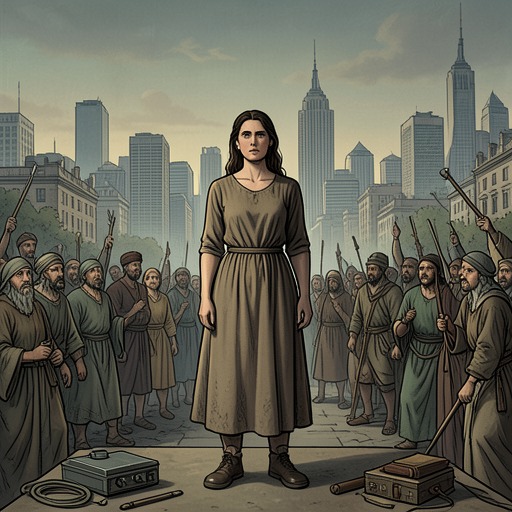
When three guards bring Antigone into the palace, they push her ahead of them and brace themselves against the door while a howling mob gathers outside. Jonas’s earlier account of the arrest thus leads into a more volatile public scene: the guards have taken custody of Antigone, but the palace itself is under pressure from the crowd. His position remains that of a subordinate reporting and enforcing events, rather than a figure who can resolve the conflict the arrest has exposed.
Later, Antigone asks for someone to be given a letter after her death. This request shows that the guard remains present at a final, personal exchange, although the supplied evidence does not establish what he says in response or whether he carries out her request. The contrast between his earlier attention to watches, orders, and bodily discomfort and this appeal gives his practical role a quieter proximity to the human cost of the law. Jonas helps move the plot from the discovery of the forbidden burial to Antigone’s capture, while his testimony keeps visible the imperfect, physical process by which state authority is carried out.