Chorus
AntigoneThe Chorus is both a character within the play and its principal guide to how the action should be watched: it introduces Antigone before her defiance has begun, marks the moment her capture releases the tragedy into motion, and returns after her death to describe the peace and forgetting left behind. Its framing voice turns the plot into a reflection on inevitability, performance, and the cost of surviving.
Identity and Dramatic Position
At the opening, the stage presents a featureless room with three identical doors; the characters are already there, talking, knitting, or playing cards. The Chorus steps forward to address the audience directly and announce that these people are about to perform Antigone’s story. From its first appearance, then, it occupies two positions at once: it belongs to the theatrical scene, yet also stands outside the action as its interpreter.
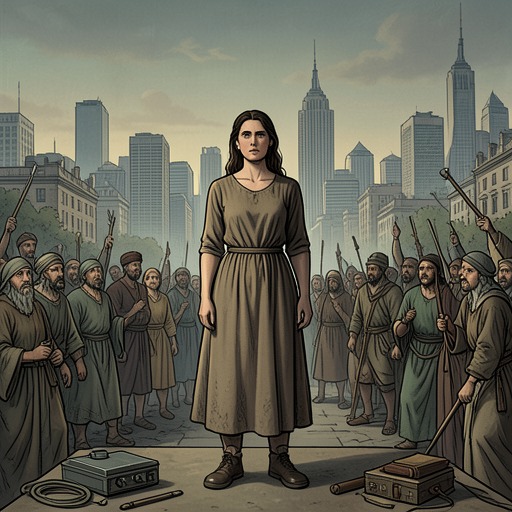
The Chorus distinguishes Antigone from the people around her by pointing her out as the silent young woman sitting apart, staring and thinking. It describes her impending transformation from a dark, skinny, brooding girl whom her family did not take seriously into someone who will stand alone before the world and face her uncle, Creon, the king. The introduction makes her fate known in advance: she is young, will die, and would have wanted to live. The audience therefore meets her not through suspense about whether she will survive, but through the distance between her desire to live and the role she is destined to play.
That opening address also sets Antigone apart from Ismene, who is talking and laughing with a young man, and from the calmly watching audience. The Chorus describes Antigone as rushing away from them all toward her death. Its account makes isolation part of the play’s initial stage picture: other people can remain spectators, while Antigone must enter the action and bear its cost.
The Chorus’s Account of Tragedy
After Creon and the Page exit, the Chorus returns to explain the play’s dramatic mechanism. It compares tragedy to a tightly wound spring: once released, it unwinds by itself. A small beginning—a look at a girl tossing her hair, a desire for respect on an ordinary morning, or one question too many—can set the action going. Once that point is reached, the audience need only sit back and watch the consequences unfold.
The metaphor gives the plot a peculiar double quality. Its beginnings can seem slight, even casual, but the action they release becomes inexorable. The Chorus’s account does not erase the characters’ choices; instead, it frames those choices as the small movements that start a mechanism whose momentum they cannot later stop. Its emphasis falls on the shift from an almost negligible beginning to an ending that has become unavoidable.
The Chorus contrasts tragedy with melodrama. In melodrama, characters struggle because they hope to escape; in tragedy, it says, there is no such hope and therefore no practical bargain to be made with events. The trapped person is left to shout what has never been said, perhaps even what was not understood until it was spoken. Tragedy is presented as both peaceful and terrible: everyone has a part, the characters are innocent in the sense that the mechanism has caught them all, and no one can undo what is happening. The calmness belongs to the form, not to the suffering it contains.
Capture and the Release of the Action
The Chorus’s theory becomes stage action when the three Guards enter, pushing Antigone ahead of them. The Chorus announces that the spring has been released and that Antigone has been caught. Her capture is not only a change in the plot; it is the threshold at which the person introduced in silence can finally act openly as herself. The Chorus calls it the first time in her life that she will be able to be herself, making arrest the paradoxical condition of her self-expression.
The moment also changes the Chorus’s position. It has guided the audience through the opening tableau and explained how tragedy works; now it disappears as the Guards push Antigone onto the stage. This withdrawal leaves the action to proceed without the framing voice in that instant. The Chorus’s words nevertheless shape the audience’s understanding of what follows: the capture is at once a consequence of the spring’s release and the beginning of Antigone’s defining confrontation.
Ending, Survivors, and Forgetting
After Antigone’s story is over, the Chorus returns to mark the approach of Creon’s turn. Its brief statement that everyone must face the same moment in the end extends the play’s concern beyond the immediate deaths: the king who remains after Antigone will not remain exempt from mortality. The ending shifts attention from the exceptional crisis to the fate shared by everyone.
In its final address, the Chorus concedes that without Antigone the others would have had peace. But that peace arrives only after the people who had to die are dead. The dead include those who believed one thing, those who believed another, and even those who believed nothing and were swept into the story without understanding it. The Chorus levels their differences through death, describing them as equally stiff, useless, and decaying; no position or degree of comprehension provides escape from the ending.
The survivors, meanwhile, will slowly forget the dead and mix up their names. The Chorus does not present the close as a restoration that repairs what happened: Antigone’s fever has subsided, her work is done, and a great, sad quiet falls over Thebes and the empty Palace of Thebes. Creon remains there to wait for death. The final peace is therefore inseparable from loss, the erasure of individual names, and the knowledge that the survivor’s turn is still to come.
Narrative Role and Significance
The Chorus gives the play a frame that is both theatrical and fatalistic. It begins by identifying the performance and directing attention to Antigone; it later names the capture as the release of the tragic mechanism; and it ends by measuring the silence that mechanism has left behind. These interventions organize the audience’s experience without making the Chorus the agent of Antigone’s actions.
Its repeated returns to the image of the spring connect small beginnings, public action, and irreversible consequences. At the opening, Antigone is already described as moving away from the spectators toward a death she cannot avoid. At her capture, the play’s movement becomes active and visible. Afterward, the Chorus’s final emphasis falls not on escape or reconciliation but on exhausted action, quiet, and forgetting. Its role is to make the tragedy legible as a performance whose end is anticipated from the beginning, while preserving the human cost of that foreknowledge.