Polynices
AntigonePolynices, the younger son of Oedipus in the account of the play’s events, is both a defeated claimant to Thebes and the dead brother whose prohibited burial drives Antigone’s defiance. He is first publicly branded a traitor, but Creon later discloses that Eteocles was no more virtuous. The reversal exposes the political judgment imposed on Polynices as a selective distinction between two compromised brothers.
Identity and the struggle for Thebes
Polynices and his elder brother Eteocles were supposed to rule Thebes in succession, each for a year. At the end of the first year, Eteocles refused to yield the throne. The brothers then fought and killed each other outside the city walls, turning a broken agreement over succession into a conflict that left both claimants dead.
Seven foreign princes whom Polynices had won to his cause were defeated before Thebes’s seven gates. The city was saved, but the victory did not restore the brothers or settle the moral meaning of their struggle. Polynices’s claim to rule and his military alliance become the grounds on which the surviving government defines him as the enemy.
The decree and Antigone’s obligation
After the battle, Creon orders a grand funeral for Eteocles, presented as the good brother, and commands that Polynices, named villain and traitor, remain unburied and unmourned. His body is to be left outside the rites that would give the dead ceremonial recognition. Anyone who performs those rites for him faces death. Polynices is thus made the object of a public decree as well as a family loss: the state’s account of the war is written into the unequal treatment of the brothers’ bodies.
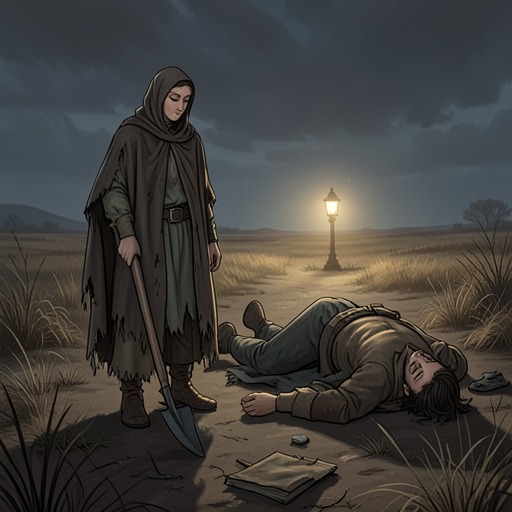
Antigone refuses to accept that distinction as a reason to abandon her brother. She says that the roles have already been assigned: Creon must have the sisters put to death, and they must bury their brother. When Creon asks whether she was responsible for the first burial the previous night, her answer confirms that she performed it. She explains that those left unburied wander without rest, and imagines caring for Polynices as she would have cared for a living brother returning exhausted from a hunt: removing his shoes, bringing him food, and making his bed. His hunt, she says, is finished. In her account, burial is not a political endorsement of his campaign; it is the remaining act of care she can offer him.
The limit of that act is also part of its force. Antigone does not claim she can undo the war or repair the city; she says she can do this much, and must do what she can. Polynices’s absence therefore gives a concrete object to a conflict between Creon’s authority and an obligation to the dead that Antigone treats as prior to political convenience.
The brothers’ contested reputations
Creon’s public settlement assigns the brothers opposite reputations: Eteocles receives honors as the loyal, virtuous defender, while Polynices is condemned as the traitor whose body is denied burial. But in speaking privately to Antigone, Creon admits that this division conceals what he knows. Eteocles had tried to arrange the assassination of his father and had also decided to sell Thebes to the highest bidder. Creon says he has proof that Eteocles was preparing the same treason for which Polynices’s body is exposed; Polynices’s plan succeeded first only by chance.
That disclosure changes the meaning of Polynices’s disgrace without making the two brothers innocent. Creon describes them as petty thieves who lied to each other and to the city, rather than as a villain opposed to a blameless hero. The state funeral and the burial ban are consequently revealed as an imposed moral contrast, not a reliable account of the brothers’ opposing characters. Polynices remains politically condemned, but the evidence Creon reveals makes the condemnation look selective: the brother honored by the city was preparing to commit the same kind of betrayal.
Narrative significance
Polynices never appears in the supplied scenes as an active participant; his significance is carried through the competing accounts of his actions and the consequences of his death. His denied funeral brings Antigone into direct conflict with Creon, while the revelation about Eteocles undermines the distinction on which the decree rests. He is at once a brother Antigone refuses to abandon and a defeated political claimant whom the authorities reduce to the label of traitor.
The play holds those meanings together rather than resolving them into a simple defense of Polynices’s political conduct. Antigone’s commitment is to burying her brother, not to establishing that he deserved the throne; Creon’s later account, meanwhile, shows that the brother celebrated as virtuous was no less compromised. Polynices’s unburied state makes that gap between political reputation and familial duty visible, and turns the aftermath of the succession struggle into the central test of Antigone’s refusal.