Nurse
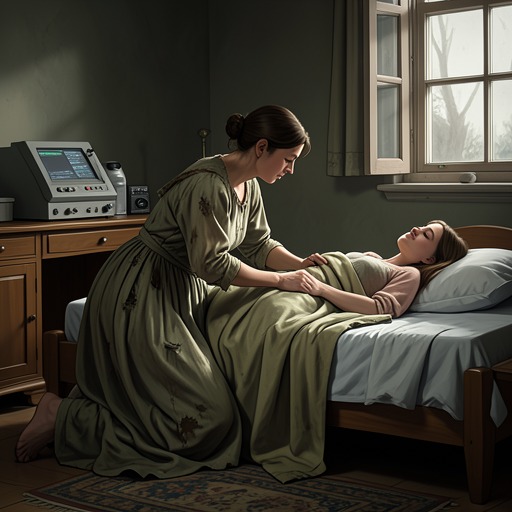
AntigoneThe Nurse is the practical, affectionate caretaker who raised Antigone and Ismene. In a play whose central choices turn on burial, authority, and death, she represents the intimate world of childhood care: a hand held beside a sickbed, warmth offered against the night, and concern for a young woman returning home at dawn. Her presence makes Antigone’s defiance more than a political position; it is also a rupture in a household shaped by years of care.
Identity and Place in the Household
The Nurse is identified as the woman who raised the two girls. She belongs to the domestic world around Creon’s family, where she is present alongside Eurydice, Creon’s wife, who knits while the action unfolds. The Nurse’s authority is neither royal nor political. It comes from familiarity with the girls’ needs and past: she knows how to tend Antigone as she did when Antigone was ill, and Antigone turns to her in the language of a child seeking comfort.
That intimacy sets the Nurse apart from the public roles that govern the crisis. Antigone describes the opposing obligations as parts assigned to each person: Creon must have the sisters put to death, and they must bury their brother. The Nurse does not decide those roles, but her care exists close to their consequences. Her relationship with Antigone makes visible what the conflict threatens to sever: the ordinary bond between an adult who once watched over a child and the grown person now choosing a dangerous course.
Dawn and Antigone’s Return
After the Chorus has spoken and the other characters have left, the stage shifts to a pale-gray dawn in a sleeping house. Antigone opens the door and slips in barefoot, on tiptoe, carrying her sandals. She pauses to listen before the Nurse appears and asks where she has been. The careful staging places the Nurse at the threshold between Antigone’s secret action outside and the household’s waking routine within.
Antigone answers that she has been walking and calls the early world beautiful. In her account, the landscape has changed while she was out: what had been gray has become pink, yellow, and green, turning into a postcard. She tells the Nurse that one must rise earlier to see a world without color. The exchange gives the Nurse no full explanation of Antigone’s purpose, but it establishes her as the first person to meet Antigone on her return and as the recipient of an answer that is at once affectionate and guarded. Antigone then moves to leave, keeping the encounter brief.
A Caregiver’s Comfort
Later, Antigone asks the Nurse to warm her, as she used to when Antigone was sick. She invokes the remembered comfort in an escalating series of images: the Nurse stronger than fever and nightmares, stronger than the bookcase’s moving shadow on the wall, stronger than insects gnawing in the silence, stronger than the night and its strange sounds, even stronger than death. The repetition turns a childhood reassurance into something more urgent. Antigone knows that no caretaker can actually command death, yet she reaches for the old ritual because it once made fear bearable.
Antigone also asks for the Nurse’s hand, recalling how the Nurse sat beside her bed when she was ill. The gesture is small and concrete, unlike the public language of decrees and punishment. It briefly restores the relation of a child receiving comfort from an adult, even as Antigone’s choices place her beyond the Nurse’s protection. The Nurse’s care is real; its limits are equally clear.
Separation and the Limits of Care
When Haemon appears, Antigone tells the Nurse to leave them alone and reminds her of a promise. The Nurse exits, yielding the room to the young couple. Antigone then runs to Haemon and asks forgiveness for their quarrel the previous night, taking the blame for it. The scene shows the Nurse as a trusted presence whom Antigone can send away with an appeal to a prior promise, but it also marks the boundary of her role: the intimate caretaker cannot remain at the center of every decision Antigone makes.
That boundary echoes the play’s larger division between affection and action. Antigone insists that she must do what she can, and later rejects Creon’s political obligations and efforts to make her accept a compromised life. Creon describes the necessity of saying yes as the work of steering a ship taking water, amid crime, poverty, and misery; Antigone refuses his account of responsibility and insists on her own choice. The Nurse offers neither the state’s command nor a counterargument to it. Her contribution is care, which can soothe Antigone but cannot change the stakes of her refusal.
Narrative Significance
The Nurse’s scenes frame Antigone’s crisis through ordinary physical gestures: returning barefoot at dawn, asking to be warmed, and reaching for a hand once held beside a sickbed. Against the scale of royal power and the threat of execution, these details preserve the history of Antigone as someone who was once vulnerable and tended. They also make the approaching separation legible without giving the Nurse knowledge or power the text does not show her possessing.
Her role is therefore both tender and limited. She is close enough to Antigone to be addressed as Nanny and trusted with a promise, yet she cannot avert Antigone’s chosen course or resolve the clash between burial and political order. The Nurse’s care does not defeat death; it gives Antigone a remembered form of comfort with which to face it.