Antigone
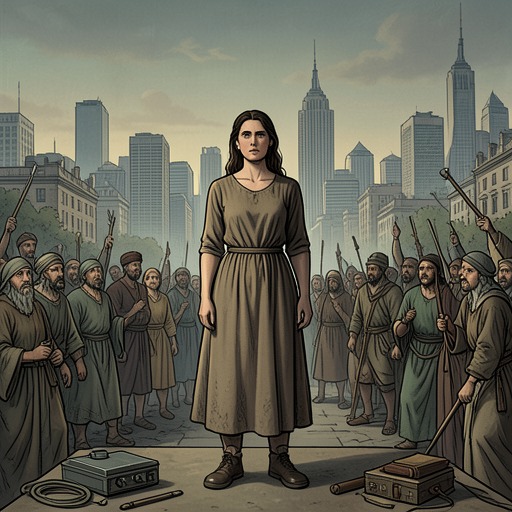
AntigoneAntigone is the young, withdrawn woman at the center of the tragedy: a girl who knows she wants to live, yet chooses to bury her brother and face death rather than give up the one act she believes remains hers to do. Set against Creon’s claim that political order demands obedience, her insistence on choosing for herself turns a family duty into a public confrontation and makes her death the play’s measure of what refusal costs.
Identity and Introduction
At the play’s opening, Antigone sits silent and intent, apparently staring at nothing. The Chorus describes her as dark, skinny, and brooding, a girl whom no one in her family ever took seriously. She is not introduced as already triumphant or fearless: she is thinking about becoming Antigone, emerging from the neglected figure she has been to stand alone before the world and before Creon, her uncle and king.
That emergence is shadowed from the start by death. Antigone understands that she is young and would very much like to live, but sees no way to avoid the role she must play through to the end. The Chorus sets her apart from the spectators, who can calmly watch without having to die that night, and from Ismene, who is talking and laughing with Haemon. The stage picture therefore holds two realities together: the visible quiet of a young woman sitting apart, and the fatal course already closing around her.
The Burial and Her Choice
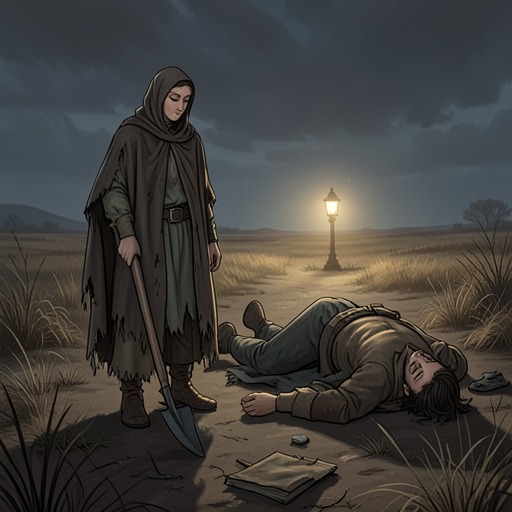
When Creon asks why she tried to bury her brother, Antigone does not claim that she can change the larger situation. She says that this is all she can do, and that she has to do what she can. When pressed to name whom the act serves, she answers that it is for nobody but herself. Her explanation makes the burial neither a plan for political victory nor a plea for recognition. Its value lies in the fact that she can choose and carry it out.
Antigone describes the opposing roles as already cast: Creon has to put her and Ismene to death, and they have to bury their brother. In that fatalistic formulation, the conflict seems predetermined; in her later insistence on choice, however, she claims a personal decision within those fixed circumstances. She cannot command the king or undo the danger, but she can refuse to treat his power as the measure of what she must accept.
Antigone and Creon
Creon’s argument is the language of collective emergency. He tells Antigone that someone must say yes and steer the ship, which is taking on water amid crime, poverty, and misery. Its crew refuses to work, its officers make a raft for themselves, the mast cracks, and the storm threatens everyone. In this image, the ruler cannot pause to distinguish carefully between yes and no: he must take the wheel, issue orders, and shoot at the first person who advances. The individual loses a name in the violence, while the ship and storm become the only names that matter.
Antigone does not accept that necessity as an answer to her. She tells Creon that she has not said yes and can still say no to what she dislikes; the choice, she insists, is hers alone. He may have a crown, guards, and the burdens of kingship, but can put her to death only because he has said yes to doing so. The exchange reverses the apparent balance of power: Creon controls the sentence, while Antigone claims the decision by which she will meet it.
Their disagreement is not resolved by a shared account of what counts as an acceptable outcome. Creon argues from the obligation to hold a failing political order together; Antigone refuses the premise that such obligations should determine her answer. His ship metaphor makes compromise seem like the condition of collective survival. Her reply rejects survival at the price of yielding the choice itself. The two positions meet in the same confrontation but do not become commensurable.
Refusal, Happiness, and Death
Antigone’s refusal reaches beyond the burial dispute. She rebukes those who cling to happiness and life at any cost, likening them to dogs that lick whatever they find and settle for a small chance at happiness so long as they do not ask too much. Against that modest bargain, she wants everything, here and now, whole and complete—or nothing. Her demand makes ordinary contentment look like an accommodation she cannot accept; it also clarifies why concessions that might preserve her life cannot settle the conflict.
The play does not portray this demand as freedom from fear. Antigone knows she is young and wants to live, even as she continues toward death. That contradiction gives her choice its human weight: she is not indifferent to what she will lose, but neither does fear persuade her that any survival is worth accepting. Her defiance is thus an assertion of agency within an outcome she cannot control, not a promise that her act will defeat the authority that condemns her.
At the end, the Chorus declares that it is over for Antigone and that Creon’s turn will come soon enough; everyone must face the same moment in the end. Her individual death is placed beside the ruler’s approaching reckoning and the universal fact of mortality. The tragedy closes not by undoing her sentence, but by showing that the king who imposed it is not outside the human condition he tried to master.
Narrative Role and Significance
Antigone’s role is defined by the tension between a part assigned to her and a choice she insists remains her own. The Chorus says that she has to play her part through to the end, while she argues that she can still say no. The play holds these claims together: her fate is shaped by the roles and power surrounding her, yet the meaning of her action comes from her refusal to let those roles speak for her completely.
Her burial of her brother is small in the face of a king’s authority, and Antigone herself describes it as the one thing she can do. Its scale is precisely what sharpens its significance. Creon’s political language treats people as a crew, a mob, or casualties without names; Antigone insists on an act whose meaning is not granted by the ruler’s approval. In the end, she cannot make the world accept her choice, but the choice exposes the human cost of an order that requires someone to say yes—and the limit of any power that can compel obedience only by killing the person who says no.