Callisto
ArtemisCallisto is the Princess of Arcadia who enters the story as the last chosen member of Artemis’s court and becomes the goddess’s beloved. Her trajectory joins a private relationship to a public divine order: when Callisto’s pregnancy reveals that she has broken Artemis’s vow of chastity, she is driven into the forest and transformed by Hera. She survives long enough to give birth to Arcas, but her life ends in a tragic misunderstanding; Artemis later raises her to the stars, where her new form offers guidance to those who travel and hunt.
Identity and Introduction
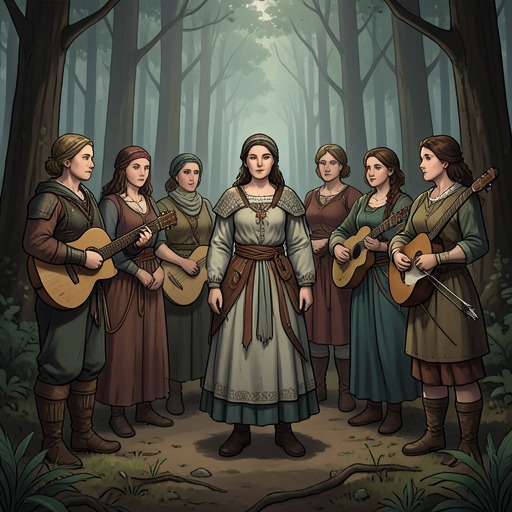
Callisto is introduced as the twentieth and final nymph sought for Artemis’s court. After the other new nymphs return to prepare a feast and dance, the king leads Artemis to another chamber in his palace. There she finds a young woman seated beside a pool, singing quietly to the lilies and playing with the water. The scene sets Callisto apart from a formal audience: she is encountered in a secluded garden-like space, and she does not seem surprised by the goddess’s arrival.
When Artemis asks her name, she answers simply, “My name is Callisto.” Her direct introduction marks the beginning of her place in the goddess’s company. Once Artemis has assembled her choir girls and handmaidens, she is accompanied by them wherever she goes and recognized as the maiden of the wild and goddess of the hunters. Callisto’s selection thus places her inside a visible retinue whose members travel with Artemis, while her later relationship with the goddess gives that chosen place a more intimate significance.
Place in Artemis’s Court
Callisto enters the narrative at the point when Artemis is completing her court. She is not merely one of the nymphs already gathered for the feast: she is the final choice, the twentieth member needed to complete the group. The king’s grim expression as he guides Artemis to the chamber contrasts with Callisto’s quiet composure beside the pool, though the account does not explain his concern or Callisto’s apparent expectation.
The court becomes the setting for both Callisto’s belonging and her eventual exposure. Artemis’s companions share their life around the goddess, and the nymphs and Oceanides are present when Callisto’s pregnancy is discovered. The same community that surrounds the goddess therefore witnesses the collapse of Callisto’s place among them: at Artemis’s fury, the nymphs fall to their knees and the Oceanides retreat to their tents. Callisto’s status as a chosen companion cannot protect her when the revelation turns Artemis against her.
Love and the Broken Vow
Callisto becomes Artemis’s beloved, and their relationship is founded on a sharp contradiction: intimacy exists within the orbit of Artemis’s vow of chastity. The narrative presents Callisto as the one who makes a direct confession of desire. Nervous and desperate, she tells Artemis that she wants to please her, and Artemis responds with surprise. The scene makes Callisto’s desire explicit while also showing its risk: she acts despite knowing that Artemis could call her hounds against her for what the goddess might regard as disrespect.
The relationship later becomes inseparable from the revelation of Callisto’s pregnancy. One morning, while Artemis bathes with her nymphs and her Oceanides rehearse their verses, a cry from the camp interrupts the music. The companions bring Callisto before Artemis; Opis and Loxo hold her in place while she tries to cover herself. Artemis sees that Callisto is not visibly injured, then notices that her belly is swollen. Recognition comes suddenly: Callisto is carrying a child.
The pregnancy transforms an intimate secret into a public crisis. Artemis calls Callisto a traitor, accusing her of breaking her oath and deceiving the goddess after being favored by her. The accusation joins two injuries in Artemis’s mind—the breach of chastity and the concealment of the pregnancy—and her shock turns to anger. The scene does not resolve the contradictions of their relationship; instead, it shows how quickly Callisto’s place as beloved and chosen companion gives way to the judgment of a violated vow.
Banishment and Transformation
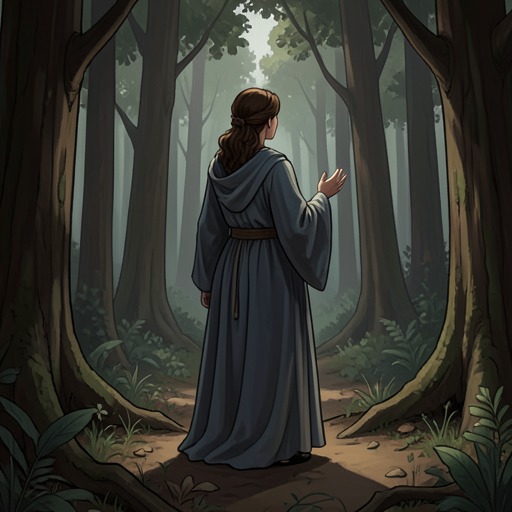
After the confrontation, Artemis whistles for her hounds. Their growls terrify Callisto, who has no choice but to flee. She runs naked and frightened through the forest, tears falling as she covers her large belly. Her escape is at once from Artemis’s immediate wrath and into a landscape where she has lost the protection of the court that had been her home.
Hera has observed the argument and concludes that Zeus is responsible for what has happened. Her response is driven by jealousy and resentment toward Artemis: she casts an enchantment that changes Callisto into a large brown bear. The transformation makes Callisto’s human identity difficult to recognize and intensifies her isolation; even after she disappears from sight, the bear’s roars carry across the land. Her animal form is not a voluntary escape but the consequence of divine hostility, and it leaves her unable to speak in the ordinary way when help arrives.
Arcas and the Starry Afterlife
Callisto eventually reaches a cave as her strength fails and labor approaches. Eileithyia tells her she cannot shield her from Artemis’s anger but can help care for the child. In the cave, Callisto gives birth to a son. Eileithyia names him Arcas and foretells that he will lead mortals to triumph and that cities will be built in his honor, allowing Callisto’s legacy to continue through him. Zeus later sends Hermes to take the baby to King Lycaon, so that he can grow up among humans rather than beasts.
Callisto’s own ending comes through a further reversal: after she is slain, Artemis asks Zeus to place her among the stars. Zeus recognizes that only heroes who have accomplished great deeds are ordinarily admitted there, but inclines his head to atone for his mistake. Light rises from the slain bear and lifts Callisto into the heavens. The transformation that had once reduced her to a hunted animal is thus answered by a final transformation into a lasting celestial presence.
Among the stars, Callisto receives eternal life, but not a return to the world she knew. Her ascent promises peace and solitude, while Artemis feels that the two of them will never again truly belong to their former world. A new constellation appears, with the North Star as its brightest point. The star guides sailors, wanderers, builders, and hunters, giving Callisto’s afterlife a practical reach beyond the private grief of Artemis. Her story closes not with restoration of their relationship but with a memorial form: the beloved who was driven into the forest becomes a fixed light by which others find their way.
Narrative Significance
Callisto’s arc is structured by repeated changes in status. She moves from final candidate to chosen companion, from beloved to accused traitor, from human fugitive to bear, and from slain animal to constellation. Each reversal is imposed or authorized by divine power, while the consequences fall on her body, freedom, and ability to remain among others. Her pregnancy exposes how the relationship between the two women is constrained by a vow that Artemis herself has made, and Hera’s intervention turns the resulting conflict into an enforced metamorphosis.
The conclusion preserves both the scale of Callisto’s loss and the reach of her legacy. Arcas is carried into human society, where he can fulfill Eileithyia’s prophecy, while Callisto is made a celestial guide. The final stars offer a form of remembrance and endurance, but the narrative does not present them as a reunion: Artemis sits in wonder before Callisto’s new form while recognizing their separation from the life they once shared. In the author’s note, the writer identifies Artemis and Callisto as an unusually close pair to a lesbian relationship in Greek myth and describes the retelling as an effort to follow Artemis from childhood to her first heartbreak. That framing makes Callisto’s story both a mythic metamorphosis and the central heartbreak of the book’s portrayal of Artemis.