Leto
ArtemisLeto, daughter of the Titans Phoebe and Coeus, is the gentle mother of Artemis and Apollo in this retelling. Her relationship with Zeus draws Hera’s vengeance, and her pregnancy becomes a long struggle for refuge: pursued by Python and refused shelter, she reaches Delos, secures its welcome with a vow, and endures a labor that culminates in the birth of the twins. Her story makes maternal endurance, divine persecution, and the consequences of Zeus’s relationships central to the twins’ beginnings.
Identity and Background
Leto is introduced as a Titaness whose lineage joins the ancient powers associated with the sun and moon: she was conceived through the love of Phoebe and Coeus. The narrative characterizes her as mild and kind toward both mortals and the deathless gods, setting her gentleness against the hostility she will face. She is also a figure of divine beauty, but her decisive role in the story is not her appearance; it is her motherhood and the trials imposed on her while carrying Zeus’s children.
Her relationship with Zeus begins a chain of events that neither his status nor his protection fully prevents. Zeus knows that Hera’s jealousy makes his attention dangerous to Leto. When Hera discovers the relationship, she curses Leto to carry a child but forbids her from giving birth anywhere the sun shines. The curse transforms pregnancy into a matter of survival and turns the landscape itself into a barrier to childbirth.
Pursuit and Flight
Hera’s persecution does not end with the curse. As Leto approaches the time to give birth, Hera sends Python to hunt her from every sunny place where she might rest. The serpent can find her as long as she remains on the mainland, while the lands she seeks are too frightened to receive her. Leto consequently wanders in labor and without a secure home, even as the birth of her children becomes more urgent.
At Tremilis, Leto hears a wolf and follows its call to a den. The pack welcomes her when other inhabitants have turned her away. She tells the wolves that Python hunts her and promises to rename Tremilis Lycia, meaning “the wolf-country,” in gratitude for their welcome. She then changes her form into a she-wolf, using transformation to evade the monster’s pursuit. After twelve days and twelve nights, she makes her way across the moonlit lands to Delos.
Delos offers a refuge because it is a floating island, not attached to the ocean floor and not considered land. That distinction places it beyond the curse’s stated prohibition against giving birth where the sun shines, while its drifting isolation also offers a way to escape Python. Leto’s arrival is therefore not simply a change of setting: it is the outcome of her search for a place that can receive her without exposing her to the same pursuit.
Delos, the Oath, and Rescue
Leto asks Delos to receive her children and promises that the island will prosper in oxen, sheep, vintage, and plants. Delos hesitates, not because it refuses her plight, but because it fears that powerful children will later despise its rocky soil, leave for a richer home, or cast the island into the sea. The island also asks for a binding assurance: her children must first establish there a glorious temple and oracle.
Leto answers with a solemn oath, calling Earth, Heaven, and the waters of Styx as witnesses. She promises that her children will have an altar and sacred precinct on Delos and that the island will be honored above all. The agreement makes the island’s welcome conditional on a lasting religious bond: Leto gains a place to give birth, while Delos gains her pledge that the children’s future honor will also belong to their birthplace.
As Leto tries to cross the water to the island, Python follows. Zeus intervenes, sending her over a dark wave driven by strong winds and moving the floating land faster than Python can swim. His rescue prevents the serpent from reaching Leto before it can harm her, and she is at last safe on Delos. The narrative thus presents Zeus as both the source of the danger, through his relationship with Leto and Hera’s response, and the power able to provide a decisive escape from it.
Childbirth and the Twins
Hera continues to obstruct Leto even after she reaches Delos. She keeps her daughter Eileithyia from helping with the birth and insists that Leto suffer for her relationship with Zeus. Eileithyia protests that her absence harms all mothers in labor, but Hera locks her in a dungeon for thirty days. Leto is left without the goddess whose aid might have eased childbirth.
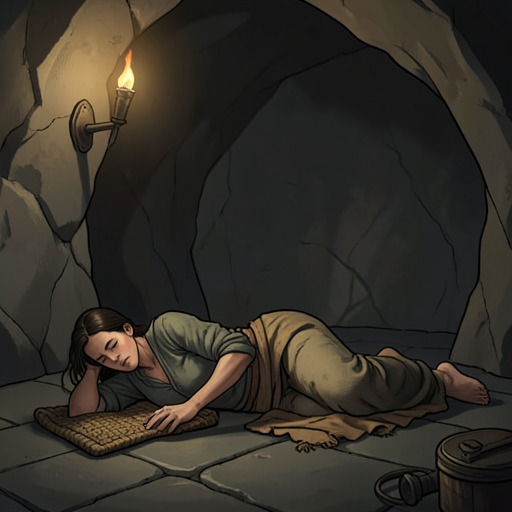
After nine days and nine nights of pain, Rhea and Dione help Leto into a cave on the tenth day. The refuge is dry and comfortable, with a stream passing through its darkness, and lies in the center of Delos, away from Hera’s observation. Ichnaea, Themis, and Amphitrite join them; Themis carries a torch as the five divine helpers guide Leto to a resting place. Rhea holds and comforts her, while Dione urges her to push. Their care contrasts with Hera’s deliberate withholding of aid.
Rhea tells Leto that the pain will bind mother and children through love and that the twins will remember what she endured. Leto takes these words to heart and refuses to give up. Artemis is born first and grows rapidly to the size and age of a mature child; seeing her mother in pain, she takes Leto’s hand and then serves as midwife for the second birth in Eileithyia’s absence. Leto bears a son, whom she names Apollo. Once the pains cease, the narrative marks the arrival of the twins as an event that will astonish the House of Zeus and Hera.
Relationships and Narrative Significance
Leto’s bond with her children is formed under pressure but is also presented as a source of future solidarity. Rhea’s assurance that the twins will remember the pain of their birth links Leto’s suffering to their later response against those who rejected her. The newborn Artemis’s immediate attention to her mother, followed by her assistance at Apollo’s birth, gives that connection an action as well as a prophecy: the first child participates in bringing the second into the world.
The twins’ birth also establishes a contrast between Leto’s isolation and her children’s eventual recognition. Zeus is described as an inattentive parent with many children, but he cannot forget these twins, whose beauty distinguishes them: Apollo is associated with a ruddy light and Artemis with a silver one. On their third birthday he summons them to Olympus. Leto remains on Delos, while the twins enter the divine court and are welcomed by Zeus; the other gods rise in amazement, and Hera curses under her breath. Leto’s children therefore gain a place in Olympus even though their mother’s own passage to safety has depended on flight, a conditional welcome, and endurance.
The account also places Leto’s story within a wider pattern of women’s bodies being caught in contests of divine authority. Hera’s jealousy of Zeus’s relationship becomes a curse on Leto’s pregnancy, and Hera’s control over Eileithyia turns childbirth into an instrument of punishment. Elsewhere, the book presents Agamemnon’s obligation to the Greek alliance as leading him to order the sacrifice of his daughter Iphigenia to appease Artemis. These episodes are not the same conflict, but together they show how political and divine demands can be enacted through women and girls, even as Leto’s story emphasizes the care and solidarity that help her survive.
The retelling’s author describes its aim as following Artemis’s life from childhood to her first heartbreak while giving life to mythical female characters through an LGBT theme. Within that design, Leto’s role is foundational: her ordeal brings Artemis and Apollo into the story, and the hardships surrounding their birth help establish the family and divine conflicts that shape Artemis’s later life. Her arc culminates not in a return to the life she had before Hera’s curse, but in the safe birth of the twins and their recognition as Olympians, while Leto remains on the island that received her.