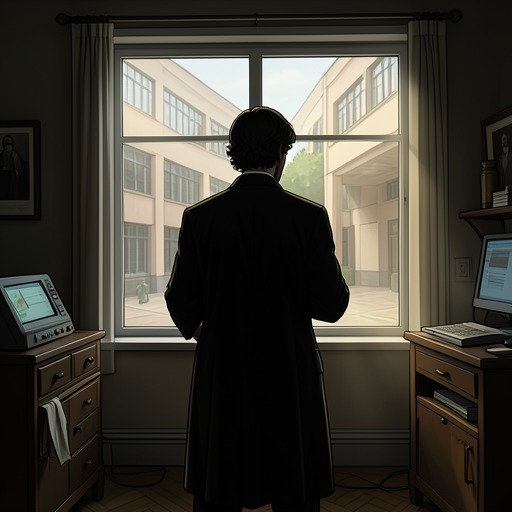
Edgar Stark’s escape from the mental hospital
AsylumEdgar Stark’s escape from the mental hospital converted a system of supervised work and conditional freedom into the means of his disappearance. Wearing Max Raphael’s clothes, he slipped away from the estate and made his way toward London; the delay in raising the alarm exposed how vulnerable the hospital’s arrangements were and drew Stella Raphael into a fugitive life shaped by secrecy, fear, and romantic illusion.
Background and Opportunity
By the summer of 1959, Edgar had spent five years in the hospital after murdering his wife, Ruth Stark, with a hammer. He had recovered his general sanity and took part in hospital activities, but he remained fixed in the belief that Ruth’s supposed infidelity had justified the killing. The evidence he offered for that belief was made up of ordinary details—a window opened as a motorbike passed, a crease in a pillow, or a stain on a skirt—given extravagant meanings. Because he showed no insight into the murder and continued to regard it as justified, Peter Cleave and the other doctors judged him unready for release.
Edgar nevertheless worked outside the wards as a parole patient. Each morning, supervised groups left through the Main Gate to maintain the estate grounds. Edgar was assigned to work in the garden of the deputy superintendent’s house, where Stella often encountered him while picking vegetables or flowers. The arrangement gave him access to the estate and brought him into daily contact with Stella, whose attraction to him grew despite her attempts to dismiss their conversations as harmless.
The Escape
The hospital’s account of the escape was reconstructed afterward. After lunch, Edgar told John Archer that he was wanted in the chaplain’s garden, then went off alone. He retrieved Max’s clothes, which he had hidden in the woods at the end of the Raphaels’ garden, and wore them to disguise himself. He kept away from the road until he was clear of the estate; from there, he apparently travelled toward London by hitchhiking, bus, or train. The account could not establish which means of transport he used, but it placed the escape’s decisive steps in the woods and beyond the estate boundary.
The alarm came late. The interval between the discovery of Max’s missing clothes and the discovery that Edgar was absent was close to three hours. Max returned to the hospital, checked with staff in Block 3, went to his office, and then waited another half-hour before calling Jack Straffen. In the meantime, the work parties were due back, and John Archer had discovered that Edgar was missing. Peter Cleave was already with Jack when Max telephoned. The delay meant that the hospital lost valuable time in which an earlier search might have found Edgar, and the fact that the fugitive was wearing Max’s clothes made the episode personally humiliating for the deputy superintendent.
Life on the Run
In London, Stella joined Edgar and Nick in a warehouse loft. The conditions were makeshift: there was one sink, often crowded with paintbrushes, one tap, and one lavatory. Stella took on the work of keeping the place clean, cooked simple meals on a two-ring stove, and made shopping lists for Nick, who shared expenses with her. At night, the three of them ate, drank, and talked, mostly about art. Stella described this period as one of rapid growth, believing that she was learning to think and feel as an artist and shedding her former identity as a wife and mother.
The danger of discovery fed rather than dispelled her idealization of their life together. She and Edgar could not go out in daylight for fear of recognition and arrest, a restriction that gave their existence what Stella regarded as the danger intrinsic to an artist’s life. Yet anxiety repeatedly broke through the imagined idyll: after four or five days, she sometimes woke to the enormity of what she had done and tried to push the thought away. She told herself they would soon be able to enter the world unnoticed, while the evidence of their isolation remained visible in the loft’s cramped routines and dependence on Nick.
Stella was also surprised to find that the fugitives received visitors. When someone knocked while they were eating sardines on toast, she rose in alarm; Edgar stayed at the table, and Nick calmly went to answer the door. The contrast between Stella’s expectation that fugitives must be cut off from everyone and the ordinary social life around Edgar and Nick unsettled her assumptions about the escape’s reality.
Consequences and Significance
The escape became a public crisis when the press revived Edgar’s case. At his trial, two psychiatrists testified that he suffered from paranoid psychosis, and the court accepted the insanity defense. The renewed attention brought scrutiny to the hospital’s practice of allowing patients such as Edgar to leave the grounds daily to work. Charlie was kept in the garden while reporters questioned people on the estate; one reporter asked him what his father talked about at lunch, leaving the child confused and tearful. The escape thus breached more than the hospital’s perimeter: it carried the consequences of its security arrangements into the Raphael family’s home.
For Stella, the escape opened the route into the fugitive relationship she had recast as a melodrama of lovers defying the world for passion. Her first days in the loft brought both excitement and anxiety, while the restrictions and precarious domestic arrangements that accompanied Edgar’s freedom contradicted the ideal she tried to preserve. The disguise is the episode’s sharpest reversal: Max’s clothes, taken from the edge of the family garden, enabled Edgar to pass out of the institution and into the life Stella would mistake for liberation.