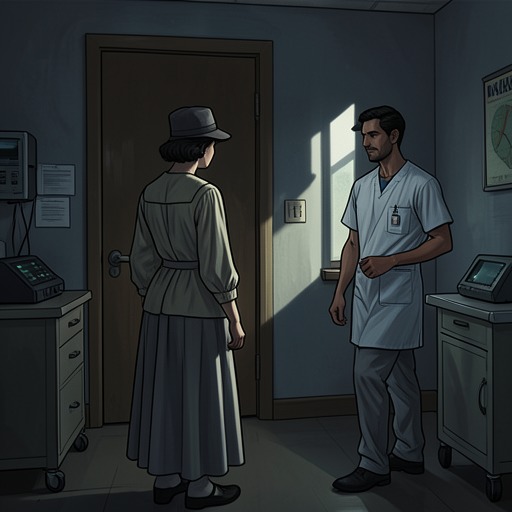
Edgar goes to Nick’s home to look for Stella
AsylumEdgar goes to Nick’s home to look for Stella is a tense encounter in which a locked door briefly separates Stella and Nick from the man pursuing her. The episode turns on uncertainty: Edgar has found their hiding place, but no one knows how he entered the building or whether he is still outside. When he finally leaves, Stella and Nick flee together, carrying the danger into another temporary refuge.
Background and Approach
At dawn, Stella and Nick are awakened by the sound of someone turning the door handle. The front door is locked, and they never learn exactly how Edgar got into the building. Their inability to account for his presence gives the first moments their force: the barrier is real, but it does not make them feel secure. They sit up and stare at the door in horror.
Edgar calls for Nick to open it. His voice terrifies Stella, not least because it is still the strange, artificial accent she associates with the other version of him. Nick looks wildly at her and shakes his head. In the gloom, she can read the terror in his face. Edgar’s manner of address is almost companionable, but the reassurance that he will not hurt Nick does not dispel the threat; he is at the door looking for Stella, and the locked entrance has become the only boundary between them.
The Doorway Standoff
When Edgar asks, “She’s in there, isn’t she?” Nick is paralyzed. Stella understands that even answering him would give Edgar an opening, so she silently signals Nick not to speak. She crosses the room, sits on the arm of his chair, covers his mouth with one hand, and grips his wrist with the other. Her response is physical and immediate: she tries to prevent a conversation that might expose them or draw Edgar further into the encounter.
Edgar calls again and thumps the door once, hard. Nick nearly jumps from the chair. Stella kisses him, and his hand creeps beneath her open dressing gown to touch her thigh. The moment is not simply a calculated distraction: Stella, too, becomes aroused by the situation as well as by Nick’s touch. But when his hand moves higher, she pushes it away. Her attempt to keep Nick silent has brought them into an intimacy that she does not allow to continue.
The silence outside leaves the danger unresolved. Stella listens at the door but hears nothing; Nick has slumped into the armchair and turned gray. She draws the curtain back only a fraction and sees Edgar emerge from somewhere along the side of the building. His walk now appears gangling and ill-coordinated. Stella says nothing to call him back, though the effort of letting him walk away costs her. She turns from the window to face Nick, who is slumped and shattered. Only then does she tell him that Edgar is gone.
Flight and Temporary Shelter
Stella and Nick move out within the hour, slipping through a side door with one suitcase each while the street is nearly deserted. They pass two loud men in evening clothes looking for a cab. Stella has only her high heels and stumbles as she tries to keep up with Nick, who is still badly frightened. He takes her suitcase; she clings to his arm. Together they board a westbound bus, leaving Southwark behind.
The bus carries them among sleepy passengers occupied with newspapers and their own ill humour. Stella and Nick draw little attention: she is a bruised woman in a raincoat, he a tall, shabby, nervous man. After several minutes they get off, and Nick says he knows where they are. He leads her through a side street to a run-down square of large Georgian houses surrounding brown grass, a single tree, and a fence. Their hotel occupies a house indistinguishable from its neighbours. A tired woman takes them up two flights of cheap carpeted stairs to a room overlooking a high brick wall topped with glass shards and an alley lined with dustbins, washing lines, and cats.
Consequences and Significance
The flight removes Stella and Nick from the immediate confrontation, but it does not offer security. Stella later describes the two days with Nick as the grimmest yet. The account she retains is fragmentary, but pointed: he is unclean, messy when eating and drinking, considerate and devoted, and constantly watchful. His gaze feels hungry rather than tender, and Stella wonders whether he could rape her. The room’s sagging double bed and weak yellow overhead light make the surroundings, and the people in them, seem uglier to her; she spends hours lying there worrying about Edgar.
The encounter therefore leads not to a stable escape but to a new, compromised hiding place. Stella fears that Edgar is now too disturbed to avoid attracting attention and may do something stupid. At the same time, the hotel gives her reason to fear the man accompanying her. The locked door, the silent signals, the brief kiss, and the hurried departure mark a passage from immediate pursuit into an uneasy refuge, where danger has changed form rather than ended.