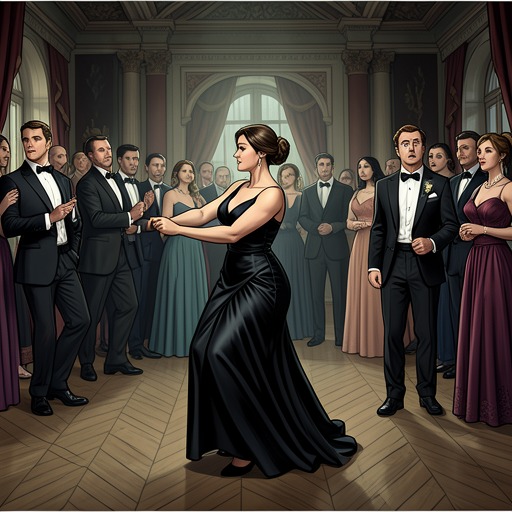
Stella at the psychiatric hospital ball
AsylumStella at the psychiatric hospital ball turns an evening of music and dancing into a test of appearance, loyalty, and clinical judgment. Stella Raphael attends after weeks of maintaining the carefully controlled image expected of a patient, and wears the black silk dress she wore the previous year, when Edgar Stark first embraced her. Peter Cleave initially reads the dress as a sign of dignity and defiance. Only afterward does he recognize its more intimate meaning: it is connected to her union with Edgar, and her attachment to him is not dead. The scene’s final unease comes from the distance between Stella’s poised public performance and the danger Peter suspects he has failed to see.
Background and Stakes
The ball takes place after Stella has been returned to the hospital following Charlie Raphael’s drowning. At the pool, in a dissociative and emotionally numb state, she watched Charlie struggle in the water without calling for help. The people who had initially sympathized with her recoiled when they heard Hugh Griffin’s account of her stillness; she was remanded and charged with manslaughter. The shock and public judgment of that episode form the immediate history behind her appearance at the dance, although the ball itself is not a hearing or a moment of public reconciliation. It is a hospital occasion in which her status as a patient is visible to the people who once knew her as a doctor’s wife.
By the time the dance is announced, Stella has been moved from the admissions ward to a downstairs ward. That transfer brings greater privacy and freedom of movement, but it also depends on staff seeing her as controlled and improved. Stella understands that ward life rewards an appearance of calm: an outburst could undo weeks of self-control, and she cannot know how long the performance must continue before it is judged sufficient. She is acutely aware of the humiliation of her changed status and of veiled contempt from patients and staff, particularly because she appears to receive special consideration from Peter, the superintendent and her psychiatrist.
The invitation therefore carries more weight for her than a simple chance to dance. At first she recoils from attending. She does not want to be displayed as a fallen woman, or to have the fracture between her former life and her present one exposed in the Central Hall. Yet she also wonders whether staying away would be taken as an act of nonconformity by Peter. She decides to attend, regarding the evening as a final challenge in her short career as a patient and resolving to give one last performance as the woman of sorrows. She has also begun to look forward to it, and Peter believes she has decided to let what happens there determine her fate.
Preparing for the Dance
The ward grows increasingly feverish as the hour approaches. Women search for hairpins, perfume, underwear, and makeup; a dispute over a cheap brooch nearly becomes a fight before an attendant intervenes. The corridors fill with screams, tears, and chatter about love affairs. Stella stays in her room and dresses carefully rather than joining the commotion. The smart clothes she brought from Wales no longer fit properly, and she chooses an outfit that, in her own calculation, risks suggesting sin rather than sorrow.
Before leaving her room, Stella counts her pills again. She is calm and believes she has enough. The detail gives the preparations a darker undertow, but does not, by itself, establish exactly what she intends or when she might act. Her measured dressing and her composure are visible; the private significance of the counted medication is not yet understood by those around her.
When Stella joins the other women, her appearance immediately changes the mood of the group. They recognize her as the loveliest among them and take pride in the reflected distinction she brings to their entrance. With a loose black shawl over her bare arms and shoulders, she moves calmly among them as they cross the courtyard and follow the terrace toward the hall. The scene makes her beauty a public fact and a kind of social resource: for the evening, the women collectively present her as their flower of beauty, while the figure of the sorrowful woman becomes a role she can inhabit.
The Ball and Its Performance
The Central Hall looks as Stella remembers it: chairs around the walls, open bay windows, and a band tuning on the stage. Peter enters with the chaplain and acknowledges Stella with a bow. When he sees what she is wearing, he is astonished. Beneath the shawl is the same low-cut black evening dress of coarse ribbed silk she wore a year earlier, at the dance where Edgar took her in his arms. Peter reads the choice as a spirit unbroken by shame, a deliberate gesture of pride in the face of the hospital community. He feels proud of her.
That interpretation is sincere but incomplete. Peter watches Stella openly and believes his affectionate attention reassures her that she is behaving exactly as he wishes. His presence also helps preserve the event’s orderly surface: patients and staff defer to his quiet authority, while covert glances reveal how closely Stella’s presence is being watched. The contrast between the formal occasion and its concealed scrutiny makes her composure part of the spectacle. Her former colleagues and current caregivers see the doctor’s wife who has become a patient; Stella, in turn, manages the impression she makes on them.
As the men’s wards enter, Stella’s attention sharpens and the atmosphere grows charged. Edgar is not among the men. Peter notes that he is in no condition to attend, while Stella has to continue the evening without the person who gives the dress its private meaning. She dances several times, and though the hall’s eyes are on her, her mask does not slip. She does not dance with Peter, who dances with no one. Each time she catches his eye, he understands her demure, inscrutable smile as reassurance directed toward him, almost as if she were dancing with him in spirit. The chaplain alone among the senior staff asks her to dance; he leads well and allows her to move with ease and grace.
Peter speaks from the stage toward the end of the evening, offering the benign words and jokes customary for the occasion. Stella watches rather than listens, absorbed by his presence and by the warmth and ease he conveys. Peter believes she genuinely hates the prospect of causing him pain. This private belief adds another layer to his misreading: he treats her attention to him as evidence of an emotional bond capable of displacing Edgar, while the dress itself carries the competing history of the night she first became bound to Edgar.
Recognition and Aftermath
Stella sits out the last dance and returns with the other women along the terrace in the moonlight. Their evening seems to end successfully: they are tired, satisfied, and ready to say good night on the ward. Stella prepares for bed. Later, she gets up quietly, runs cold water into the basin, and reaches into her cupboard. The narrative does not immediately disclose what she is doing.
Peter, writing in his office, cannot stop thinking about the dress. At first he dismisses the thought that Stella might still love Edgar. Then the meaning of the garment becomes clear to him: he recalls that it was the dress she wore on the night Edgar took her in his arms, and recognizes it as her wedding dress in the private sense of the union she experienced with Edgar. What he had praised as defiance directed at the hospital was, he realizes, meant for Edgar. Her performance at the ball has not signalled that the affair is emotionally over; his reading of her has been clouded by his own private concerns, a failure he identifies as countertransference.
Alarmed, Peter telephones the downstairs ward. The attendant checks Stella’s room and reports that she is in bed, asleep and breathing deeply. This check provides no confirmation that she has taken the pills, and it does not resolve what her counting them meant. Peter nevertheless remains profoundly uneasy and does not return to his writing. The ball thus closes not with a public breakdown, but with a belated correction in the psychiatrist’s understanding: Stella has carried out her performance without visibly losing control, while the symbol he mistook for recovery has revealed the persistence of her attachment to Edgar and the limits of his clinical confidence.