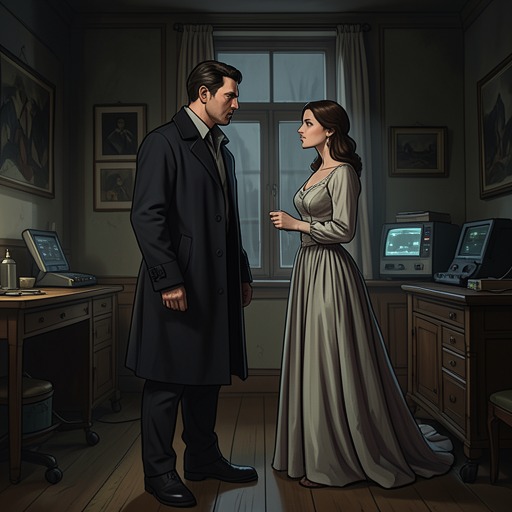
Stella flees Edgar’s warehouse hideout
AsylumStella’s escape from Edgar’s warehouse hideout begins when a familiar jealous accusation turns into a warning of a different order: she recognizes in his suspicion and behavior the madness connected to Ruth Stark’s murder. Once Edgar leaves, she slips out of the studio and finds Nick, exchanging a room in which she fears what Edgar may do for the modest but immediate relief of safety, company, and a bath.
The assault and its warning signs
Edgar’s accusation that Stella is having sex with Nick erupts into violence. She has just picked up an orange from the table when Edgar crosses the room, drags her to the floor, grips her wrists, and demands to know whether she thinks he is a fool. Stella does not answer; he slaps her harder than before, and she falls, turns over, and buries her face in her arms. The orange rolls toward the window. She is preoccupied with the possibility that he will tread on it because oranges are expensive, a mundane concern that coexists with the immediate danger.
She lies still, breathing into her arms, unable to hear what Edgar is doing or judge how much time has passed. Afraid that sitting up might enrage him further, she waits until a scraping sound draws her attention. Edgar stands with his back to her at the table. When Stella examines her face in her compact, one side is already changing color and pain pulses through it. The sound is Edgar sharpening a blade against a stone. The ordinary studio has become a place where she cannot tell what he intends, and her previous confidence that she knew him gives way to the recognition that she may have invented the safer man she thought she knew.
The orange and the recognition of danger
Edgar cuts another slice from the orange and tentatively brings it to his lips, watching Stella in a way she cannot understand. His behavior recalls what Peter Cleave had told her about Edgar’s delusions concerning Ruth Stark: he had believed Ruth was poisoning his food. The possibility that Edgar now suspects Stella of poisoning him changes the meaning of the scene. She had found ways to explain away his violence and jealousy; this suspicion connects his present state to the delusions surrounding Ruth and to the murder she has been trying not to acknowledge.
Stella understands that she must get away, but does not dare leave the room while Edgar is still there. She fears that he will know what she is thinking and that discovery will make the danger immediate. Upstairs, she waits among the bedclothes, propped against the bricks and smoking, while the knowledge she has suppressed becomes unavoidable. She remains capable of pitying Edgar and understands his madness as disease, but that understanding does not make her safe. She fears he could do to her what he did to Ruth, and believes she must conceal her terror rather than let him perceive it.
Leaving the studio
Edgar stays in the studio through the afternoon, working on Stella’s head. Peter Cleave suggests that the work may be an effort to see Stella clearly and master the madness in himself, but Stella does not know this; she waits for Edgar to go and makes her preparations mentally. Shortly after dark, he leaves without a word. She acts at once, packing her suitcase and dressing in less than ten minutes.
In a raincoat, head scarf, and sunglasses, Stella runs down the stairs and along the passage. She pauses to peer into the yard, which is empty, then walks quickly into the street. At the wall she checks once more that Edgar is not coming back. He is not. A cold wind comes off the river as she hurries away. The sequence is deliberate rather than impulsive: she has planned what to do, waits for the chance to leave unseen, and checks for Edgar before putting distance between herself and the studio.
A temporary refuge with Nick
Half an hour later Stella enters a small pub near Waterloo. Its warm light, fire, carpet, gin and tonic, and cigarettes offer a brief appearance of safety, but she remains alert to the possibility that Edgar will find her. She sits with her bruised cheek turned toward the wall. After an hour, sadness overwhelms her; she tries to discipline herself in Max’s familiar manner and imagines the scene as a framed work titled Melancholy. She smiles, but tears continue to run down her face. When the man at the bar scrutinizes her, she leaves and tries to reach Nick for the third time.
The flat Nick takes her to is tiny, but better than the loft. He had returned to the loft, found it empty, and feared the worst; hearing Stella’s voice on the phone brings him enormous relief. He comes to the pub, shares a drink with her, and takes her back to the flat. Stella says that more than anything she wants a bath. In the hot water, she feels some of the unhappiness, squalor, anxiety, and guilt of the previous days lift. She examines her body but blocks out thoughts of Edgar. Her escape secures immediate shelter and a measure of physical and emotional relief; the events establish neither that the danger has ended nor that she has resolved what she knows about him.