Anand Chakravarti
BabelAnand Chakravarti is a professor at Babel and one of the institution’s very few scholars capable of maintaining the Chinese match-pairs that sustain silver-working across England. Genial, understated, and possessed of an impeccable London accent, he teaches Chinese as an inquiry into meaning rather than a recital of rules. His role expands from Robin Swift’s instructor to guide, technician, colleague, and defender, while his work exposes how an apparently English industrial system depends on a small number of linguists and on knowledge drawn through colonial relationships.
Identity and Intellectual Practice
Anand Chakravarti first appears as Robin Swift’s Chinese instructor during a solo tutorial. Robin has expected Professor Richard Linton Lovell, but instead finds Chakravarti, whose English sounds so precisely London-born that it could have come from Kensington. The contrast between his manner and the difficulty of his subject is important: he is genial and restrained, yet he directs Robin toward questions with consequences far beyond ordinary language instruction.
His tutorial proceeds as a conversation. Rather than lecture or demand recitations, Chakravarti asks Robin to examine what a word is, what the smallest unit of meaning might be, how a word differs from a character, and how Chinese speech relates to Chinese writing. He then turns to the relation between recognizable pictures and characters whose histories are less transparent. The character for woman also serves as a radical in characters associated with slavery and goodness, prompting Robin to ask whether slavery and goodness are innately feminine. Chakravarti does not manufacture an answer. He admits that he and Richard are still trying to solve such questions and that Babel remains far from a satisfactory edition of the Chinese Grammaticas.
That admission establishes Chakravarti as a scholar who treats uncertainty as part of rigorous work. He recalls having no adequate Chinese-English resources during his own studies and having to rely on Abel-Rémusat’s Elémens de la grammaire chinoise and Fourmont’s Grammatica Sinica. The inadequacy of those tools has become a headache associated with both Chinese and French, but it also explains why Babel’s grammar project requires continuing collaboration rather than the simple application of settled knowledge. Robin’s presence matters because his native command of Chinese can expand the institution’s scant understanding; Chakravarti recognizes him not merely as a pupil but as a potential colleague.
Teaching Robin Swift and Opening Babel’s Hidden System
Chakravarti’s instruction combines humility with practical initiation. He guides Robin through Classical Chinese, explaining through the work itself that it relates to vernacular Mandarin as Latin relates to English. A reader may guess at a phrase’s general sense while remaining unable to grasp its grammar without sustained practice. Punctuation becomes uncertain, nouns can act as verbs, and a single character may support contradictory but grammatically valid interpretations. Chakravarti’s pedagogy therefore trains Robin to inhabit ambiguity instead of pretending that translation produces one automatic meaning.
He later lets Robin remove and examine a silver bar inscribed on one side with garden and on the other with a Chinese character associated with a landscape garden, private withdrawal, ritual purification, alms-giving, and Daoist repentance. The bar is intended to make wealthy people’s gardens quieter than Oxford’s general bustle, a service whose subtlety and limited testing do not prevent the wealthy from paying for it. When Robin asks whether activation simply requires speaking the words, Chakravarti explains that speech is only part of the process: the operator must hold two meanings in mind at once, exist in both linguistic worlds, and imagine moving between them. His explanation turns silver-working into a discipline of simultaneous translation, mental alignment, and controlled imagination.
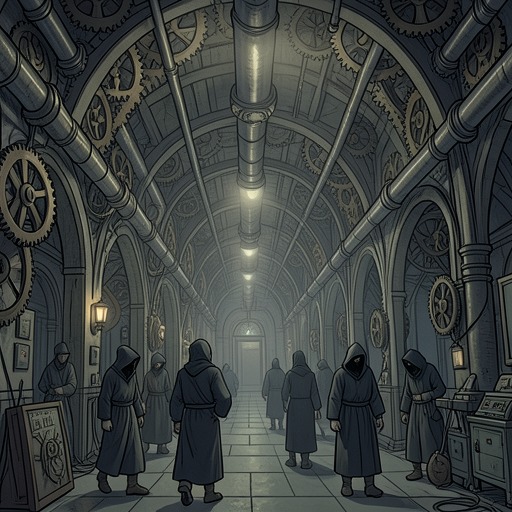
Chakravarti then takes Robin beyond the spaces normally available to a student. He leads him to the southern wing of Babel’s eighth floor, past the worktables and through doors secured by three sets of locks. He confesses that he is not supposed to reveal the area yet, presenting the tour as privileged information required for understanding. Inside, Robin encounters the resonance rods that form the hidden centre of Babel’s national system. Chakravarti explains that Babel supplies power to resonance-dependent bars throughout England: the distant bars are the periphery, while the rods in the tower are the centre, sustaining linked installations engraved with commonly used match-pairs. The rods appear to vibrate at extraordinary speed, yet the room remains silent.
Robin compares this arrangement to British outposts in the colonies calling upon the home country for soldiers and supplies. Chakravarti accepts the metaphor as convenient. The comparison captures the political structure of his own technology: power appears local, but its continuity depends on a remote centre and on the specialists who maintain that centre. He tells Robin that he and Professor Lovell are the only people able to perform this work, and that Robin’s graduation will make three. Robin marvels that an entire empire depends on a handful of people; Chakravarti agrees, adding that being needed is valuable in their situation. Looking over Oxford, they imagine a city functioning like a music box whose silver gears keep its bells, cabs, and inhabitants in motion. Chakravarti’s lesson thus reveals both the grandeur and the fragility of Babel’s system.
Translator, Mediator, and Imperial Labourer
Chakravarti’s importance becomes clearer when Babel’s scholars travel to Canton. Western traders need translators urgently, yet distrust the government-licensed native linguists because they consider their language skills inadequate or their loyalties uncertain. Teaching Chinese to foreigners is officially punishable by death, making qualified translators scarce even as the loosening of China’s borders renders the prohibition difficult to enforce. Under these conditions, people such as Robin and Professor Lovell become extraordinarily valuable, while Ramiz Rafi Mirza, Letitia Price, and Victoire Desgraves are sent from factory to factory to maintain silver-work.
Mr Baylis tells Robin that he will interpret at a meeting with Commissioner Lin because Western-trained Chinese translators are difficult to find. Professor Lovell gives the sharper explanation: he and Baylis cannot perform the task themselves because they are Caucasian men and therefore, in the official Chinese framework, barbarians. Chakravarti is not present at the meeting, but the institutional problem he represents is present throughout it. Babel’s knowledge makes imperial commerce possible while the translator is treated as a scarce instrument whose value rises precisely because foreign merchants cannot speak directly for themselves.
At the audience, Baylis demands legal permission for the opium trade, an apology for the treatment of trading agents, and the return of twenty thousand chests of seized opium or equivalent compensation. Robin tries to render the demands without reproducing Baylis’s patronizing tone, yet the act of translation cannot eliminate the unequal circumstances. Commissioner Lin eventually asks to speak privately with Robin, identifying the interpreter as more than a transparent conduit. Robin automatically explains that he has no authority and is only the interpreter; Lin replies that he seeks merely a casual conversation. The exchange makes visible the social tension in Chakravarti’s profession: a translator may be denied formal authority while possessing the linguistic access through which authority is exercised.
The same political pressure later appears within Babel. When Anthony Ribben instructs Robin to prepare inflammatory pamphlets from Professor Lovell’s letters, he tells him to avoid language about anticolonialism and national sovereignty and instead use terms such as scandal, collusion, corruption, and lack of transparency. Robin recognizes the instruction as translating material for white readers. Chakravarti’s work provides the wider context for that command: translation is never only the transfer of vocabulary, because institutions decide which meanings can circulate, which audiences are considered legitimate, and which political claims must be softened into a form acceptable to imperial public opinion.
Defender During Babel’s Crisis
During the violent confrontation in Babel’s tower, Chakravarti acts directly rather than remaining a detached scholar. After Victoire Desgraves shoots Professor Jerome Playfair, Professor De Vreese suddenly runs for Playfair’s gun. Robin is too far away to stop him, but Chakravarti throws himself at De Vreese. The two middle-aged professors crash to the floor and wrestle, their academic gowns flapping as Chakravarti wrenches the weapon from De Vreese and pins him in an awkward hold. When Robin addresses him, Chakravarti pants that he has received the message and praises Robin’s work. The scene recasts him as physically courageous and politically committed: his knowledge of the system is matched by a willingness to intervene when its violence becomes immediate.
Afterward, when Victoire Desgraves asks what resonance is, Robin explains the centre-and-periphery structure Chakravarti taught him. Robin proposes removing the centre so that distant bars will fail, but Professor Margaret Craft distinguishes withholding services and resources from deliberate sabotage. Chakravarti’s earlier explanations make the moral dilemma concrete. Babel deliberately designed many bars to last only weeks rather than months because maintenance appointments generated income; the institution inflated prices and created artificial demand. The resonance network is therefore not merely infrastructure accidentally placed at risk. It is an engineered dependency whose failure can expose the exploitation built into its design.
Chakravarti explains that the consequences of removing only two dozen bars become severe because the system was made to rely on Babel as completely as possible. By the third day, transportation begins to break down. Speed-based match-pairs had allowed carts and carriages to move rapidly and safely, but drivers had grown dependent on them and failed to compensate when the bars stopped working. Oxford’s roads fill with overturned wagons and cabs, while a family of eight in the Cotswolds falls into a ravine after a driver lets the horses manage a turn that the silver system had previously controlled.
The postal system fails through the same dependence. Royal Mail carriages had used a French-English match-pair that made parcels seem a fraction of their actual weight. Once the bar fails, horses must haul loads three times heavier, and the carriages collapse along their routes. These details confirm the scale of the system Chakravarti helped maintain: resonance is embedded not only in spectacular machinery but in ordinary movement, delivery, and commercial time.
Significance and Limits
Chakravarti embodies Babel’s contradiction. The institution needs his linguistic knowledge so urgently that, together with Professor Lovell and eventually Robin, he helps sustain the silver-work on which England’s roads, postal routes, industry, and imperial communications depend. Yet the same arrangement makes him part of a structure that resembles the British Empire’s colonial outposts: a central authority draws resources from a network whose apparent independence conceals dependence.
His scholarship also complicates the fantasy that language can be mastered as a neutral tool. The Chinese Grammaticas remain incomplete; characters carry layered and conflicting histories; activation requires two meanings to be held simultaneously; and diplomatic interpretation places a young translator between commercial demands and governmental authority. Chakravarti does not resolve these tensions. His importance lies in teaching Robin to perceive them, then in embodying the cost of the knowledge that Babel treats as both intellectual achievement and institutional property.
When the resonance network begins to fail, the machinery reveals what its smooth operation had hidden. Silver makes London larger, faster, and more industrial, but that modernity rests on extracted resources, colonial commerce, and a small group of specialists whose labour is difficult to replace. Chakravarti’s arc moves from quiet tutor to keeper of the centre and defender in the tower, making him one of the characters through whom the novel links the ethics of translation to the material vulnerability of empire.