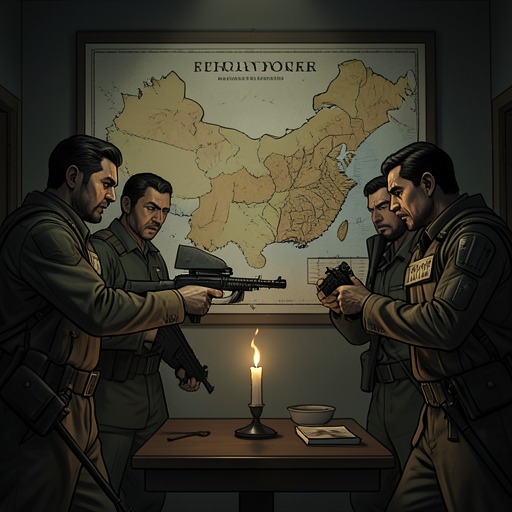
Lin Zexu
BabelLin Zexu is the Qing imperial commissioner sent to Canton to enforce the government’s prohibition of the opium trade. Although he appears only briefly in the supplied episodes, his decisions reshape the political and commercial world around the characters: he orders searches, suspends trade, confines foreign merchants to the Factories, demands the surrender of opium, and finally burns the seized drug. His presence converts what British traders describe as an inconvenience into a direct confrontation over law, sovereignty, and the human cost of commerce.
Imperial Authority in Canton
Lin Zexu arrives in Canton as the representative of the Qing Emperor during a mounting crisis over opium. Mr Baylis, the liaison for Jardine, Matheson & Co., explains that Chinese officials have broken up distribution rings, destroyed a fast smuggling boat in the harbour, and begun house-to-house searches. The city is consequently frightened by even the mention of the drug. Baylis attributes the crackdown to the new commissioner and identifies Lin as the official with whom the British will have to deal.
The immediate political stakes are made clear through Baylis’s account of the previous spring. Lin demanded the immediate surrender of all opium brought into China. When the foreign merchants refused, he suspended trade and ordered them not to leave the Factories until they accepted the government’s terms. Baylis calls this a siege, though he simultaneously minimizes its effects by complaining mainly that Chinese staff had gone home, leaving him to do his own washing, while the confined merchants suffered from overfeeding and lack of exercise. The contrast exposes the unequal meanings of the same policy: for the foreign traders it is an irritating restriction on business, while for Lin it is an exercise of state power against a trade the government has decided to suppress.
Reputation and Appearance
Before Robin Swift meets him, Lin is filtered through Baylis’s racialized and self-interested description. Baylis calls him exceptionally intelligent and nearly incorruptible, repeating the southeastern nickname Lin Qingtian, or “clear as the heavens,” because he is thought impervious to bribes. Yet Baylis immediately surrounds this grudging respect with racist warnings about Chinese duplicity and urges Robin to remain alert lest the Chinese outwit him. Lin is therefore introduced through a revealing contradiction: the British merchant recognizes his integrity and intelligence but interprets Chinese authority through suspicion and contempt.
In person, Lin bears little resemblance to the monstrous figure Baylis’s rhetoric suggests. He is of average height and build, mild-mannered, and gentle-featured. Nothing about him is striking except his unusually bright, perceptive eyes. This understated physical presence gives his authority a different texture from Baylis’s imagined giant with fiery eyes and trickster’s horns. Lin does not need theatrical menace. His power is expressed through decisions already carried out and through the composure with which he receives the demands of men who assume that commercial confidence gives them political superiority.
Lin is accompanied by his own interpreter, William Botelho, a young Chinese man who has studied English in the United States. The arrangement matters because the meeting is not an encounter in which British representatives possess exclusive control of translation. Lin has his own linguistic intermediary, and the conversation is conducted through a structured exchange in which the commissioner’s government retains its institutional voice.
The Meeting with the British Traders
The morning after Robin’s arrival in Canton, he accompanies Baylis to a downtown government office for an audience with Lin. Baylis prepares Robin by presenting Lin as unusually formidable but warns him to distrust Chinese speech. Robin, already determined to perform only the minimum duties required of him, refuses to amplify Baylis’s racist diatribes. His role as interpreter places him between the commissioner’s office and the commercial demands of the British firm, but his embarrassment makes clear that translation cannot neutralize the inequality embedded in the message.
Baylis presents the position of Jardine and Matheson as though it were a reasonable program of mutual benefit. He demands that their agents be allowed to sell opium legally along the Canton coast, an official apology for the treatment of foreign trading agents earlier in the year, and the return of the twenty thousand chests of opium seized by the authorities, or compensation equal to their market value. The scale of the demand makes the conflict material as well as ideological: the British claim not merely a principle of free trade but the value of a vast confiscated stock.
Lin listens without an immediate response while Robin translates Baylis’s list in as flat and emotionless a manner as he can manage. Robin’s reddening ears register his sense that the meeting is not genuinely dialogic. Baylis speaks as though lecturing a child, and his appeal to Adam Smith turns the language of commercial self-interest into a claim about national prosperity. He argues that the Qing government’s exclusive trade policies harm the Chinese themselves and that Chinese subjects would prefer unrestricted association with foreigners because it would give them opportunities to seek wealth. The scene places Lin’s silence against a torrent of imperial economic reasoning: one side arrives with demands framed as universal principles, while the other has already acted through administrative enforcement.
The Opium Destruction
Lin’s most decisive appearance is revealed not in the government office but from the English Factory. Letitia Price suddenly notices a great fire across the river and points toward it in horror. The flames seem catastrophic until the observers see that they are controlled, concentrated around chests loaded onto deep-bellied boats pushed into the shallows. The wind carries the contents’ sickly sweet scent across the water, identifying the cargo before the act is explained.
The substance being burned is opium. The fire is therefore the visible completion of Lin’s policy: the seized drug is not being held for negotiation, returned to foreign merchants, or converted into compensation. It is being destroyed. The controlled nature of the burn contrasts with its overwhelming visual effect, making the scene both an administrative operation and a public demonstration of resolve. The destruction transforms the earlier dispute over possession into an irreversible act. Once the twenty thousand chests are burned, the merchants’ demand for restitution can no longer be answered simply by restoring the goods.
Narrative Significance
Lin functions as the force that makes the British characters’ commercial world impossible to treat as politically neutral. Baylis describes penalties as necessary because the Chinese must learn that they cannot “get away with this,” revealing that the merchants regard resistance to their trade as an offense requiring punishment. Lin’s measures reverse that presumed hierarchy. He searches premises, restricts movement, suspends commerce, and destroys the commodity on which the foreign traders’ claims depend.
His characterization also complicates the perspective of the British visitors. Robin arrives in his motherland feeling empty rather than emotionally reconciled, and he encounters Canton through noise, commercial turmoil, and colonial hostility. Lin is first represented by Baylis’s prejudice, but his actual appearance is quiet and controlled; his policy is then made unmistakable by the fire across the river. The movement from caricature to person and from report to irreversible action gives Lin a concentrated narrative importance. He is not merely an official whom the protagonists must meet. He is the political embodiment of a government refusing to let foreign commercial power define the terms of law, trade, or sovereignty.