Mrs Piper
BabelMrs Piper is the kindly Scottish housekeeper who tends Robin Swift during his recovery, helps prepare him for his passage into British life, and remains one of the few adults to offer him uncomplicated physical and emotional care. Her importance lies less in formal authority than in the ordinary acts through which she makes an unfamiliar world inhabitable: cooling a fevered forehead, bringing nourishing food, explaining unfamiliar words, finding suitable clothes, and worrying about whether a college will feed him properly.
Identity and First Care
Mrs Piper first appears as a cheerful, round woman who regularly interrupts Robin’s dreamless sleep to plump his pillows and wipe his forehead with deliciously cool wet cloths. Her English carries such a peculiar accent that Robin repeatedly asks her to repeat herself, prompting her to joke that he must never have met a Scot. The exchange turns an obstacle of comprehension into an introduction to regional identity: when Robin asks what a Scot is, she tells him that he will soon learn the lay of Great Britain. Her care is therefore both bodily and cultural. While Robin is weak with fever and disorientation, she gives him immediate relief while also beginning to translate the country around him.
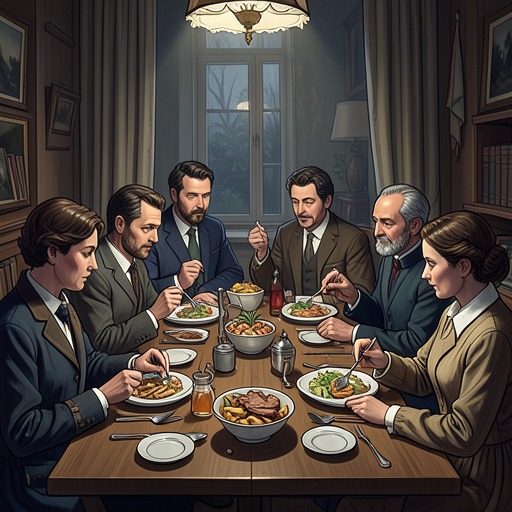
Her practical tenderness is equally visible in the rhythm of meals. She brings Robin bread and beef, tells him that Professor Richard Linton Lovell wants to see him upstairs, and insists that he finish eating first because the professor is not going anywhere. With her help, Robin gets dressed in Western clothes that fit his short, skinny frame, although he is too tired to ask where they came from. In this scene, Mrs Piper mediates every threshold at once: recovery from illness, movement through the house, entry into the professor’s study, and the first adaptation to British dress.
Domestic Knowledge and the Journey to Britain
Mrs Piper explains that Professor Richard Linton Lovell spends much of his time working on translations, collecting scrolls and old books during his journeys, and preparing English versions before returning to London. She adds that he is an important fellow of the Royal Asiatic Society and values sea voyages because they provide peace and quiet. Her account gives Robin information about the professor’s professional life that he does not receive directly from the professor himself. It also reveals the limits of Robin’s understanding: he is startled to learn that the voyage included two weeks and some change in Macau, because he had naively imagined that he alone was the reason for Professor Richard Linton Lovell’s journey to China.
Mrs Piper’s story about Macau further establishes her resourcefulness. Because foreign women were not permitted onto the mainland, customs officials delayed the party, and she had to dress up and pretend to be the professor’s uncle. The anecdote is comic in her telling, but it places her inside the practical difficulties of imperial travel rather than at its sheltered margins. She knows how rules operate, how appearances can be manipulated, and how the household must improvise when official restrictions intervene.
On the night before Robin leaves for college, Mrs Piper bakes him a plate of small, hard, round shortbread biscuits so rich and crumbly that they seem to melt in his mouth. She explains the word through etymology, telling him that fat “shortens” pastry and that this is the origin of “shortening.” Robin’s reply turns the lesson into a joke about the biscuits not lasting long, and their exchange shows how language becomes an intimate form of play between them. Her teaching is not institutional translation but domestic explanation: she makes a new culture memorable through taste, humor, and conversation.
Farewell and Emotional Attachment
The shortbread farewell exposes the depth of Mrs Piper’s attachment to Robin. When he says that he will miss her etymology lessons, her eyes redden and her voice grows thick. She tells him to write home whenever he needs a sack of victuals, adding that she knows little about what occurs inside the colleges but knows their food is awful. The offer combines affection with material knowledge. She cannot control the academic world Robin is entering, but she can promise provisions, and food becomes her concrete answer to the uncertainty of his future.
That concern persists when Robin later returns to her home in Jericho after the group disperses from Magpie Lane. He hopes she will be away so that he can leave a message, but she opens the door almost immediately with a wide smile and embraces him tightly. She smells of warm bread, and the scent makes Robin’s sinuses sting as he struggles to hold back tears. She notices that he looks thin, pats his cheeks, and asks whether he was not fed in Canton or had lost his taste for Chinese food. Her greeting is affectionate but also diagnostic: she reads his physical condition at once and answers his altered appearance with the same practical concern that marked his illness.
Narrative Role and Significance
Mrs Piper occupies the novel’s domestic counterpoint to its colleges, voyages, translations, and political dangers. Professor Richard Linton Lovell’s world is defined by scholarship, documents, travel, and institutional importance; Mrs Piper’s authority rests on nourishment, bodily observation, household movement, and the intimate meanings of words. She does not merely provide background comfort. She gives Robin the first vocabulary through which he can approach Britain, from the meaning of “Scot” to the history of “shortening,” while her food and physical care answer the vulnerability produced by displacement.
Her recurring presence also makes care tangible rather than abstract. At sea, she carries meals and explanations into the professor’s isolated cabin life; before Robin’s departure, she sends him onward with biscuits and an invitation to write; after his return from Canton, she recognizes deprivation before he explains it. These repeated gestures create continuity across changes of place. Mrs Piper cannot shield Robin from the institutions he must enter or the conflicts that will surround him, but she remains a remembered and recurring sign of ordinary human attachment: warmth at the bedside, bread at the table, and a door opened with a smile.