Abel Goodfellow
BabelAbel Goodfellow is a working-class protester whose movement from antagonism to alliance embodies the book’s insistence that opposition to imperial silver extraction can cross the boundaries of race, education, and class. He first appears to Robin Swift as one of the impoverished people excluded from the privileges surrounding Babel, then re-enters the story as a determined organizer who helps defend the tower against the British Army. His importance lies less in personal biography than in the political knowledge he carries: Abel makes the costs of the silver industrial revolution visible from the factory floor and turns that experience into practical collective action.
Identity and Introduction
Abel is initially encountered indirectly, through the social distress surrounding Oxford. On a stormy night, Robin Swift sees a family begging at the corner of Woodstock Road. The father, whose beard and clothing have deteriorated, is recognizable as one of the men who had previously shouted obscenities at Robin on his way into the tower. Robin gives the family pennies but hurries away before the man can speak. This encounter establishes the world from which Abel emerges: poverty is not an abstraction, and hostility toward Babel is connected to material deprivation rather than simple personal malice.
Abel later arrives at Babel as a tall, broad-shouldered, bearded man waiting on the steps. He appears unarmed and not especially hostile, but his presence confounds the scholars. Robin recognizes him as a recurring figure at the mill workers’ protests, where he had stood with clenched fists and raised chin, glaring at the tower as though determination alone might bring it down. His physical bearing makes him seem, at first, like an embodiment of the crowd’s anger against privileged students.
When the door is opened, Abel courteously backs away and raises his arms to show that he carries no weapon. He identifies himself by name, and Victoire Desgraves accuses him of throwing an egg at her during the previous February’s demonstrations. Abel confirms that he did so, but treats the act as impersonal and minor. The exchange immediately complicates his image: he has participated in harassment, yet he is capable of restraint, courtesy, and a surprisingly matter-of-fact recognition of the boundary between protest and personal hostility.
From Protester to Ally
Abel explains that the approaching barricades are not merely physical defenses. Their purpose is psychological: they create the impression that genuine resistance exists, give protesters confidence, and provide a place to retreat. He identifies his cause without hesitation as opposition to the silver industrial revolution, holding up one of the pamphlets produced by the Babel group and recognizing that they are on the same side. The pamphlet becomes a material sign of convergence between a movement formed inside an elite institution and workers protesting outside it.
His arrival produces an extraordinary collaboration. Men who only weeks earlier had shouted abuse at Babel students enter the lobby and discuss street-fighting tactics with them. Professor Craft and the striker Maurice Long study a map of Oxford together, planning barriers at broad roads and narrow approaches. Their proposals include paving stones, overturned trees, and obstructions designed to delay cavalry and heavy artillery. Victoire, Ibrahim, and other strikers take notes on which silver bars might strengthen the defenses, while the possibility of raiding wine cellars for barrels turns the tower’s wealth into improvised protective infrastructure. Abel is therefore not simply welcomed as a symbolic representative of labor; he helps convert protest into organized resistance.
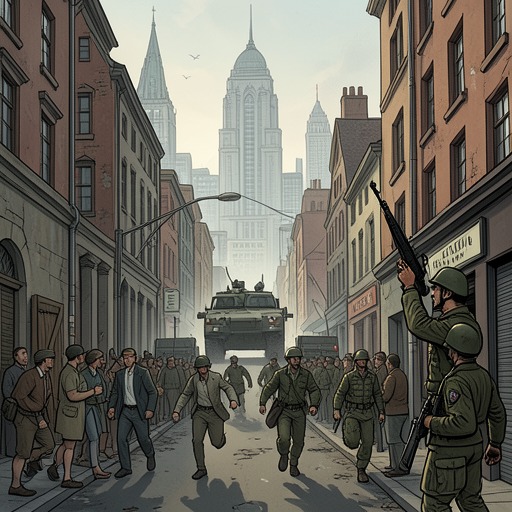
The British Army enters Oxford that evening in a column of red-coated troops moving along High Street. Their arrival looks more like a polite parade than a punitive expedition, but the troops halt at the barricades. Abel then walks out alone to meet the decorated, mustachioed commander. Robin cannot hear the discussion, but observes its progression from civility to heated gesticulation and fears that Abel may be arrested. Instead, the commander eventually withdraws his battalion. Abel returns with the news that the Army has granted the occupiers forty-eight hours to leave before clearing the barricades by force. His solitary negotiation does not end the danger, but it wins the resistance time and demonstrates that the barricades have political as well as military force.
Class Knowledge and Political Meaning
Abel supplies the lived experience that the Babel students lack. When Robin asks whether the factories are truly as terrible as the newspapers report, Abel answers that conditions are worse than the sensational accounts suggest. Reports describe freak accidents, but omit the ordinary structure of factory labor: rising before dawn, working until nine, and receiving few breaks on cramped floors. Even those jobs, Abel adds, are conditions that unemployed workers wish they could regain. Robin, embarrassed by the comparison, acknowledges that university work does not demand the same physical endurance.
This testimony gives concrete meaning to the political arguments circulating among the students. Griffin Harley Lovell insists that stopping the invasion of Canton is urgent because victory would give the British Empire an almost limitless supply of silver and greatly expand its imperial capacities. He also identifies an antiwar faction in the House of Commons, including Sir James Graham, Viscount Mahon, and William Gladstone. Anthony Ribben broadens the argument: the campaign against imperial expansion must become a class coalition, because appeals to justice or human dignity will not move men whose decisions are governed by profit. The fate of a poor family in Canton and that of an unemployed weaver in Yorkshire are linked by the same economic structure.
Abel’s presence makes that connection politically credible. A hundred miles away, white British factory workers crowd Westminster Hall to protest a war in a country they have never visited. Earlier disturbances, including the Rebecca Riots in Wales, the Bull Ring Riots in Birmingham, and Chartist uprisings in Sheffield and Bradford, had been presented as isolated outbreaks. Abel’s movement into Babel helps reveal them as related responses to a system that distributes suffering across colonies, factories, and impoverished communities while concentrating profit at the center of the Empire.
Relationships and Conflict
Abel’s relationship with the Babel students begins in suspicion and remembered injury. Victoire recalls his egg attack, while the scholars regard the demonstrators as dangerous enough to threaten the tower. Professor Craft even warns the students not to go outside because he expects Abel to attack them. Yet Abel’s conduct repeatedly unsettles that expectation. He arrives without a weapon, explains his tactics rather than issuing threats, and accepts an invitation into the lobby. The relationship changes not because the earlier hostility is denied, but because a shared political objective makes cooperation possible.
With Robin Swift, Abel becomes a crucial interpreter of working-class life. Robin can observe poverty, read political arguments, and help extract evidence from Professor Richard Linton Lovell’s letters, but he does not initially understand the full cost of factory labor. Abel’s answer to Robin’s question forces him to compare the sheltered life of Babel with the exhausting conditions endured by workers. The contrast is sharpened by Babel’s system of provision: Babblers receive their room, board, tuition, a monthly stipend of twenty shillings, and access to discretionary funds, while ordinary people must secure food, lodging, and employment without such institutional support. Abel’s account exposes the social price hidden by the students’ academic privilege.
His alliance with the students is also practical rather than sentimental. He does not erase differences between them, and his earlier protests remain part of the relationship’s history. What joins them is the recognition that Babel’s silver and the factories’ silver-powered machinery participate in the same structure. Abel therefore functions as both ally and corrective: he supports the occupation while preventing it from becoming a self-contained student drama.
Change and Narrative Role
Abel changes from an apparent antagonist into a threshold figure between the inside and outside of Babel. At first, he belongs to the crowd looking toward the tower with anger. After entering it, he helps turn the institution into a refuge for protesters and a site of shared planning. The barricades mark this transformation physically: they are built outside the walls, but they acquire meaning only when students and workers defend them together.
His role becomes most urgent as the Army prepares to advance. At dawn, when the troops are reported to be inching closer, Abel demands to know the current word. Robin tells him to send his men home, making clear that the coming confrontation may require a decision about whether the workers should remain exposed. Abel’s demand and Robin’s response place him at the center of the resistance’s final tactical crisis, where solidarity must be measured against immediate danger.
Abel’s decisive significance is thus structural. He is the helper who makes a cross-class coalition imaginable, the witness who translates industrial suffering into political knowledge, and the negotiator who temporarily checks state force. His path through the plot does not culminate in assimilation into Babel; instead, Babel is forced outward toward the workers whose labor and deprivation sustain the silver economy. Through Abel, the novel makes the central opposition between privileged enclosure and collective resistance impossible to ignore.