Ibrahim
BabelIbrahim is a second-year Arabic scholar from Egypt whose presence in Babel’s crisis makes visible the human cost of the struggle over the tower. Initially marked by his youth and uncertainty, he ultimately refuses evacuation, chooses to remain with the occupation’s defenders, and begins recording what happened inside the tower. His arc is brief but decisive: he moves from hesitation before authority to a deliberate acceptance of danger, while preserving the events for a future beyond the immediate confrontation.
Identity and Introduction
Ibrahim is introduced as a second-year student and an Arabic scholar from Egypt. Robin Swift recalls him as extraordinarily young, with a baby-faced appearance that makes the academic institution’s hierarchy seem suddenly unstable: the students who are being asked to enforce force and violence look scarcely old enough to bear such responsibility. When Professor Playfair orders him to fetch the constables and let them into the tower, Ibrahim does not move. He looks first toward Robin and Victoire Desgraves and then back to Professor Playfair, frowning before offering a hesitant objection.
That hesitation is not presented as cowardice. Ibrahim is confronted with an order that would surrender the building to the authorities, and his pause registers the moral and political weight of obeying it. His youth places him between institutional obedience and personal judgment. The scene also establishes his connection to the group resisting the authorities: even before he declares himself, he looks to Robin Swift and Victoire Desgraves for orientation rather than acting automatically on Professor Playfair’s command.
The Occupation and the Choice to Stay
The confrontation soon becomes a matter of force. When two third-year students suddenly try to escape, one shoves Ibrahim against a shelf. Robin Swift prevents their flight by throwing a silver bar at the door and invoking the explosive working, causing a terrible screeching howl that drives the students back. Ibrahim is therefore not an abstract supporter of the occupation; he is physically caught in the disorder that follows the decision to hold Babel.
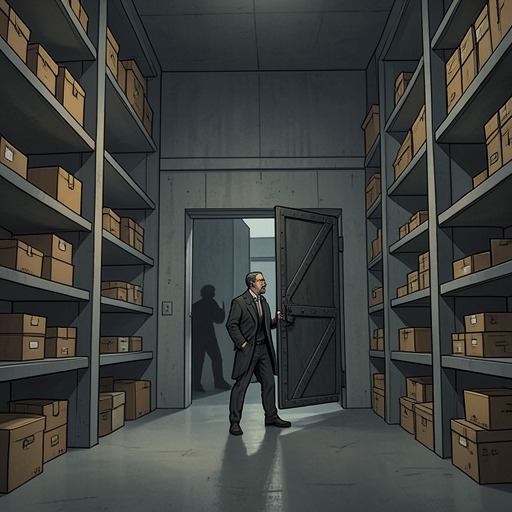
After the authorities’ opponents are given the option to leave, most of the scholars depart. The Classicists, the Europeanists, and nearly the entire faculty file out, while Professor Playfair is carried away, still moaning, between Professor De Vreese and Professor Harding. Ibrahim remains among only six scholars: Professor Chakravarti, Professor Craft, the undergraduate Juliana, and the graduate fellows Yusuf and Meghana. This reduced company matters strategically because Babel contains the country’s greatest concentration of silver-working resources, including Grammaticas, engraving pens, match-pair ledgers, reference materials, and silver itself. Retaining the tower means retaining the material infrastructure necessary to disrupt the country’s silver-work before a decisive political vote.
Ibrahim’s own position becomes explicit when the group later discusses who can escape. Robin Swift says that not everyone will be needed, and Professor Craft suggests that the younger students who do not know any silver-working might be allowed to leave. Ibrahim interrupts that calculation with a direct refusal: he wants to stay and does not want to run. The statement is significant because it transforms his earlier hesitation into agency. He is no longer merely a young scholar caught between orders; he claims responsibility for the consequences of the resistance, even though the evidence does not suggest that he possesses the same technical importance as the senior silver-workers.
Chronicle of the Tower
Ibrahim’s contribution is not limited to remaining in the building. He spends a great deal of time writing in a leather-bound notebook, and when Robin Swift and Victoire Desgraves ask about it, he identifies it as a chronicle of what happened inside the tower. He records everything that was said, every decision made, and everything the group stood for. He then invites them to contribute, proposing a shared account rather than a private diary.
The notebook gives Ibrahim a distinct function within the resistance. The occupation is not only a contest over silver, institutional control, and political leverage; it is also a struggle over how the events will be remembered. Ibrahim’s chronicle preserves the words and decisions of a group whose authority has been challenged and whose members may not survive. His writing gathers together speech, deliberation, and principle, treating the tower’s history as something made collectively rather than imposed by the professors or the state.
Robin Swift’s question about whether he is being asked to become a co-author underscores the notebook’s collaborative purpose. Ibrahim’s record can therefore be read as a counter-institutional archive: a written account produced from within the occupied tower, by those who have chosen to remain, rather than by the authorities who will later describe the action from outside it.
The Division Between Flight and Death
When Victoire Desgraves says that the group can go home, Yusuf moves to stand beside her. Ibrahim, Professor Craft, Meghana, Juliana, and Robin Swift stand on the other side. The division is described with stark simplicity: it determines who flees and who dies. No one pleads, begs, or changes their mind. Ibrahim’s decision is consequently not extracted through pressure in the moment; it is a settled choice made alongside the people who accept the approaching danger.
The contrast between Ibrahim and Juliana is especially revealing. Ibrahim speaks and declares his wish to stay, while Juliana, pale as paper, says nothing. Yet both are placed on the side of those who remain. His words give voice to the decision, but the scene also makes clear that courage can appear as silence, fear, or a refusal to retreat. Ibrahim’s youth remains visible in the image of him looking small, but smallness no longer means helplessness. It becomes the physical measure of the risk undertaken by someone who understands that dawn will bring the attackers.
Narrative Role and Significance
Ibrahim’s role joins action to testimony. His refusal to run helps determine the defensive group’s final composition, while his chronicle ensures that the occupation will not exist only as a sequence of forceful gestures or as a victory-and-defeat narrative controlled by the institution. He represents the students and colonial subjects who are present at the center of Babel’s crisis but are not granted automatic authority within its academic hierarchy.
His Arabic scholarship and Egyptian origin also place him among the scholars from the colonies who remain in the tower, alongside Professor Chakravarti, Meghana, Yusuf, and Juliana, with Professor Craft the sole exception to that pattern. The evidence does not make Ibrahim speak for every colonial subject, but it gives his decision a wider political resonance: the people most exposed to Babel’s imperial structure participate in deciding whether its resources will continue to serve the state.
Ibrahim’s ending is not a completed escape, triumph, or death. It is a commitment made on the eve of violence, accompanied by a notebook that attempts to hold the group’s words and principles against disappearance. His importance lies in that combination. He stays because he does not want to run, and he writes because remaining alive or dying inside the tower must not be the only measure of what the resistance meant.