Ava and Lincoln try to repair their relationship
BeautifulAva Spirini and Lincoln try to repair their relationship in a cautious encounter at Ava’s front door, where a single yellow gerbera becomes the opening gesture to a larger reckoning. They name the hurt surrounding Kelly Waititi’s death, acknowledge how their own history has been damaged, and leave open a friendship that neither assumes can be restored at once. The scene turns on a modest but consequential change: Ava and Lincoln move from treating their shared past as something to cut off toward considering a future connection, without pretending that grief or anger has disappeared.
A Gesture at the Door
Lincoln is walking down Ava’s front steps when she opens the door. On the welcome mat lies a single gerbera wrapped in brown paper. Ava has been hoping the visitor would be Gideon, even as she dreads that possibility; seeing Lincoln instead brings a different, complicated response. The bright yellow flower briefly makes her wish that Gideon had sent it. The gift is not a simple declaration of affection: it arrives from someone Ava wants to reject, but whose presence still matters to her.
Ava wants to tell Lincoln to leave or press the flower against his chest and shut the door. Yet his shy posture—hands in his pockets, sunglasses on, biting his lower lip—undercuts the anger she is trying to hold onto. She feels the pull of their shared history as a set of ties that cannot simply be cut. Lincoln belongs to her childhood memories and connects her directly to Kelly; therefore, rejecting him would also mean trying to sever a link to the past she shares with Kelly. The conflict is both emotional and bodily: Ava’s mind urges distance while her response to Lincoln’s presence resists it.
The flower also makes the approach unusually specific. Ava challenges the idea that Lincoln has bought flowers for anyone before, and he remembers buying a Year 10 girl a Valentine’s Day teddy bear. The small anecdote brings a trace of their familiar ease into a meeting otherwise burdened by grief. After the pause, Ava asks why he has come. Lincoln does not offer a polished explanation; he gestures toward the year and everything that has happened. Ava understands, because the same unfinished accounting is already within her.
The History They Cannot Cut Away
Ava’s thoughts give the attempted reconciliation its background. She regrets that she and Lincoln hooked up when neither of them really wanted to, that they yelled at each other and said hurtful things, and that she failed to tell him how she truly felt about Kelly’s death. She also regrets not letting him in, what happened at the Formal, and imagining she could remove him from her life altogether. Beneath those separate injuries sits her strongest shared regret: that they let Kelly down. The meeting does not erase these events; it allows Ava to recognize them together rather than reducing Lincoln to the person she is angry with now.
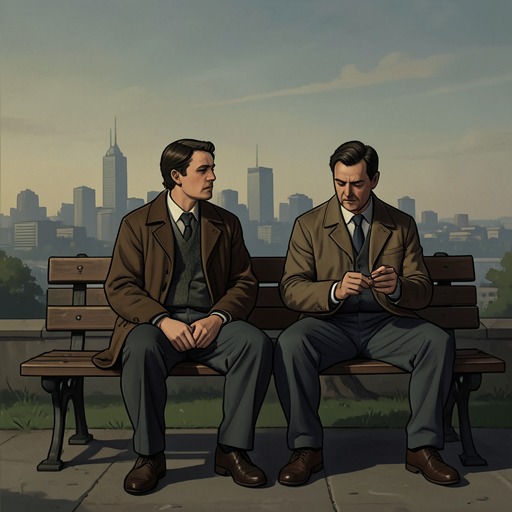
Their pause on the porch makes room for that recognition without forcing it into a quick explanation. Ava sits on the step, and Lincoln tentatively perches beside her. They remain silent for a long time. She then notices a bruise emerging from beneath his sunglasses. When he takes them off, the skin around his eye is several shades of purple. The injury is visible, but this encounter does not establish how it happened; Lincoln later remarks that the boy can punch. What matters in the moment is the change from looking back at their shared hurt to noticing what Lincoln is carrying now.
Ava asks whether they will ever be friends again. Lincoln answers by observing that they were never quite friends: he had been Kelly’s brother, and then their own connection became complicated. Ava recognizes the truth of this distinction. Their past is intimate and consequential, but it has not been a straightforward friendship that can simply resume where it stopped. Her next question—whether they could become friends—therefore proposes something new, not a return to an uncomplicated earlier state.
A Friendship Without a Deadline
Lincoln answers that they could be friends one day, and Ava believes he means it. When she asks whether they can take it a day at a time, he agrees. The phrasing sets the scale of their repair: neither promises immediate closeness nor demands that grief be settled first. Their shared silence, the tentative seating beside one another, and the direct question about friendship all give the possibility room to exist without making it a guarantee.
Lincoln also speaks plainly about his anger. He says he is angry at his parents, at Ava, and even at Gideon, but mostly at Kelly; he knows he has been taking that anger out on other people and calls the result terrible. His admission does not excuse the hurt between him and Ava, but it makes the anger legible as grief spreading across his relationships. Ava’s eyes sting. Lincoln looks down and says he is sorry; she touches his shoulder and breathes hard. The apology and touch are small, reciprocal gestures rather than a solution: he acknowledges harm, and she responds with contact instead of withdrawing.
The conversation remains cautious even as it opens toward future contact. Ava jokes that she might tell everyone to get lost, and Lincoln asks her to come as a friend. They hold eye contact, and Ava senses an acknowledgment that things will be different. When she asks about his parents, he says they want to see her. The invitation and his parents’ wish to see her suggest that the repair reaches beyond the two people on the porch, while the word friend marks the new terms on which Ava is being asked to return.
Ohana and the Unfinished Repair
Before leaving, Lincoln explains the change Ava has noticed in him: he watched Lilo and Stitch. He invokes Ohana, the idea that family means no one gets left behind. Ava finds it characteristic of Lincoln to find meaning in something apparently random. She reflects that advice and other people’s efforts to help had not reached him in the same way; a Disney movie did. In this scene, the film does not cancel his anger or Kelly’s absence. Instead, it gives Lincoln a phrase for connection that he can carry back into a relationship strained by loss.
As Lincoln drives away, sounding the horn twice, Ava feels happiness and relief as the knot in her stomach about their relationship loosens. That physical easing is the scene’s clearest immediate consequence, not proof that everything has been repaired. Lincoln has admitted that he remains angry, and Ava has not forgotten their painful history. Their agreement is deliberately provisional: they can try, as friends, one day at a time. The gerbera and Ohana frame that possibility from opposite ends of the encounter—a solitary gift at the threshold, then an idea of family broad enough to include someone who has been pushed away. Repair begins not by denying the damage, but by making room for a connection that is different from what came before.