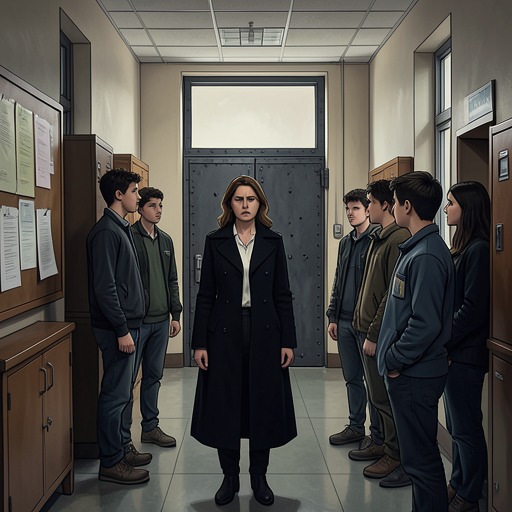
Ava punches Trevor and is expelled
BeautifulAva punches Trevor and is expelled after he makes remarks targeting her and Kelly’s death. The incident turns private grief into a school disciplinary crisis: Ava insists that her violence was intentional, while the school treats her conduct and its capacity to support her as grounds for removing her. Her father ultimately agrees to a meeting at TAPs, leaving Ava to face the change as another loss of control in an already altered life.
The confrontation and its trigger
The episode is recounted during a meeting with Mrs Bryan, who asks Ava to explain what happened. Ava begins by reporting that Trevor had called her a derogatory name. Her father, seated beside her, touches her shoulder when her reply becomes confrontational, but she continues to identify the target of Trevor’s words as herself. The exchange establishes that the physical conflict cannot be separated from the language that preceded it.
Ava explains that she had overheard Trevor speaking about her and Kelly, including expressing satisfaction that Kelly had died. When Mrs Bryan starts to qualify or dispute Ava’s account, Ava rejects the attempt to soften what he said. The meeting therefore becomes a contest over how the school will describe the incident: as an outburst to be managed, or as a deliberate response to a specific and deeply personal provocation.
Trevor then makes a further cruel comparison, wishing that Ava had died in Kelly’s place and reducing Kelly to her appearance. Ava responds by punching him and continuing the attack until Mr Barnaby carries her out of the room. The account gives the violence a clear immediate cause without presenting it as accidental: Trevor’s remarks target both Ava and her friend, and Ava’s response is forceful and purposeful.
Ava’s account and the school’s response
Mrs Bryan asks whether Ava meant to hit Trevor. Ava answers that she did. When the principal suggests that anger may have taken over, Ava again refuses that explanation. She states that she acted on purpose, considers Trevor’s conduct vile, and will not apologize to him. Her insistence does not erase the seriousness of the assault; it does make her position unmistakable. She will not accept a version of events that treats the punch as something she did not choose.
Ava also challenges the apparent imbalance in the school’s response. She asks whether Trevor will be punished. Mrs Bryan says the school will take action specific to his behaviour and raises the possibility that other students could confirm Ava’s account, but the conversation does not establish what consequence Trevor receives. The immediate decision is instead directed at Ava: Mrs Bryan tells her that the school needs to expel her, citing her record that year.
Ava’s father reacts with alarm, while Ava initially falls silent. When he asks whether the school understands what she is going through, Mrs Bryan acknowledges that Ava has experienced trauma, while also saying the school has other students to support and can no longer support Ava there. She recommends TAPs as a better fit for Ava’s needs and says the placement could carry her through Year 11, after which she could reconsider her options. A bright red and yellow pamphlet makes that proposed next step tangible, but it does not make the decision Ava’s.
Expulsion and the move toward TAPs
By the time Ava and her father get home, he has decided that she will attend a meeting at TAPs. Ava says she had no say in that choice. She objects that she is not like the students there, but her father tells her that she has no option and argues that her education must not be allowed to suffer. He agrees that, despite his view of Mrs Bryan’s competence, the school may be right that it cannot meet Ava’s needs. The change is presented as a practical response to the school’s limits as well as a disciplinary consequence, not as a resolution of the grief behind the conflict.
Ava experiences the decision as a chain of setbacks. She feels that she has disappointed her father, Kelly, and herself; in a few months, Kelly has died, relations with Kelly’s parents have deteriorated, Ava is uncertain about Lincoln, and now she has been expelled after openly defying the school. Her expectation that the day could not get worse is overturned. The event’s consequence is thus both institutional and personal: she loses her place at school while interpreting the incident as evidence of how much of her life has changed.
Aftermath and narrative significance
At home, Ava lies on her bed, fuming, before her father appears in the doorway and gives her a mint-green envelope. She opens it to find two pages covered in neat handwriting. The passage does not identify the writer in this moment, so the letter functions here as a transition rather than an explained outcome. Its arrival follows the expulsion and introduces a new element into Ava’s immediate aftermath without undoing the decision already made.
The confrontation marks a sharp collision between grief, moral judgment, and school discipline. Ava’s refusal to apologize preserves her distinction between losing control and accepting responsibility: she admits the choice while insisting that the provocation matters. The school, for its part, acknowledges trauma but frames its response around its ability to care for multiple students. The proposed move to TAPs may offer a different educational setting, yet the immediate experience for Ava is exclusion imposed by adults. Her violence is consequential, but the episode also shows how an institution’s response can register the disruptive act more decisively than the grief and cruelty that formed its context.