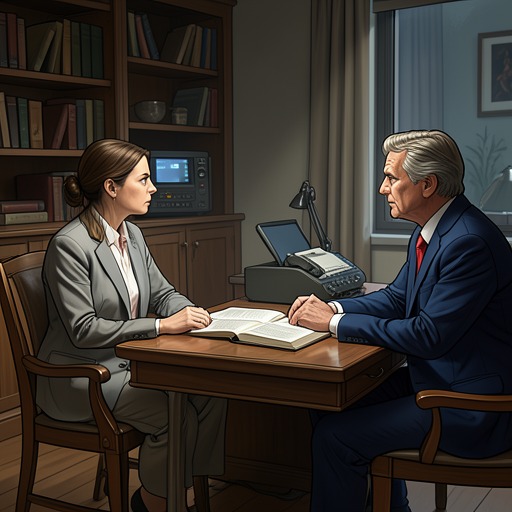
Ava begins therapy with Nola
BeautifulAva begins therapy with Nola at TAPs as she struggles to live with Kelly Waititi’s death and the changes it has brought. Nola offers her a deliberately non-prescriptive space: Ava can choose what to disclose, begin without speaking, and work toward strategies for difficult feelings at her own pace. The sessions do not make grief disappear. Instead, they help Ava understand its uneven course, recognize that she has changed, and consider how to act while feelings of sadness, anger, love, and confusion remain.
Entry into Therapy and Its Terms
Nola is available to students at TAPs, and Minda has encouraged Ava to make an appointment. When they meet, Nola explains that Ava decides how much to tell her; Nola will learn about Ava and the people in her life only through what Ava chooses to share. The aim is to help Ava find ways to manage feelings she does not want, rather than to make her speak or behave according to someone else’s expectations. That emphasis on choice matters for a teenager who has felt judged for not recovering from Kelly’s death quickly enough.
Ava initially wonders whether Nola wants her to talk about herself or about something more general. Nola does not insist on an answer. She offers drawing as another starting point and suggests putting on music so they will have something to discuss besides Ava herself. The invitation lowers the demand to produce a clear account of grief before Ava is ready. Their first work together can proceed through attention and interpretation, with Ava retaining control over how personal the conversation becomes.
This approach contrasts with the responses Ava resents elsewhere. Six months after Kelly’s death, school feels slower, and Ava believes other people are impatient with both her and Kelly: they seem to expect her to get over the loss. She cannot make ordinary schoolwork feel important beside her numb sadness. Therapy begins in the context of that mismatch between grief as Ava experiences it and the speed at which others appear to expect her to resume ordinary life.
Drawing as a Route into Speech
Nola opens her art journal and draws with a yellow crayon, then changes to red and makes broad, loose swirls. Ava chooses a black felt pen and makes a sequence of squares, then adds a small purple heart inside the smallest one. As music plays, she writes down a lyric, changing its pronoun, and repeats the words across the page in increasingly large letters. The image gives the session a concrete focus: instead of beginning with a direct account of bereavement, Ava and Nola can look together at marks, colors, and what can or cannot be seen.
Ava notices that the heart is small and partly hidden beneath the other lines. Nola follows Ava’s observation rather than imposing a single meaning on the drawing. They talk about the colors, the lines, and the details each notices; gradually, the picture becomes a shared subject of conversation, and Ava begins telling Nola about herself and things that have happened. Drawing functions here not as a test or a diagnosis, but as an indirect way into speech. The hidden heart and the marks surrounding it give Ava a means to approach what is difficult to state plainly.
Grief Without a Prescribed Timetable
Nola draws a graph to explain her understanding of grief. One line represents time and another the experience of grief; she marks the death with an x, then fills the graph with irregular, haphazard lines. The image rejects the idea that bereavement follows a predictable slope or a standard sequence. Nola tells Ava there is no typical path: the feelings are what they are, and they may remain difficult for an unknown length of time before becoming a little less so.
Ava feels relief at this account, despite having expected that advice from an adult would fail to make sense. Nola does not promise a date when grief will end or suggest that Ava should already be better. Her explanation gives Ava permission to experience grief as variable rather than as evidence of personal failure. The graph’s disorder also answers the gap between calendar time and emotional time: months have passed, but that passage does not dictate what Ava should feel.
The importance of that permission becomes clearer against Ava’s earlier attempts to make sense of Kelly’s death. Ava turns over possible explanations and wonders whether Kelly’s pain became so overwhelming that she could see no other option. She searches the details for information that might make the loss comprehensible. Nola’s model does not supply a definitive answer about Kelly; it offers Ava a way to acknowledge uncertainty and the continuing force of her own grief without treating either as a problem she must solve immediately.
Change, Relationships, and Choice
Nola also reframes Ava’s sense that she might remain permanently as she is. People change, she explains, and Ava is not the same person she was before Kelly died. Part of grieving, in this account, is grieving for the earlier self who has changed or is no longer present in the same way. Nola then directs attention toward the Ava who is still alive and asks, in effect, what this changed person wants and how she wants to feel. Her suggestion to take change a week at a time gives Ava a near-term scale for considering the future rather than demanding that she settle her whole life at once.
Ava uses that opening to talk about Gideon: their friendship, their kisses, and the conflict between them. She describes having told him to stop acting as her boyfriend if he wants to be her friend, after he tried to hold her hand. The account places a developing relationship inside the broader question of how Ava wants to live after bereavement. Nola’s framework makes room for that subject without reducing it to a simple answer or suggesting that a new relationship can cancel grief.
Later, Ava applies the same distinction between feelings and actions to her choices. She continues to experience sadness, hurt, anger, confusion, grief, and love, but recognizes that feelings themselves do not have a right or wrong form; choices made under their influence can have consequences. Looking back, she considers sleeping with Lincoln a poor choice and ending her relationship with Gideon the right choice, even though the breakup hurt. Therapy thus supports reflection without turning painful emotion into proof that the decision was wrong.
Continuing Support and Significance
Ava continues seeing Nola every fortnight. At a point when Ava can feel calm, she is clear that the difficult feelings have not vanished; they are still there, though they are not overwhelming her in that moment. Nola’s recurring box analogy and reminders that there is no single correct way to feel help Ava distinguish the presence of grief from the choices she makes while carrying it. The distinction is not a claim that loss can be neatly contained: it describes a way Ava can sometimes live alongside feelings that remain part of her.
The sessions also fit a wider pattern in Ava’s life, where relief and pain alternate rather than resolve in a straight line. Before therapy, being with Lincoln can temporarily make everything else matter less and let Ava feel something besides misery, even as she knows the situation is bound up with Kelly’s absence. Later, at the gathering marking a year since Kelly died, Ava can feel calm while still naming the many emotions that persist. The movement between distress and moments of ease is not evidence that she has forgotten Kelly or completed grief; it is part of her changing experience of loss.
Nola’s role is therefore supportive but limited in a meaningful way. She does not claim to repair Ava, decide what Ava should feel, or remove the grief attached to Kelly. She offers attentive conversation, practical ways to approach difficult feelings, and a model of grief that allows change without prescribing its pace. Ava’s therapy begins as a place to speak indirectly and on her own terms; it continues as a framework for recognizing that moving forward can include both enduring grief and choices made in the present.